



- Efforts to enact moratoriums or bans on data center development in the U.S. have risen sharply.
- A tracking site shows actions against proposed projects increased nearly tenfold the past year.
- Strategies to slow down or halt data centers include legislation, voter initiatives and referenda.
Utah residents concerned about the potential impacts of a proposed massive data center project in rural Box Elder County are not alone.
Public opposition to data center developments across the U.S. has exploded over the past year. One tracking site shows that while only eight different local and state government efforts to enact moratoriums or bans were active in May 2025, that number has swelled to 78 in just a year’s time and is continuing to grow.
That groundswell may reflect a national boom in data center development efforts, driven primarily by artificial intelligence development and cloud computing needs. Data center buildouts are getting bigger and more powerful, with average capacity per facility more than quadrupling over the past decade, according to a report released last month by the University of Utah’s Kem C. Gardner Policy Institute.
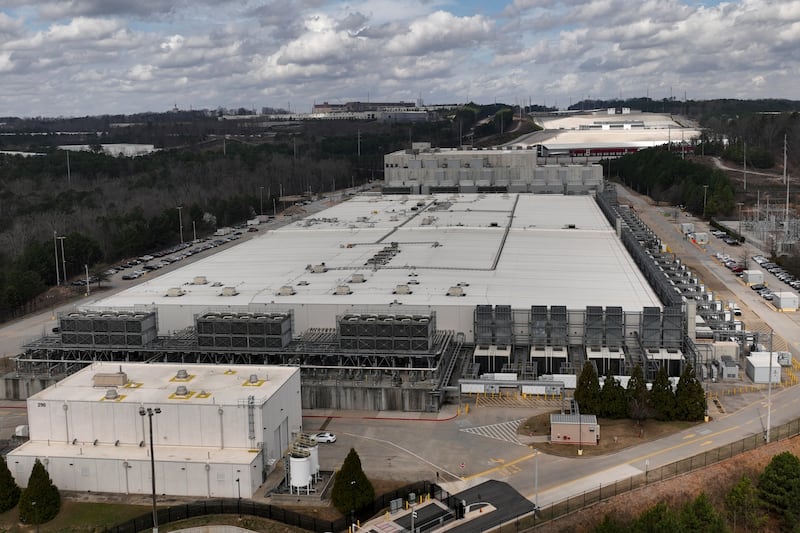
Across the U.S., some 700 hyperscale and co-location data centers are under construction, adding to the 3,000 centers already in operation.
Tapping the brakes on data center developments
As of April 2026, 69 jurisdictions have active data center moratoriums in place, according to the U.S. Data Center Moratorium Tracker, with most of those restrictions in place for six to 12 months. Four locales have permanent bans and many more efforts are underway and include a mix of proposed legislative changes and ballot initiatives or voter referenda.
It’s worth noting that only 26 states currently allow for statewide citizen initiatives, referenda or both. While the initiative process, if successful, creates new laws or makes amendments to previously adopted legislation, referenda aim to overturn earlier decisions by elected officials.
Tracking by the National Council of State Legislatures currently shows 10 states have introduced or are in the process of considering proposals aiming to slow down or outright ban data center development. Some proposed legislation, like Georgia’s HB1059, shut down the ability of local jurisdictions to issue permits for data center developments over a specified time period. Others, including Vermont’s S205, seek to put blanket, statewide data center bans in place while impact studies are conducted.
Utah is not among the states currently considering legislation to place limits on data center development.
Recent data center moratorium proposals in New Hampshire and Wisconsin failed to win the support of state legislators and while Maine’s proposal for a one-year pause on data center buildouts earned the support of a majority of state lawmakers, Maine Gov. Janet Mills vetoed the bill last month to protect one data center development in her state that had already earned local support, according to the governor’s veto message.
“A moratorium is appropriate given the impacts of massive data centers in other states on the environment and on electricity rates,” Mills wrote. “But the final version of this bill fails to allow for a specific project in the Town of Jay that enjoys strong local support from its host community and region.”
One of the most recent actions took place in Reno, Nevada, on Thursday when city council members there voted to support a 30-day moratorium on data center projects that could be extended in a follow-up vote on June 1.
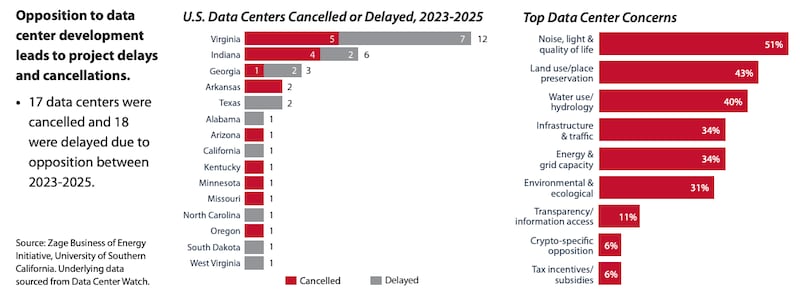
Community pushback on data center proposals is finding success across the country, according to data in the Gardner report. The analysis notes that 17 data center projects were canceled and 18 delayed due to opposition between 2023 and 2025.
The top complaints from communities near potential data center locations, per the Gardner report, include noise/light/quality of life impacts; land use/place preservation; water use/hydrology; infrastructure and traffic; energy and grid capacity; and environmental/ecological worries.
In March, Sen. Bernie Sanders, I-Vt., and Rep. Alexandria Ocasio-Cortez, D-N.Y., introduced legislation seeking a federal suspension of data center construction until national protections are put in place. The bill hasn’t gained traction.
What’s going on in Utah?

The proposal for a massive data center development in Utah, backed by Canadian businessman and TV celebrity Kevin O’Leary, calls for the phased development of data processing facilities on 40,000 acres in western Box Elder County that when completely built out would consume 9 gigawatts of energy, a level that far exceeds the peak usage of the entire state of Utah and would become the largest data center of its kind in the world, according to the developers.
Concerns surrounding the proposal, which has so far earned unanimous approval from an obscure state agency known as the Military Installation Development Authority as well as the Box Elder County Commission, are myriad. The main points of contention, however, are focused on water use and environmental impacts from the data center and its on-site, natural gas-fueled power generation in a state that finds itself in the midst of severe drought conditions and air quality challenges that stretch back decades.
Box Elder County residents could find themselves added to the list of active, data center-focused pushback efforts after paperwork was filed last week seeking to put a referendum before voters.
That filing is currently under review by the Box Elder County Attorney’s Office. Should it move forward, referendum organizers would have 45 days to gather 5,422 signatures and meet other criteria to put a measure on the ballot seeking to overturn the commission’s May 4 vote to advance O’Leary’s data center plans.
Utah currently plays host to 48 operational data centers that draw 920 megawatts of power with an additional 2,600 megawatts now under construction and set to more than triple the state’s overall data center output, per the Gardner report.
Data center development is concentrated mostly along the Wasatch Front and a small number of larger facilities dominate the market. The state’s 10 biggest data centers account for roughly 80% of total current capacity and some even larger projects are in the pipeline including a massive, so-called hyperscale facility (generally defined by an energy draw in excess of 100 megawatts) near Delta, Utah.