



- A majority of Utahns and Americans say it isn’t worth building data centers near residential areas even if competition against China or jobs are at stake.
- Experts say the U.S. is racing to “gobble up space” for data centers to maintain its AI lead over China, but Utahns — and Americans broadly — aren’t persuaded that this urgency justifies building near their communities.
- The political fight over data centers is intensifying, with 66% of Utahns opposing the Stratos Project in Box Elder County and candidates like Peter Crosby making local control a campaign issue.
It’s no secret that Utahns vocally oppose data centers: From Mona’s mega center to Box Elder County’s Stratos project, rural residents rush to community meetings to make their opinions known.
Americans across the country feel pretty much the same way, as vulnerable candidates in this year’s midterm elections line up to denounce the continued construction of the centers.
But what’s fueling the opposition?
In a new Deseret News/Hinckley Institute of Politics poll fielded this month, Americans and Utahns showed most voters are resistant to arguments made by the pro-data center crowd — that they will bring jobs and help the United States maintain its AI edge.
When asked to choose between two alternatives — building data centers to compete with China even if some are built near residential communities, or to protect communities from data centers “even if it slows America’s progress in competing with China” — 67% chose the latter.
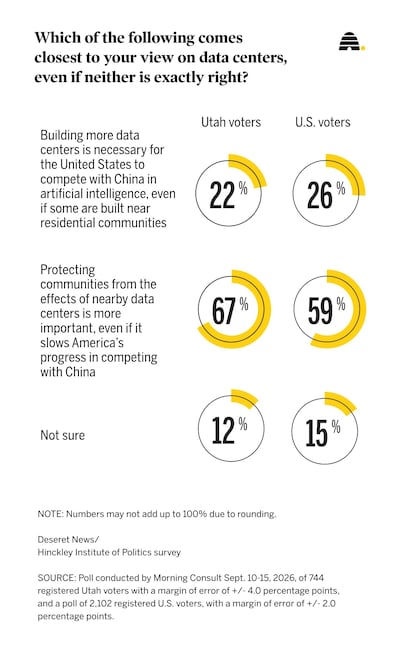
Opposition softened slightly — but only to 59% — when the question was reframed around economic growth.
Nationally, a slightly larger percentage supported data centers in both questions, though the majority still opposed.
The national poll was fielded among 2,102 registered U.S. voters from Sept. 10 to Sept. 14, and has a margin of error of +/- 2 percentage points. The Utah poll reached 744 registered voters from Sept. 10 to Sept. 15, and has a margin of error of +/- 4 percentage points. Both polls were conducted by Morning Consult.
The race to dominate artificial intelligence

Aaron Starks, president and CEO of 47G, an aerospace and defense organization, said the four major areas of AI capability are chips, data centers, electricity and talent.
“China does energy and electricity very, very well,” he said. “Eighty percent of China is undeveloped. They have a lot of land. This is a top-down authoritarian regime that can build and electrify at their own pace.”
The United States, on the other hand, doesn’t have that capability. “But what we do have is we have tremendous data compute capabilities,” Starks added.
To catch up, he said the U.S. is trying to “gobble up space” wherever possible to build more data centers — increasingly depending on the Department of Energy to scope out future sites.
Zach Boyd, director of the Office of Artificial Intelligence for the State of Utah, agreed that the U.S. does have a “lead” over China — depending on how you measure the race — and the nation should be able to maintain it for some time.
Even still, he said: “I think it should be on people’s radar.”
Boyd explained Utah’s part: Gov. Spencer Cox has called on the federal government to create more regulatory policy, though the state is considering creating additional legislation itself.
“As these agents become more powerful, I think we are going to see definite benefits for society,” Boyd said, “but also the cases where they get out of hand will become more and more serious just because the AI agents are more powerful.”
Data centers and AI are not just a consumer or economic development challenge, Starks said, it’s a national priority.
“And so it’s not really just about Utah, it’s about our national interests as a whole and whether or not Congress can properly determine and prioritize things, which they can’t,” he said. “They haven’t for many years.”
The promise of a better economy
In the Deseret News poll, opposition to data center construction eased slightly when the question shifted to economic growth — though a majority of Americans and Utahns still said no.
“Things are rough right now for a lot of people,” said Peter Crosby, Democratic nominee for Utah’s 2nd Congressional District. “So, if you tell me that this kind of economic development project is going to bring jobs, then I’m probably going to be more likely to say yes.”
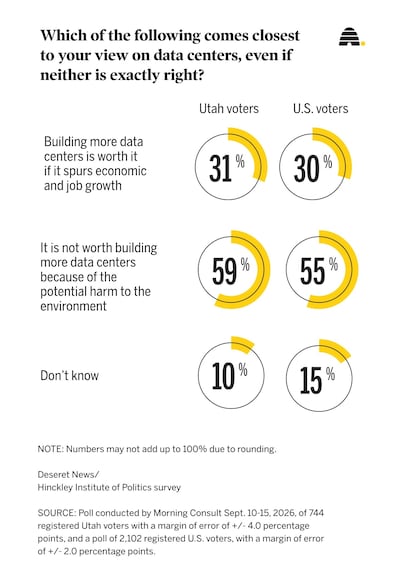
Also according to the Deseret News poll, young residents ages 18–34 were more likely to support data centers for job growth (33%) than those ages 35–44 (25%) — which might not come as a surprise, as the Harvard Institute of Politics found nearly half of young Americans say they are personally affected “a lot” by inflation (50%) in a study earlier this year. Another 45% say they are struggling to make ends meet or getting by with little financial security.
“Especially right now with the state of the current economy, anything that suggests that it might give somebody a job is probably going to have a slightly more positive response,” Crosby added.
The Governor’s Office of Economic Development projected the Creekstone Energy data center in Millard County — which is currently under construction — will produce 106 full-time jobs, averaging $160,000 per job.
But not everyone buys those numbers.
“Typically, you see a job buildout for about a year or two while the construction actually happens. But that may be a local workforce — it may not,” said Crosby. “But once the center itself is set up, it takes a caretaker crew — you’re looking at 25, 50 folks maybe, because it’s just a warehouse with server banks.”
The next steps for Utah politicians
Crosby is the Democratic nominee for Utah’s 2nd Congressional District — which includes Box Elder County, where the controversial Stratos Project launched.
Earlier this year, developers were met with hundreds of angry residents who filled local meeting rooms, voicing their opposition.
Recalling his experience attending one of those meetings, Crosby said: “We were asking the commissioners to vote not yet — to give us some more time, and they directly ignored the will of Box Elder residents.
“From a campaign perspective, we’ve always taken a pretty clear stance that the people themselves in a community should be able to make this decision,” he added. “They should have all the information they need to make that decision, and then they should make that decision.”
Rep. Blake Moore, the Republican candidate in the 2nd Congressional District, did not respond to a request for comment in time for publication.
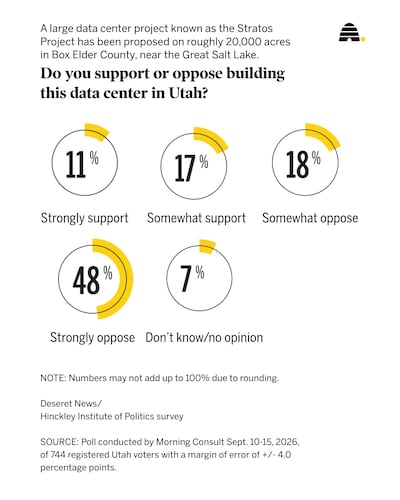
In the Deseret News poll, 66% of Utahns either “strongly” or “somewhat” opposed the 20,000-acre Stratos Project.
But the poll suggests something deeper than opposition to any single project.
More than rejecting a singular data center, Utahns reject being told why they should accept them. The more urgent the justification, the less Utahns wanted to hear it.