


PARK CITY — When Kenneth Feinberg and his associates had to determine monetary compensation for those who lost loved ones in the Sept. 11 attacks, his team had a rule: no public tears. That meant, among other things, remaining stoic through thousands of interviews with grieving family members.
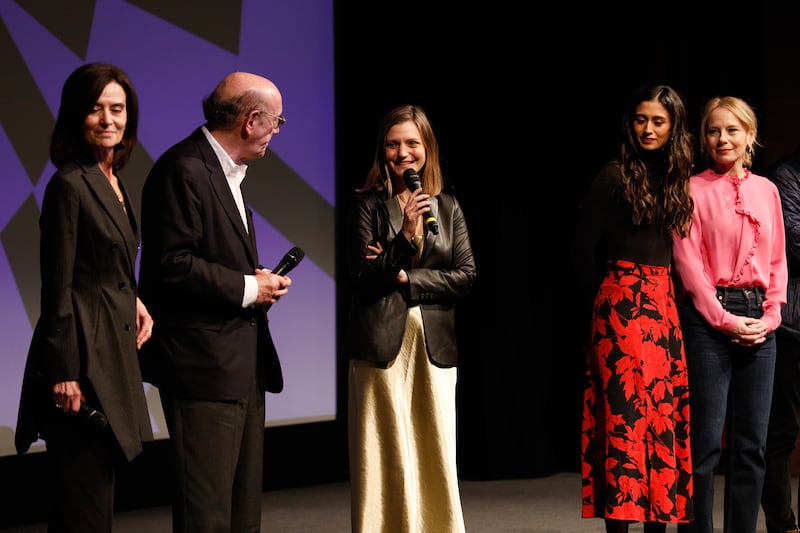
“That was the most difficult part of the job, … the emotion of dealing with individual families,” Feinberg told the audience at the premiere of “Worth,” a new film about the September 11 Victim Compensation Fund, on Friday night at Park City’s Eccles Theatre. Standing next to him onstage was Camille Biros, his colleague who privately met with 800 of those family members between 2001 and 2003. Feinberg described these meetings as “absolutely debilitating.”
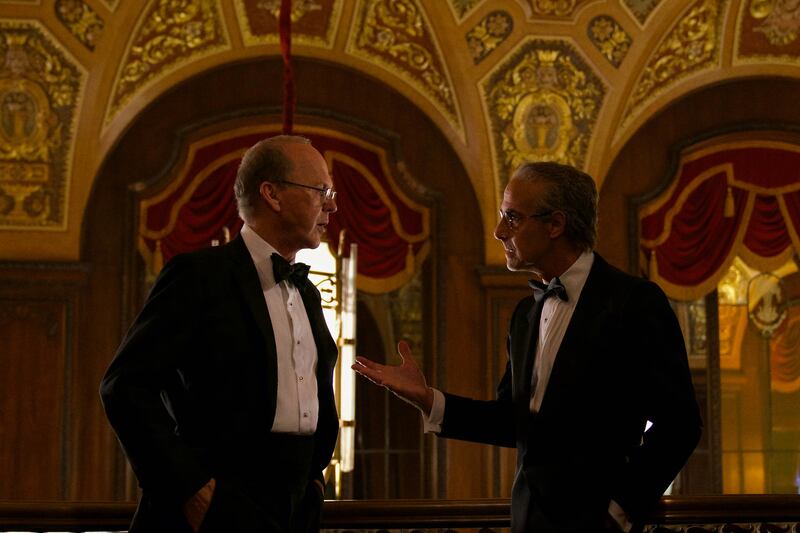
“Worth” stars Michael Keaton as Feinberg and Amy Ryan as Biros. Stanley Tucci plays Charles Wolf, a community organizer whose wife died in the towers. Wolf was Feinberg’s most outspoken critic at first, but eventually became a confidante of sorts, and a key figure in getting the settlement approved.
When Congress appointed Feinberg special master over the compensation fund, he took on a nearly impossible task. If more than 20% of claimants rejected the settlement and sued the airlines involved, the costs might bankrupt the airlines — which could cripple America’s economy. But 9/11 victims ran the socioeconomic spectrum — janitors, CEOs and everything in between — and those victims’ families would never all agree to the same settlement amount. Giving payouts scaled to each victim’s salary, however, could be cruel for those on the low end.
If that weren’t enough, Feinberg and co. had a two-year deadline to persuade these thousands of beneficiaries. If his team didn’t meet their deadline, the fund could get kicked back to the U.S. government, and stuck in political gridlock — a scenario in which victims’ families might not receive any compensation whatsoever. Feinberg had negotiated settlements for victims of asbestos and Agent Orange poisoning, but 9/11 was a completely different beast.
“It was just so fresh, and so raw, and people were so angry,” said Sara Colangelo, the director of “Worth,” during an interview with the Deseret News on Saturday. “So it required so many new emotional tools, and he (Feinberg) had to really build them for himself.”
In Feinberg’s memoir “What is Life Worth?”, he admits to a certain amount of close-mindedness initially. Keaton portrays him as commanding and decisive, but not outwardly empathetic. That isn’t to say Feinberg isn’t uncaring — he accepts the 9/11 assignment pro bono partly because he, like so many Americans after 9/11, wanted to help heal a wounded nation — but he purposely tries keeping empathy out of the equation. In time, that omission becomes untenable. Getting 80% of claimants to accept the settlement required their trust, and they wouldn’t trust him unless he really heard them out.
Feinstein didn’t necessarily need to try harder — he seems like a workhorse — but that he needed to try differently.
“He is, even from the beginning, a really decent man who’s trying in some way to do good,” Colangelo said.
And really trying, it seems, is at the core of “Worth.” The September 11th Victim Compensation Fund came together because people across the social, economic and political spectrum themselves came together.
“This fund wasn’t liberal, conservative, red state, blue state, Republican, Democrat,” Feinberg said at the premiere. “Everybody rallied around the fund.”
By today’s measures, the fund was quite generous. The World Trade Center’s collapse took a lot of lives, including those of undocumented immigrants. The Bush administration, composed of Republicans, and Feinberg, himself a Democrat, both insisted these immigrants’ families receive compensation without fear of deportation, and have their anonymity protected. The fund also allowed certain same-sex partners of 9/11 victims to receive compensation.
“And that level of cooperation, that kind of governmental productivity — they were so productive and efficient and working together — I hope that we take inspiration from that,” Colangelo said. “I doubt they’ll be another fund quite like that.”
“Worth” is not a warm and fuzzy movie. It is about tragedy, and the injustice of life, and the seemingly impossible task of putting order to unfathomable chaos. At its core, though, “Worth” is still decently hopeful, if only because clawing one’s way out of a tragedy like 9/11 requires it.
“And I think it was a really unique moment in history, in that cooperation kind of superseded individualism and panic and greed in a really interesting way,” Colangelo added. “I hope that people can recall that, and work toward maybe getting there again.”
“Worth” at Sundance Film Festival — remaining screenings:
- Jan. 28, 6 p.m., Sundance Mountain Resort Screening Room, Sundance Resort
- Feb. 1, 5:30 p.m., Egyptian Theatre, Park City