

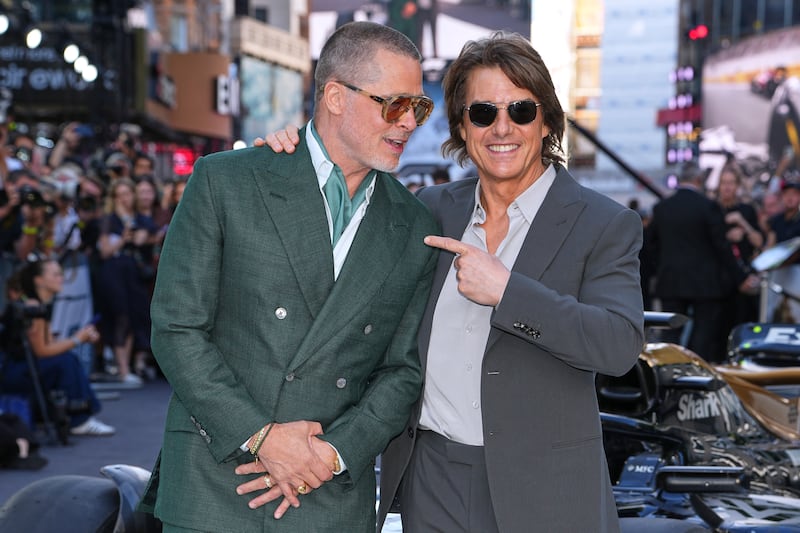

A hyper-realistic AI video depicting Brad Pitt brawling with Tom Cruise on a rooftop exploded online, drawing millions of views — and sharp criticism from the Motion Picture Association, which accuses the company behind the artificial intelligence model of “infringement,” as Hollywood confronts how to navigate the rapidly evolving technology.
The 15-second fight was created using a new AI video generator, Seedance 2.0, which is owned by ByteDance, the Chinese parent company of TikTok.
Ruairi Robinson, the Oscar-nominated Irish filmmaker behind the viral clip, said he gave Seedance only a “two line prompt” and the tool generated the ultra-realistic fight scene entirely on its own.
In response to the viral video, the Motion Picture Association called on ByteDance to halt its “infringement” of copyrighted material.
“In a single day, the Chinese AI service Seedance 2.0 has engaged in unauthorized use of U.S. copyrighted works on a massive scale,” Charles Rivkin, chairman and CEO of the Motion Picture Association said in a statement shared with Deadline.
The statement continued, “By launching a service that operates without meaningful safeguards against infringement, ByteDance is disregarding well-established copyright law that protects the rights of creators and underpins millions of American jobs. ByteDance should immediately cease its infringing activity.”
The AI tool, which BytedDance bills as delivering an “ultra-realistic immersive experience,” has been used to generate several more clips that have circulated online, including twists on “Lord of the Rings‚” “Seinfeld,” “Titanic,” “Shrek,” “Spider-Man” and more.
Rhett Reese, the screenwriter behind the “Deadpool” films and “Zombieland,” said he felt “terrified” by the potential ramifications of the technology.
Of the Pitt-Cruise brawl video, Reese wrote, “I hate to say it. It’s likely over for us.”
“In next to no time, one person is going to be able to sit at a computer and create a movie indistinguishable from what Hollywood now releases,” the screenwriter continued in a follow-up post. “If that person possesses Christopher Nolan’s talent and taste (and someone like that will rapidly come along), it will be tremendous.”
“I am not at all excited about AI encroaching into creative endeavors. To the contrary, I’m terrified. So many people I love are facing the loss of careers they love. I myself am at risk,” Reese said in a final post. “I was blown away by the Pitt v Cruise video because it is so professional. That’s exactly why I’m scared.”
Hollywood’s push against AI
The use of AI in filmmaking is a hotly debated topic in Hollywood.
Despite reluctance from hundreds of actors, musicians, filmmakers and other artists, AI tools have crept their way into modern filmmaking.
In December, Disney signed a $1 billion deal to hand over beloved characters from Disney, Marvel, Pixar and “Star Wars” to Sora, OpenAI’s short-form generative AI platform.
Disney will also integrate OpenAI’s chatbot, ChatGPT, into its employees’ workflow, and aims to collaborate with OpenAI to “build new products, tools and experiences” as part of the agreement.
Bob Iger, former CEO of The Walt Disney Company, noted that Disney would collaborate “thoughtfully and responsibly” with OpenAI.
“Technological innovation has continually shaped the evolution of entertainment, bringing with it new ways to create and share great stories with the world,” Iger said in a statement.
Several films nominated and awarded at the 2025 Academy Awards relied on AI for production, such as “The Brutalist,” “Dune: Part Two,” “Emilia Pérez” and “A Complete Unknown.”
Following the award show, the Academy of Motion Picture Arts and Sciences updated its rules for eligibility, voting and campaigning, and acknowledged the growing use of AI in film.
Using artificial intelligence and other digital tools to make a film will “neither harm nor help the chances of achieving a nomination,” the Academy shared in a statement. The update provided a new standard for increased acceptance of AI in filmmaking.
Still, hundreds of actors and filmmakers are pushing for stricter guidelines surrounding AI use in film.
In March, more than 400 Hollywood actors, filmmakers, musicians, writers and others signed an open letter sent to the White House’s Office of Science and Technology Policy, encouraging the Trump administration not to weaken copyright protections for AI, per Variety.
The letter included signatures from Ben Stiller, Paul McCartney, Cate Blanchett, Mark Ruffalo, Paul Simon, Cynthia Erivo, Taika Waititi and Joseph Gordon-Levitt.
“We firmly believe that America’s global AI leadership must not come at the expense of our essential creative industries,” the letter said, as reported by Variety.
“AI companies are asking to undermine this economic and cultural strength by weakening copyright protections for the films, television series, artworks, writing, music and voices used to train AI models at the core of multibillion-dollar corporate valuations.”