

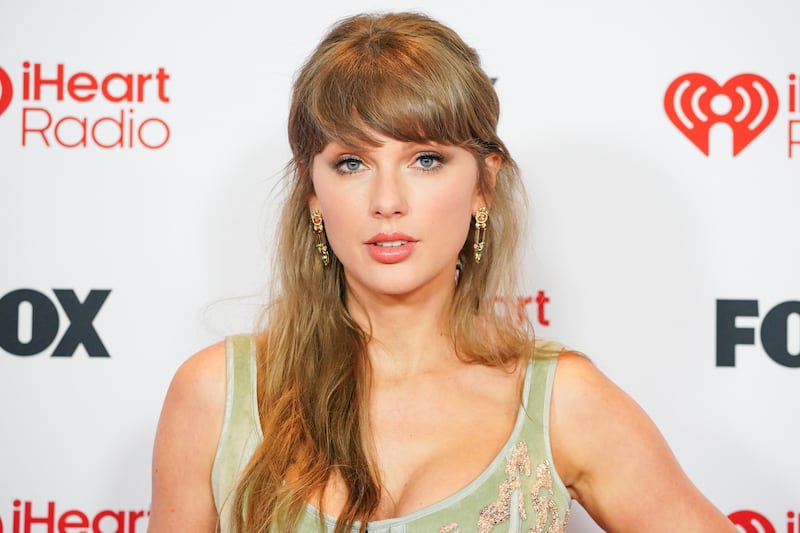

Taylor Swift reveals some of the secrets behind one of her greatest strengths — songwriting — in a new interview with The New York Times.
The Times “polled more than 250 music insiders and gathered six Times critics to choose the 30 Greatest Living American Songwriters.” Swift made the list and shared some of her insights and experiences with songwriting over her 20-year career.
“Talking about songwriting > Talking about anything else,” she wrote in a post on X promoting the interview.
Swift started writing songs at the ripe age of 12 years old.
“As soon as my love for singing and picking up an instrument happened, songwriting just spontaneously started becoming the entire cornerstone of my life,” Swift said.
She explained how the impact of storytelling in songs is what led her to country music.
“It’s that story time structure,” Swift said.
Some of the musical influences she listed include:
- The Chicks: “Goodbye Earl”
- Jeannie C. Riley: “Harper Valley P.T.A.”
- Any Kenny Chesney song
- Dashboard Confessional: “Hands Down”
- Chris Carrabba
- Fall Out Boy
- Pete Wentz’s lyrics
- Sombr
At 14, Swift nabbed a publishing deal at Sony, and she asked that her songs be excluded from being pitched to other artists as she tried to secure a record deal for herself.
“I think one of my favorite things about the Nashville music scene, country music and the storytelling, where it was when I arrived there, there was almost this tradition of sort of breaking the fourth wall, making the song then part of a song or the writing of the song becomes a part of the song,” Swift said. “And I did that in a song called ‘Tim McGraw.’”
She revealed that her favorite end plot twist that she’s done with songwriting is her song “the last great american dynasty” from her album “folklore.”
“It is just so much fun to, like, to tell this story about this real woman who lived in history, and she defied the social norms, and she drove people crazy...,” Swift said. “And basically then in the end, you’re like, you know, she moved away from Holiday House. It sat quietly on that beach, free of women with madness, their men and bad habits and then it was bought by me. ... I had to taper down my own excitement that that hook happened.”
Taylor Swift speaks on the ‘reputation’ and ‘Speak Now’ albums
Despite receiving critical reviews of her “reputation” album, Swift said she still knew it was good, despite the negative initial feedback.
“I loved the ‘reputation’ album,” Swift said. “I was like, ‘You guys say what you want,’ I know what I did. I love it, like, go with God, sorry, you can come around if you want, it’s OK if you don’t.”
Then years later, songs like “...Ready for It” and “Don’t Blame Me” became popular and more critically acclaimed.
“I think the first time I felt like ‘I don’t care if people hate this because I love it so much’ was when I wrote the song ‘Love Story’ when I was 17 sitting in my bedroom mad at my parents because they wouldn’t let me go on a date with a guy who was too old —so I shouldn’t have been on a date with him anyway. And this is why you need to discipline your kids because they might write songs that go No. 1,” Swift said.
Unlike the “reputation” album, her sophomore album “Fearless” set the charts ablaze and even won a Grammy for Album of the Year. Because it performed so well, the scrutiny on Swift as a songwriter intensified and some critics accused Swift of leaning on co-writers and co-collaborators to make such catchy tunes.
For her third album, Swift was the sole writer for every single song on “Speak Now.”
“That was a really important album for me in terms of becoming a writer that knew I could trust my own intuition,” Swift said.
When it comes to songwriting, Swift keeps the notes app and voice memos app handy on her phone. And she explained how when she’s writing, she really “gravitates towards juxtaposition.”
“We are all filled with polarity, hypocrisy, these kind of battling features and factors that make up our jagged personalities,” Swift said.
Taylor Swift on the importance of bridges in songs
One of the things Swift is known for is the iconic bridges she adds to many of her songs.
A bridge in a song is a section that provides contrast to break up the verses and the chorus. It sounds different than the rest of the song but is a tactic to bring the whole song together and elevate the song.
“It just feels like we’re painting a picture, we’re setting a scene, we have this opportunity as a songwriter to tell an entire story, an entire movie, or a very detailed description of one scene in a movie, or a very nuanced dynamic between people, or a complicated emotion, and we only have so long to do this,” Swift said. “... You can start painting the picture in the verse. You can get to the heart of it at the chorus. But then the bridge can be where you zoom back, you walk 20 feet back and you see what this entire painting was supposed to be. ... The bridge can be when you step back and you feel everything that that piece of art was supposed to make you feel.”
A specific type of bridge Swift is known for is something she calls “the rant bridge.” It makes for a more intense listening experience, with Swift often crafting lyrics that listeners can scream along to, like in songs like “Out of the Woods” or “Cruel Summer.”
“You want this rant bridge to feel the most intense of what that feeling is that you’re trying to establish over the course of the song and you want it to kind of be a crescendo,” Swift said. “We usually love those so much that we then bring them back.”
Swift reflects on being in the public eye in ‘mirrorball’
When it comes to the most trademark indelibly Swift-like songs, one she told Seth Meyers in an interview earlier this year was that her song “mirrorball” is one she would most likely include in her top five songs.
She argues that “A public person who makes art is a mirrorball.”
“Being a person in the public eye, I’ve really begun to realize that you are a mirror,” Swift said in the Times interview. “Like you are a mirror for your fans, for the media, for people on the internet, for just random, just people who don’t even care about your music but they know who you are. However they feel about themselves and their life will be projected on to how they perceive you.”
When writing a song, she seeks connection, and she said with that song, some of the lines feel too true, which means a lot of people probably feel the same way.
“That always overrides my discomfort with if a line feels too true, because I don’t really think that there’s anything that’s too true,” Swift said.
Taylor Swift talks about the iconic ‘All Too Well 10-Minute Version’
Swift reflected on being devastatingly sad about a breakup during her “Speak Now” tour, saying that during a sound check, she started playing the same four chords over and over again and just let her stream of consciousness flow about how hurt she was feeling at the time.
Her mom heard what was happening and rushed over to the sound crew to see if they happened to record it. They had.
When she went back and listened to it, she said it was a “catharsis of intense emotion.” She pared down the song to something she felt would be more palatable to fans, and at first, it didn’t make a lot of noise. But then “this song just keeps bubbling up.” It became a fan favorite.
“I made the mistake of kind of explaining how the song came to be in an interview,” Swift said. “It ended up being a really fortuitous mistake that turned into being like, ‘Oh, I’m so glad that happened.’”
In the interview, she explained how the song was originally 10 minutes long, so fans started begging for her to release the 10-minute version. For years.
When she was rerecording her “Red” album, she cobbled together the song from old notes and recordings to release her sleeper hit “All Too Well 10-Minute Version (Taylor’s Version),” to the fans’ delight.
“That was the most extensive restoration process I’ve ever done on a song,” Swift said.
Taylor Swift shares the background of how she gets ideas for songs
Getting an idea for a song always happens differently, according to Swift.
It can be spontaneous, like with “Elizabeth Taylor,” where she was talking about the starlet and said an intrusive melody just “pops into my head.”
Another way she’s seen it happen is for one of her producers, like Aaron Dessner or Jack Antonoff, to make an instrumental and she’ll write a vocal melody and the lyrics to go with the music.
It can also happen in the same room as her collaborators, like for her song “New Year’s Day.”
Taylor Swift says the best idea always wins out with her
When she’s writing, Swift said she appreciates when her co-writers challenge her or come up with different ideas because it makes “the music better.”
“I do kind of like it when people challenge me on something because I never want to be in the room with creators who are afraid that if they have a better idea, they can’t argue with me because it must be my idea that makes it through” Swift said. “I’m never gonna grow that way.”
Taylor Swift talks about her love for songwriting
Swift has said multiple times that her favorite thing to do is write songs.
“Songwriting is something that it’s a very intimate, tiny little thing, for me,” Swift said. “I have a lot of things I like to do. I like to bake. I like to make art. I like to paint. I like to sew. I like to write songs, and I try to keep it as dear to me as those other things I just named.”
Sometimes her songwriting stems from criticism she’s received, like in her songs “Anti-Hero” and “Blank Space.”
“Yeah, criticism has been a huge fuel for me. It’s been a huge jumping-off point, like a creative writing prompt or something,” Swift said. “There are so many songs in my career that wouldn’t exist if people weren’t doing a slideshow of all my boyfriends.”
While Swift does write about her personal life, she hopes that fans listen to the music without trying to identify who each song is about and instead just enjoy the art.
“When it gets a little bit weird for me is when people act like it’s sort of a paternity test, like ‘this song’s about that person.’ Because I’m like ‘that dude didn’t write the song, I did,’”Swift said.