



The multidecade fight to build a short, four-lane highway through a section of southern Utah just got another green light from the Trump administration. But the question remains: will lawyers for environmental groups succeed in slowing down construction again?
Federal reapproval of the Utah Department of Transportation’s proposal marks the eighth time the 4.5-mile highway has been considered. The road crosses through a small portion of the Red Cliffs National Conservation Area, which is just north of St. George, Utah.
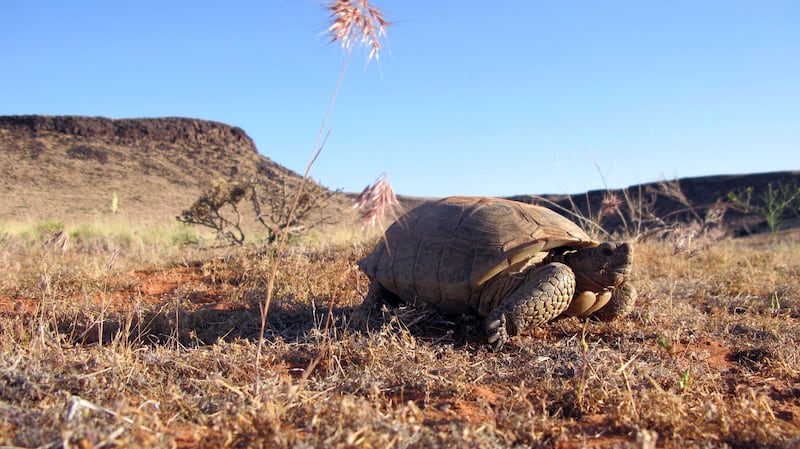
Environmental groups like Conserve Southwest Utah are opposed to the highway, largely over concerns it could further endanger the Mojave desert tortoise.
Lisa Belenky, a California-based counsel for the Center for Biological Diversity, said the proposed highway “would destroy some of the last best habitat for threatened desert tortoises and forever scar this rare natural refuge.”
The long history of the proposed highway
Adam Snow, a Washington County commissioner, told the Deseret News that in 2009, former President Barack Obama signed a bill that directed the Interior Secretary to propose a route for a highway through Utah’s Red Cliffs National Conservation Area.
“There was a lot of pushback by the end of the Obama administration,” Snow explained, so the road didn’t make any progress. Then when President (Donald) Trump came into office in 2016, the highway started gaining momentum. Once a plan had been approved, “it was immediately seized upon by Conserve Southwest Utah.”
Lawsuits kept the highway from progressing, then former President Joe Biden entered office, and the project was halted for four years.
“As soon as President Trump came back into office, they looked at the decision to halt it again, and realized it was largely just a political decision,” Snow explained.
The Bureau of Land Management then “re-analyzed the road, the benefit to the tortoise and the benefit of habitat conservation, and they realized that, yes, the law gave a right of way. So they reissued a new decision yesterday,” he said.
But Utah’s fight for the highway precedes 2009. Gil Almquist, another Washington County commissioner, told the Deseret News that St. George “always knew an east-west route across that area would be necessary.”
Before becoming a Washington County commissioner, Almquist served on St. George’s Planning Commission and City Council for a combined 20 years. St. George had been discussing the route “long before” Obama signed the 2009 bill.
Environmental groups are still against the highway
Upon news of the highway’s federal approval Wednesday, seven environmental nonprofits from six states signed onto a press release expressing their concerns over the project.
The highway could “damage iconic red rock landscapes, disrupt treasured outdoor recreation opportunities and set a dangerous precedent for congressionally-protected public lands across the U.S.,” they wrote.
In another press release from the Center for Biological Diversity, the Arizona-based nonprofit referenced a Biden-era BLM report that concluded the highway would increase wildfire probability, permanently destroy the tortoises’ habitat, spread invasive plants and harm cultural and historical resources.
Why Washington County leaders think the highway is necessary
Southwestern Utah is home to dozens of natural wonders that bring in millions of tourists annually. Zion National Park alone typically attracts about 5 million visitors a year.
“You’ve got huge state parks that get millions of visitors on one side of the county, and then two other state parks and a national park — the second busiest national park in the country — on the other side of the county," Snow said.
“The roadway is necessary because we’ve got to get traffic through east and west across the county,” he said.
As the area’s infrastructure currently stands, residents and tourists rely on I-15, which is at one point pinched between two stone walls.
“There are no additional lanes we could add for more room without removing a mountain,” Snow said. “And we’ve got roads that go around the south side of that hill, but nobody goes eight miles out of their way. ... So we’re getting traffic failure at that point.”

7,000 acres of land offered to placate environmental groups
In an attempt to make the Northern Corridor more appealing to environmentalists, the Washington County Commission promised to add 7,000 acres of land to Red Cliffs National Conservation Area, in exchange for the less than 200 acres needed for the Northern Corridor Highway.
Those 7,000 acres include several trails and climbing areas, which would remain accessible to the public and would likely receive better maintenance, if designated conservation land, Almquist said.
However, Conserve Southwest Utah has said it would like to conserve the 7,000 acres and prevent the highway from being constructed.
Stacey Wittek, the executive director of Conserve Southwest Utah, said, “If there is a will to protect both, then there is a way.”
She added, “Not only is it an economic question, it is an emotional, moral and spiritual question for us. How do we build and make places that are preserved in perpetuity?”
Almquist countered, “What’s ironic is we’re doing it for environmental reasons.” If the Northern Corridor de-congests traffic elsewhere, it will offset carbon emissions, he explained, adding, “I don’t know why the environmentalists are hitting us over the head when we’re trying to preserve land for them.”
Regardless of how long it takes, Snow and Almquist told the Deseret News they believe the highway will be built eventually, even if new environmental lawsuits come in.
“We can put this road in, which is a benefit to the tortoise. Having worked for the federal government for so many years, I’ve never seen a true win, win, win. If you’re a conservationist, you can claim a victory. If you care about the tortoise, you can claim a big win there. If you’re a recreationist, and you love open space, you can say we protected Moe’s Valley, which is another win,” Snow said.
Utah Sen. Mike Lee, Rep. Celeste Maloy celebrate the Trump admin’s decision
Sen. Mike Lee, R-Utah, described the BLM’s reapproval of the Northern Corridor as “great news for Washington County” and “a big win for a fast-growing community.”
Rep. Celeste Maloy, R-Utah, added in a press release that the reapproval is “the result of decades of work, research, collaboration and dedication.”
For Maloy, the decision came after working on it in varying capacities for over a decade, first as an attorney in Washington County and then as a congresswoman in Washington, D.C.