


Politics can be brutal. At its best, it’s a place to exchange ideas and solve problems together. At its worst, it pulls us down to the lowest common denominator, driven by algorithms, outrage and contempt.
Over the late 2010s and early 2020s, America underwent a rapid and alarming transformation in our public dialogue. From poisonous rhetoric seeping into every level of politics to violent riots in the streets, we witnessed a breakdown in the very mechanisms that bind a democratic society. Regardless of ideology, we all felt it, and we all worried it might be the new normal.
Our collective state felt far from the Founders’ call to “form a more perfect union” or Lincoln’s plea: “With malice toward none; with charity for all.”
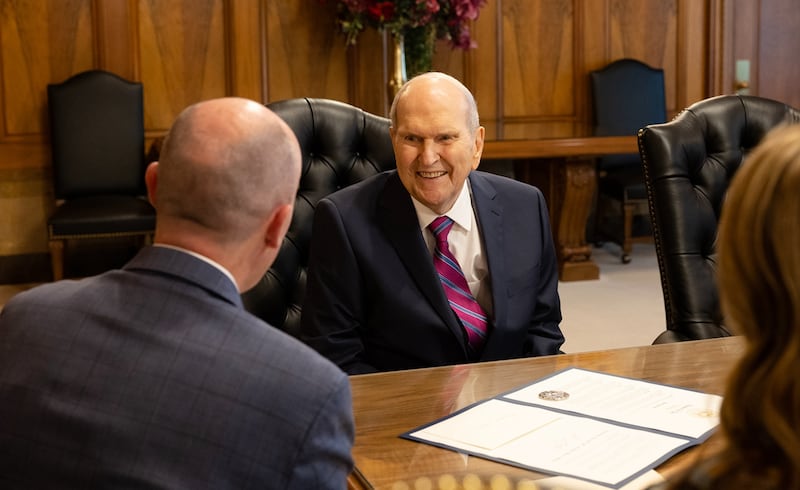
In April 2023, President Russell M. Nelson waded into this climate of conflict. At a General Conference for The Church of Jesus Christ of Latter-day Saints, he said, “I am greatly concerned that so many people seem to believe that it is completely acceptable to condemn, malign and vilify anyone who does not agree with them.”
To be a true disciple of Jesus Christ, he said, was to strive to be a peacemaker.
His words pierced my soul. I was soon to serve as chair of the National Governors Association, a bipartisan coalition that unites governors from red states and blue states. President Nelson’s words solidified something we had been working to develop.
Shortly thereafter, I launched Disagree Better, an NGA initiative to reclaim the dignity of our public square. We convened governors, scholars, civic leaders and concerned Americans around a singular mission: to show that principled disagreement is better than what we had been doing.
We created bipartisan public service announcements and hosted respectful debates on college campuses, convinced that healthy conflict is not only possible but necessary to our American democratic experiment.
It took a research-driven approach. Studies by Stanford University’s Polarization and Social Change Lab showed that when voters engaged with leaders modeling healthy conflict, polarization measurably decreased. The data supported the common sense belief that contempt was destroying our national culture, while constructive disagreement could help us save it.
This belief is a beautiful part of our national heritage, but it needs constant maintenance. Our Founding Fathers and other American leaders knew it. Madison studied the stoics, Franklin pursued the virtue of temperance, and Lincoln famously tucked his angry letters into a drawer rather than send them. Their restraint didn’t weaken them; it defined their legacy.
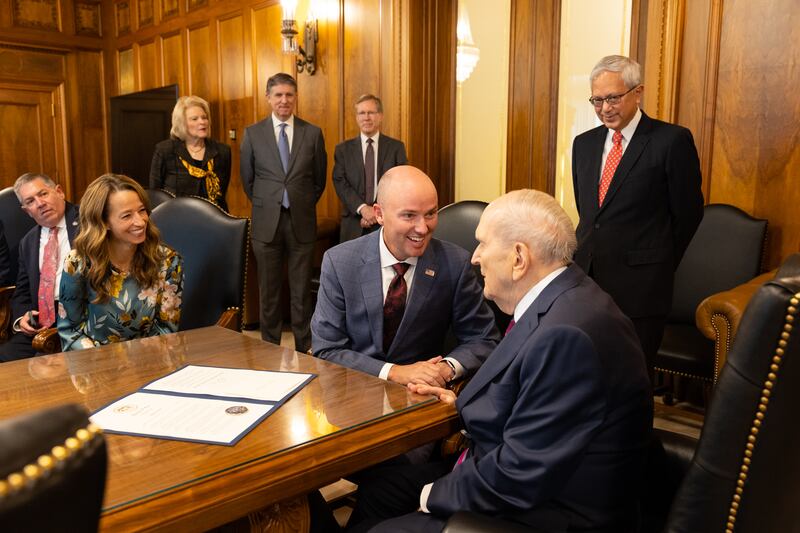
I’m not always calm. I’ve gotten worked up in press conferences. I’ve sometimes made a point at another’s expense. As much as anyone, I’ve needed the example of President Nelson, who has embodied how to disagree with charity, not contempt. And as a believer in Christ, I long for each of us to walk down that path together.
We can be stronger and more unified — not by agreeing on everything — but just by disagreeing without hate or contempt. We’re quick to misunderstand one another when the volume of our anger drowns out each other’s deeply held feelings and beliefs. But when we choose to listen, something extraordinary follows.
As Yuval Levin has written, “Unity does not mean thinking alike. Unity means acting together.” That is the very work the Constitution charges us with.
Today, President Russell M. Nelson, at 101 years old, is truly a prophet for our time. He models the best of the American spirit. After four decades as a heart surgeon, and four decades as a global faith leader, he’s had many accomplishments. His role as a peacemaker is perhaps his greatest.
His call — “Anger never persuades. Hostility builds no one. Contention never leads to inspired solutions.” — is the message our country desperately needs. May we all follow his guidance, and form a more perfect union.