


This article was first published in the State of Faith newsletter. Sign up to receive the newsletter in your inbox each Monday night.
Over the past few months, I’ve heard of compelling stories about the use of AI in settings that involve faith. In under-resourced congregations, some pastors are turning to AI to manage equipment rentals, create schedules, balance budgets and write fundraising emails, freeing up time for the in-person ministry they had uniquely prepared for.
Chatbots trained on the theological traditions of particular denominations can surface in-depth references with a simple query. And the answers are becoming increasingly accurate.
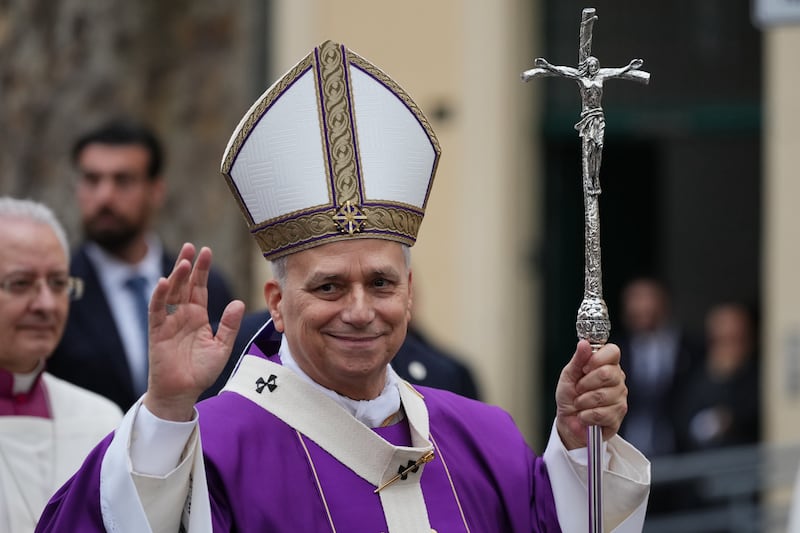
But Pope Leo recently drew a hard line when it comes to using AI for writing sermons. In a closed-door meeting with the priests from the Diocese of Rome, Pope Leo said that the priests should resist “the temptation to prepare homilies with artificial intelligence,” according to the Vatican News. He also discouraged them from chasing “likes” on social media platforms, including TikTok.
“Like all the muscles in the body, if we do not use them, if we do not move them, they die. The brain needs to be used, so our intelligence must also be exercised a little so as not to lose this capacity,” Leo said in a meeting.
“To give a true homily is to share faith,” he said. He continued that AI ”will never be able to share faith.”
Finding the boundary for AI in spiritual contexts, including how it should be used in teaching parishes and congregations, is top of mind for leaders across many faiths.
Last year, Elder Gerrit W. Gong, a member of the Quorum of the Twelve Apostles in The Church of Jesus Christ of Latter-day Saints, warned of the spiritual cost of outsourcing sacred preparation to technology.
“As church members we will not grow spiritually if we let artificial intelligence write our sacrament (meeting) talks or do our seminary homework. AI cannot replace our individual effort and spiritual preparation as we prepare lessons, prayers or blessings.”
Recognizing AI as a tool, and discerning when it becomes more than that, is a challenge believers everywhere are navigating. More specifically, AI seems to clash with some of the core tenets of Christian belief: the capacity to make free and independent moral choices and the doctrine of imago Dei. If machines can replicate traits once considered distinctly human, what, then, remains distinctive about the image of God?
The Church of Jesus Christ of Latter-day Saints has also advised against using AI to generate images of deity. “Artificial intelligence (AI) is not God and cannot be God,” Elder Gong had taught.
So how might someone embrace technological help without infringing on spiritual practices that require openness to impressions that are not merely intellectual, but may come from beyond the screen? Pope Leo aptly described this pull to eliminate intellectual and spiritual friction with AI as a “temptation.”
In my research about AI and faith for an upcoming Deseret Magazine story, I’ve come across other examples of clergy attempting to draw careful boundaries. For instance, Lorenzo Lebrija, a chief innovation officer of Virginia Theological Seminary and an Episcopal priest, was on the team that created EpiscoBot, a chatbot trained on Episcopal teachings and texts. In some congregations, it’s bridging the knowledge gap, where there is a lack of trained clergy.
Out of 7,000 Episcopalian congregations, there are 425 that don’t have a clergy person, according to Lebrija, and Episcobot helps equip lay people who are increasingly stepping up to lead and pastor in their congregations with needed theological insights.
“As much as I’m a proponent of using AI, inside our spaces —our sanctuaries — we do not use it,” Lebrija told me.
One of the challenges Matthew Harvey Sanders, founder of The Magisterium AI, a Catholic chatbot, has tried to address is what he calls “off-ramping” — teaching the AI to recognize when a user should step away from the chat and speak instead with a priest or even a therapist.
With proper boundaries drawn, some believe that AI could even make us more human.
“We are likely to become the only places where you can be fully human,” Lorenzo Lebrija told me, “where the expectation is that you can come with all of your vulnerabilities, with all your fears.”
Fresh off the press
- First-edition Book of Mormon sells for $250,000 at auction, sets new ‘world record’
- Elizabeth Smart’s abduction is a big part of her story. But it doesn’t define her
- Religious liberty nonprofit Becket enters a fight over private speech and public jobs
- How can America heal? Eboo Patel says through pluralism
What do the ‘nones’ believe?
About 30% of Americans claim they are not religiously affiliated. In other words, they identify as the “nones” (atheists, agnostics or nothing in particular believers). But recent research has shown that this doesn’t mean that they’re not believing – Pew had examined the beliefs of the “nones,” and more recently, we’ve learned more from Lifeway Research. Here are some of the findings:
- Nones aren’t simply secular. Only 36% report total absence of religious beliefs, while the majority hold some level of belief or uncertainty.
- Spirituality remains widespread. Nearly half (47%) consider themselves spiritual, with most connecting with their “inner self,” nature and belief in spiritual forces or a higher power.
- Belief in the supernatural is common. Fifty five percent of the nones believe the existence of supernatural entities is very likely.
- Religion feels imposed, not offered. Nearly two-thirds feel religion was imposed on them and that they didn’t make an independent choice. Most see society’s drift from religion as inevitable.
- Morality comes from within. A majority, at 78%, rely primarily on their own sense of right and wrong, while peers, religion and institutions play a minor role.
- Meaning and purpose matter deeply. More than half of the nones prioritize finding purpose, and even more feel there must be something more to life than what they have already.
Faith in the news
- Iran’s Supreme Leader Ayatollah Ali Khamenei, who led the Islamic Republic since 1989, is dead at 86. — AP
- This coverage of a gathering called the Conscious Life Expo, where panelists shared out-of-body experiences and encounters with aliens, is quite fascinating. Kathryn Post writes: “Fueled by social media influencers and a post-pandemic cultural shift, the expo’s content has become more cosmic and, often, more conspiratorial, attracting a diverse audience hungry for meaning outside of institutional religion.” — Religion News Service
- It’s been seven months since 27 campers and counselors died during the flooding of Camp Mystic in Texas. The camp is back in the news amidst the owners’ plans to partly reopen it for the summer against the victims’ families wishes. — The New York Times
- A Day in the Life of a Military Mennonite in Ukraine. — Plough
End notes
In case you missed it, Hannah Neeleman revealed that she was expecting her ninth baby as part of a commercial for the Ballerina Farm’s Protein powder. “As a ballerina, you are associated with many things: elegance, grace, poise,” Neeleman says in the ad, watching ballerinas dance on the stage as she touches her belly. “But a term not often associated enough? Strength.” Gazing out over the farm from her porch with a glass jar of milk in hand, she adds: “The stage is different, but the strength is the same.”