


This article was first published in the State of Faith newsletter. Sign up to receive the newsletter in your inbox each Monday night.
I’ve been on vacation in France this past week, traveling with my son’s school choir as they performed at various churches. I’ve also tried to take a break from the news, so this State of Faith newsletter edition is a bit shorter and is inspired by what I experienced on the trip.
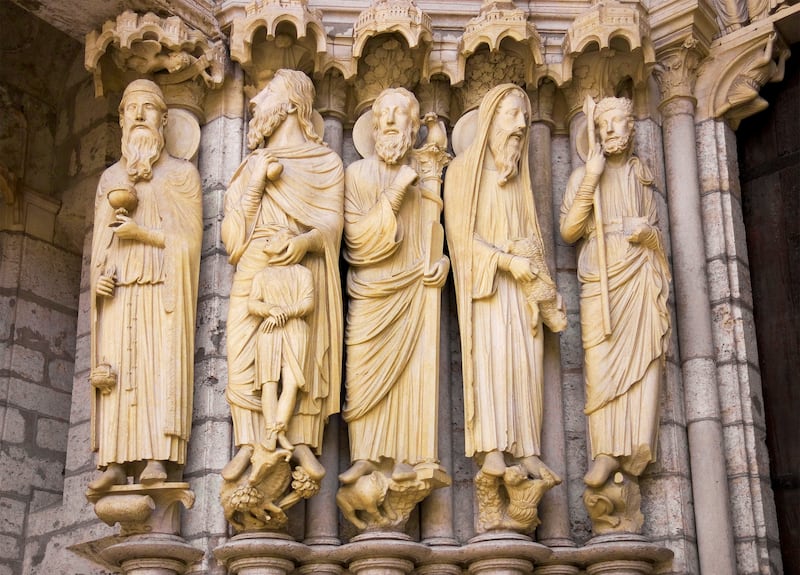
One of the stops on the tour was Chartres Cathedral, a Gothic church about 50 miles southwest of Paris. It’s is an awe-inspiring place, partly because of the scale. Inside, the high-vaulted ceiling stretches up 121 feet. The stained glass covers about 28,000 square feet and each window — there are about 170 of them — is like a visual encyclopedia featuring elaborate scenes from the Bible, zodiac signs and philosophical messages. In the center of the floor is a labyrinth, which symbolizes the journey to Jerusalem, and ultimately to Christ.
This church also has a personal significance for me and my family: It’s where I got engaged 16 years ago.
There are many remarkable stories about Chartres — how it was rebuilt in just 26 years after the 1194 fire, an unusually quick pace by medieval standards; how a tunic believed to have been worn by the Virgin Mary miraculously survived in the nearly full destruction of the church. But there is one story I heard on our tour that I found especially moving and relevant.
In August of 1944, Allied troops were advancing through France and closing in on the city of Chartres. Germans were still occupying the area at the time and American soldiers believed that the German snipers were hiding in the mismatched bell towers of the cathedral.
So the order was issued to bomb the cathedral. “The objective was to get rid of that Cathedral if there are snipers, because it’s in the way,” Eugene Schulz, a former American soldier, recalled.
But one American officer by the name of Colonel Welborn Barton Griffith Jr. didn’t exactly follow the orders. Along with a driver in a Jeep, he took off toward the cathedral, crossing enemy lines, to check whether Germans in fact were inside Chartres. According to Schulz’s account detailed in his memoir, Griffith said: “I’ll ring the bell and put out a flag. If I don’t ring the bell after a while, you attack.”
After walking through the nave and examining the side chapels, he climbed to the top of the bell towers, where he found no German snipers at the church. Back on the ground, he relayed the message to the artillery to withdraw the order to shell the cathedral.
We know that Griffith was from Quanah, Texas, and he graduated from West Point in 1925, where he played football. He had one daughter, who later shared the story of her father’s bravery. But none of the accounts of the story I came across explain why Griffith felt compelled to risk his life to save the cathedral.
On the same day, just hours after his Chartres expedition, Griffith was killed in action in Lèves, a French suburb about two miles away from Chartres, before the city was fully liberated. He was posthumously awarded the U.S. Distinguished Service Cross and France’s Légion d’Honneur, an award for exceptional service to the nation. A small park in the village where Griffith died is dedicated to him.
There are many Americans today who feel that they’re not making a difference. About 47% of Americans under 30 felt “hopeless” and “down,” according to one 2023 study.
Yet the story of Colonel Welborn Griffith, an officer from Texas who ventured to the Nazi-occupied Chartres to check the facts on the ground, shows how a single decision by one person can change the direction of history. Griffith’s decision helped preserve centuries of craftsmanship and religious heritage. It also paved the way for tourists and pilgrims who visit Chartres today — and will continue to do so for generations to come — to be spiritually transformed within its walls.