

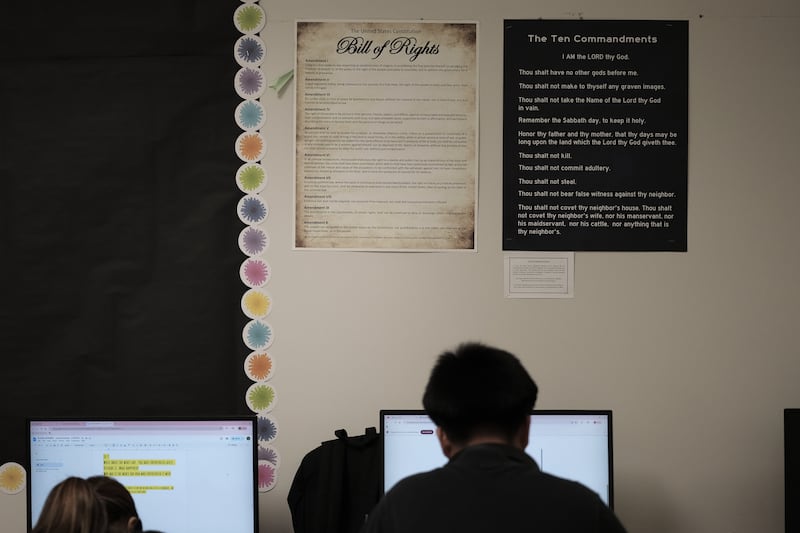

Texas can require the state’s public schools to display Ten Commandments posters, the U.S. Court of Appeals for the Fifth Circuit ruled Tuesday.
The 9-8 decision follows a lawsuit by a group of families of diverse religious backgrounds, who argued that the law violates their First Amendment protections — the prohibition on government establishment of religion and the guarantee of free exercise. But in its opinion, issued in New Orleans, the appellate court concluded that the Texas law did not violate these constitutional principles.
“We conclude the Texas law does not violate either the Establishment Clause or the Free Exercise Clause,” the ruling reads.
The close ruling is the latest development in a long-running national debate and legal battle, also playing out in Louisiana and Arkansas, about the place of religion — and religious texts in particular — in public education.
After the decision on Tuesday, Texas Attorney General Ken Paxton hailed the decision as a victory.
“The Ten Commandments have had a profound impact on our nation, and it’s important that students learn from them every single day,” Paxton posted on X.
Louisiana Attorney General Liz Murrill also celebrated the decision: “Our law clearly was always constitutional, and I am grateful that the Fifth Circuit has now definitively agreed with us.”
The opponents, however, see the decision as a major erosion of the separation between church and state. The 15 families who filed the lawsuit, who were represented by the American Civil Liberties Union and other groups, said they were disappointed in the decision by the court.
“The First Amendment safeguards the separation of church and state, and the freedom of families to choose how, when and if to provide their children with religious instruction,” the plaintiffs said in a statement. The plaintiffs said they would ask the Supreme Court to “reverse this decision and uphold the religious-freedom rights of children and parents.”
The law was passed by the Texas Legislature in 2025 and was signed into law by Gov. Greg Abbott, taking effect on Sept. 1, 2025. The law requires each public school classroom to display a Ten Commandments poster that measures at least 16 by 20 inches. The schools don’t have to spend their own funds on the posters, but they are required to accept any privately donated posters or copies that fit the law’s requirements. Last year, the passage of the law spurred the donation of posters from conservative and religious organizations in Texas.
Before the appeals court ruling, the law was challenged by two federal judges, who ruled the law unconstitutional. In November 2025, a federal judge blocked the law, asking certain public school districts in Texas to take down Ten Commandments posters.
Supporters of the law have framed the Ten Commandments as a document foundational to American legal and moral traditions, appropriate for classroom display as part of the nation’s historical heritage.
Tuesday’s ruling claimed that the posters are not representative of a “religious establishment” since they don’t impose beliefs on churches or other houses of worship. It rejected the view that the Ten Commandments posters are coercive. “It punishes no one who rejects the Ten Commandments no matter the reason,” the ruling said. “Students are neither catechized on the Commandments nor taught to adopt them.” If students ask about the displays, the teachers don’t have to “proselytize students” or “contradict students who disagree with them,” the decision said.
Critics counter that these arguments obscure the explicitly religious nature of the commandments and risk marginalizing students from non-Christian religious backgrounds.
The case will likely reach the Supreme Court, experts believe, which will ultimately decide how far the states are allowed to go in incorporating religious texts and symbols into public classrooms.