

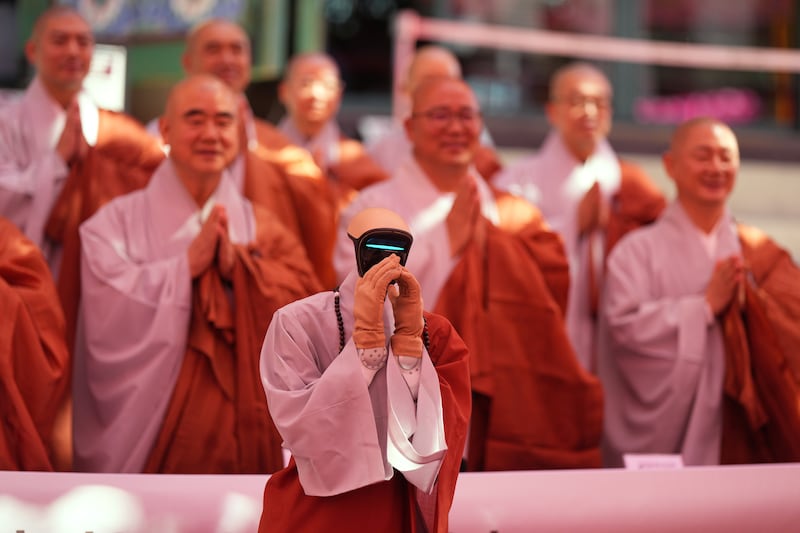

As the world grapples with the implications of AI priests and chatbot-written sermons, a new figure has entered the conversation: Gabi, the humanoid robot that is now a Buddhist monk.
Per Reuters, the robot devoted itself to Buddhism in a ceremony held at Jogyesa Temple in Seoul, South Korea, on Wednesday. The AI-powered Unitree G1 model robot, which stands approximately 4 feet 3 inches tall and costs $13,500, was given the name “Gabi.”
The robot was dressed in traditional brown robes for Wednesday’s ceremony. It wore plain shoes and gloves that gave it the appearance of human hands, although its head has no facial display or hair. In front of a panel of Buddhist monks, Gabi held its hands in a praying pose — its motions remotely controlled — and committed to Buddhism.
“Will you devote yourself to the holy Buddha?” one monk asked the robot.
“Yes, I will devote myself,” Gabi responded.
Another monk draped a mala, or prayer bead necklace, around the robot’s neck. The robot then waved to cheers from the assembled crowd.
Who is Gabi and why is a robot becoming a monk?
The robot’s inclusion in the ceremony, hosted by the Jogye Order of Korean Buddhism, is part of a larger movement to make Buddhism more relevant to today’s youth, per the New York Times.
“The ordination of a robot signifies that technology must be used in accordance with the values of compassion, wisdom and responsibility,” the order said in a statement, “and symbolizes new possibilities for the coexistence of humans and technology.”
The order shared a video of Gabi on its Instagram page, introducing it as the first humanoid robot monk. The caption also hinted that Gabi would appear at Seoul’s upcoming Lantern Festival on May 16-17 to honor the Buddha’s birthday.
Hong Min-suk, a manager at the Jogye Order, told the Times he hoped Gabi would help spread Buddhism in a progressive era.
“Robots are destined to collaborate with humans in every field in the future,” Hong said. “It will only be natural for them to be part of our festival.”
Buddhism’s traditional Five Precepts were adapted for Gabi’s ceremony. While ceremony participants usually pledge to abstain from killing, stealing, sexual misconduct, harmful speech and intoxicating substances, Gabi took a different vow.
The robot monk vowed to respect life, refrain from damaging property or other robots, respect and follow humans, abstain from deceptive behavior, and save energy by not overcharging.
What people are saying about the robot monk
Gabi quickly garnered international attention. Reuters’ video of the robot reciting its pledge had been viewed over 1 million times by Wednesday afternoon, and commenters had a lot to say.
Most seemed unimpressed by the robot’s vows.
“Gabi’s vows are just code, not enlightenment,” one X user wrote. “Sensors can’t meditate on nirvana.”
“As a Buddhist, I find this ridiculous and insulting,” another user responded.
Some, however, see it as a sign that technology recognizes the strength of faith.
“While the world is trapped in anger and hatred, Buddhism brings peace to the mind and calmness to the soul,” one user wrote. “Now even technology seems to understand that real strength lies in peace, not ego.”
One responder argued that ordaining a robot crosses a line.
“This isn’t innovation — it’s a distortion of something sacred,” Instagram user Kiki Bhutia wrote in the comments section of The Korea Times’ post on the event. “A monk’s vows are conferred upon a living human being — someone capable of understanding, speaking, exercising moral judgment, and upholding discipline. These are not optional criteria; they are foundational principles established by the Buddha himself.
“Dressing a robot as a monk and presenting it to the public as such reduces a deeply spiritual commitment to spectacle. It ignores the very conditions that define monastic life and undermines the integrity of the tradition.”
Does this cross a line?
The intersection of technology and religion has sparked debate for years, and there isn’t a clear consensus on the “right” way forward. Generally, faith leaders have discouraged relying on artificial intelligence.
For example, the Rev. Justin Lester, who leads Friendship Baptist Church-Vallejo in California, uses AI to manage administrative tasks. He told the Deseret News that it has allowed him to be a better pastor, but he is skeptical about the role AI can play in spiritual matters.
Pope Leo has recently spoken along the same lines. He said that priests should resist “the temptation to prepare homilies with artificial intelligence,” according to the Vatican News. He has also discouraged them from chasing after social media influence.
In October 2025, Elder Gerrit W. Gong of the Quorum of the Twelve Apostles of The Church of Jesus Christ of Latter-day Saints addressed the possible emergence of robotics like Gabi in religion.
“For good and ill, we know AI-enhanced virtual reality, robotics and other leading-edge technologies are coming,” he said at the Rome Summit on Ethics and Artificial Intelligence.
Elder Gong said Latter-day Saints do not fear AI, but they also don’t think it holds all the answers.
“AI is neither the sum of, nor the solution to, all our opportunities or problems,” he said.
It’s unclear exactly what Gabi the robot monk’s role will be moving forward, but it seems unlikely that this will remain the only instance of a robot joining a religion — this is just the latest example of AI moving into uncharted territory.