


This article was first published in the State of Faith newsletter. Sign up to receive the newsletter in your inbox each Monday night.
Let’s say you’re about to pay a visit to the Vatican to meet the pope. Maybe you’re a head of state from Brazil, Japan or the United States. According to a centuries-old tradition, you don’t arrive empty-handed — it’s customary to present the pontiff with a gift, ideally something that carries some personal or symbolic meaning.
So the question is: What do you give the head of the Catholic Church?
Some dignitaries opted for wine, tea and unique food items from far-flung places in the world. In 2025, Ukraine President Volodymyr Zelenskyy presented Pope Leo XIV with a special icon, “Mother of God with Child.” Painted on a fragment of a heavy artillery box from Izium, a war-torn city in the east of Ukraine, the piece represented the children suffering in the war.
During the pandemic, Pope Francis received thousands of COVID-19 tests and letters of Italian patients and healthcare workers detailing their experiences during the pandemic. Others went a more playful route, gifting the Holy Father plushies and Lego figures that look like the pope. In 1967, President Lyndon B. Johnson gave Pope Paul VI a bronze bust of the president himself.
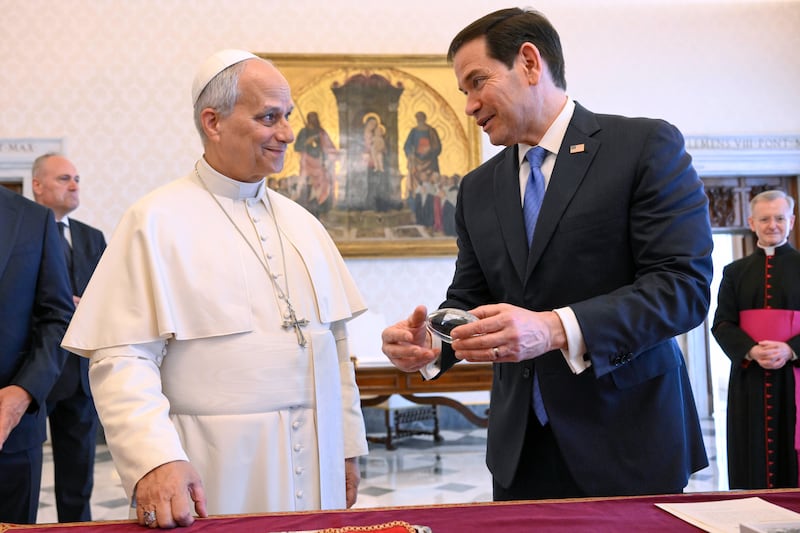
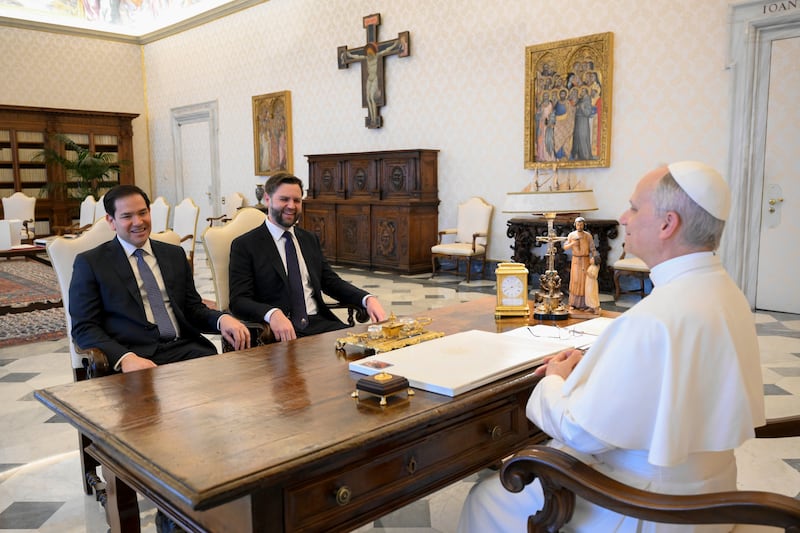
The latest offering for Pope Leo came from Secretary of State Marco Rubio, who paid a visit to the Vatican last week. Rubio gifted Chicago-born Pope Leo a crystal football, which appeared to be a paperweight the size of an avocado.
“I know you’re a baseball guy, but I mean, it has the seal of the State Department,” Rubio said. “What to get someone who has everything? I thought, ‘Oh, a crystal (football).’”
Pope Leo exhibited restraint: “Wow, OK,” he said.
Pope Leo then proceeded with his gift for Rubio — a pen made of olive wood with the pontificate coat of arms. “Olive being, of course, the plant of peace,” Pope Leo noted.
The meeting and the gifts followed a string of critical comments from President Donald Trump, who called Pope Leo “weak on crime” and “terrible on foreign policy.” Pope Leo responded that he didn’t want to debate with the president and said he “had no fear” of the administration or “speaking out loudly of the message of the Gospel.”
After Rubio’s visit, the internet took to discussing what may have moved Rubio’s gift choice of a football-shaped paperweight. Katie McGrady, podcast and SiriusXM Catholic Channel host, thought the gift may have not been especially well thought out, she said on the Bulwark podcast. The Bulwark’s Jonathan V. Last thought the opposite: In light of the recent Trump-Leo exchange, Rubio had to walk a fine line of honoring the Holy Father while also not appearing overly eager to please the leader that Trump has recently clashed with.
“There’s a real contrast in those two gifts,” said Father Edward Beck on CNN. “The question I thought afterwards was: Whose end zone is that football closer to? I’m hoping it’s peace.”
The tradition of presenting gifts to popes dates back centuries, to the customs of Roman imperial power and medieval diplomacy. In ancient Rome, visitors presented offerings to the emperor as a sign of loyalty and respect. Over time, after Emperor Constantine the Great legalized Christianity and the authority of the papacy expanded, many of those customs migrated to the bishop of Rome. The culture of gift-giving came to symbolize a mix of ceremonial pleasantries with an expression of religious devotion and statecraft, which continues today.
So what becomes of the vast trove of gifts that passes through papal hands? The most historically or artistically significant items are typically sent to the Vatican Museums or the Sacristy and Treasury Museum. Many others are handled by the Floreria Apostolica, the Vatican’s Apostolic Flower Shop, a little-known department of roughly 40 employees that manages a lot more than floral arrangements.
The office furnishes Vatican events and papal audiences, and maintains a sprawling warehouse filled with furniture, ceremonial objects and gifts accumulated over decades. Some items are later repurposed as decorations for official events or are auctioned off inside the Vatican, McGrady mentioned.
But not every gift at the Vatican is stored. While accepting a piece of handmade jewelry during a recent visit to Algeria, Pope Leo said that he would be giving it to his niece.
Here are some of the most unusual gifts that the popes have received:
- In 1514, Pope Leo X received a white elephant named Hanno from the king of Portugal. The animal became a beloved sensation in Rome before dying two years later.
- For his 80th birthday, Pope Francis received a wood-framed pair of glasses made from part of a 1,600-year-old olive tree.
- In 2017, Lamborghini gave Pope Francis a custom-made white Lamborghini Huracan, adorned with golden stripes. The car was auctioned off for a million dollars, and the funds were donated to human trafficking causes and rebuilding Christian communities in Iraq.
- In 2009, Pope Benedict was gifted a tortoise in a basket during his travels through Africa.
- Pope Francis also received a pepperoni pizza from a Chicago-area chain, Aurelious, that was delivered to Pope Francis on dry ice by Madeline Daley, who was at the time working for the Archdiocese of Cincinnati.
- In 2015, Mark Zuckerberg gave Pope Francis a model of Aquila, the solar-powered drone.
Fresh off the press
- If at any point “We Don’t Talk About Bruno” from Disney’s “Encanto” lived in your head rent-free, you might enjoy this story of Adassa, the voice of Dolores in the song and Disney’s “Encanto.” She shared with me her inspiring story of striving to make it in the music industry while also becoming a mother of seven and overcoming a life-altering health crisis.
- More about Trump-Rubio visit: Rubio says visit to Vatican already planned as Trump continues Pope Leo criticism and Rubio, Pope Leo discuss religious freedom amid U.S.-Vatican tensions.
What I’m reading
- Who is Mildred Prevost, the woman who raised Pope Leo? — Christopher Hale’s substack, Letters from Leo.
- What a Catholic Church Unafraid of Donald Trump Means to the World. — The New York Times
- David Brooks takes a deep dive into what it means to be a traditionalist and what they offer to the world. — The Atlantic
- Bishop Evelio Menjivar-Ayala, who arrived to the U.S. from El Salvador as an undocumented immigrant, discusses Pope Leo, priests standing up for migrants and his love for bluegrass music. — The Washington Post
End note
I loved the response that sculptor Christian Bolt gave when my colleague Tad Walch asked him about how he conjured up the face and character of Christ as he was carving out the new statue on Temple Square.
Bolt said: “It was a deep inner process for me. I felt that this statue was not about a representation of the Savior. I felt that I should not go in that direction. It’s not about representing him, but it is more presenting him. It’s a manifestation. Then the Spirit, during the process, told me, ‘Don’t be focused on my look, but on my spirit and on my power.’ This was really helpful for me, because I think as human beings, we are simply not able to really represent the Savior in his power, but we can present to the world his Spirit and power, which is so full of love and elevation for everyone. So this became my motivation. I knew the spirit, how it works and how it feels like, but working through the process I kept searching for it again and again. Can I feel it? Can I feel this spirit?”