


In the winter of 2022, “We Don’t Talk About Bruno” was everywhere.
The breakout hit from Disney’s “Encanto” — almost an entire theatrical production in itself — became the first Disney song in nearly three decades to reach No. 1 on the Billboard Hot 100, even surpassing the once ubiquitous “Let It Go” in chart performance.
Written by Lin-Manuel Miranda, “Bruno” exploded across TikTok and streaming platforms with fans around the globe cosplaying members of the Madrigal family. As the world emerged from the pandemic, “Bruno” became a defining pop culture moment. Today, the song has been played more than 614 million times on Spotify.
It also catapulted the film’s cast into a new level of success.
Hadassa Nohemi Candiani, the Colombian singer known as Adassa and the whispery voice behind Dolores Madrigal, found herself in a whirlwind of radio appearances and performances to promote the movie.
“It just blew up. That’s when different opportunities started knocking on my door,” Adassa told me over Zoom from her studio in Clarksville, Tennessee, where she lives with her husband and music director, Gabriel Candiani, and their children (they have a total of seven).
Once a scrappy reggaeton singer, she’d long been propelled by ambition. She got her first record deal at 17 and went on to collaborate with big-name artists like Pitbull, Snoop Dogg, Missy Elliott and the ’90s heartthrob Enrique Iglesias. She was signed to Universal Latino as the first dark-skinned Latina since Cuban American singer Celia Cruz and sang at Madison Square Garden. “Bruno” felt bigger than all of it.
But Adassa almost didn’t join “Encanto” at all.
At the time of the audition, she had stepped away from her career to homeschool her children and immerse herself in motherhood the way she had always longed to: to be there for bedtime stories, sports games and family prayers. Then, the day after her callback, her body collapsed into a scary and mysterious paralysis from the neck down. In her new book “Love Keeps Showing Up: Music, Messes, and Miracles” (Shadow Mountain), which comes with QR codes to the songs from the new album titled “Drink It Up,” she wrote, “Strength was kind of my thing. But now I couldn’t even walk to the bathroom without help.”

On the cusp of the role of a lifetime, the sudden frozenness also stripped her of the ability to speak or sing.
The crisis brought on a soul-searching reckoning: Who was Adassa Candiani if she wasn’t performing onstage before an adoring audience? Without the albums, concerts, record deals and relentless striving, what was her worth and her purpose?
‘You were never meant to be perfect’
The daughter of Colombian immigrants, Adassa, who goes in the industry by her first name, broke into the music scene with reggaeton and hip-hop, rapping in both Spanish and English. In her decade-old music videos, she delivers breathy Spanish verses, not unlike Dolores, with confidence and edge while she’s getting a tattoo or sprawling across the sand on a beach.
But as more children came along and as Adassa grew more deeply rooted in her faith, her music evolved alongside her life. Her latest album traded reggaeton beats for upbeat, country-inspired Christian songs about God, family, resilience and learning to embrace life’s rough patches without shame. In 2023, she released an album called “In Jesus We are One” and went on a world tour with the Tabernacle Choir at Temple Square.

Born in Florida and raised in the Virgin Islands, Adassa and her sister often tagged along with their father to his cleaning jobs, munching on oyster crackers and roaming the halls of the buildings he cleaned. Meanwhile, Latin music — salsa, champeta, vallenato, cumbia — was always on, the background to Adassa’s childhood.
From about 3 years old, Adassa knew she wanted to be an extra on Disney. She also dreamed of a full-ride scholarship to Stetson University, which was close to Disney. Adassa’s first performance was at a Seventh-day Adventist church that her family attended. In one of the photos in the book, Adassa is singing next to her parents at a church, both holding guitars and all three donning white.
Adassa’s mother and grandmother dreamed of being singers, too, but opted for more practical futures — both became nurses. “For me, music was stitched into my DNA, a thread connecting three generations of dreams,” Adassa wrote in her book.
There were choirs, church performances and a four-girl band called Xtasy. And then there was Gabriel Candiani.
A producer of the band, he was quiet and reflective and had a kind of depth that pulled Adassa in. He was 32 and she was 17, but the two found a connection — they talked endlessly about adventures, songwriting and eternity.
Candiani was a former missionary for The Church of Jesus Christ of Latter-day Saints with an impressive record of baptisms and leadership, he told me. But now his faith was flailing.
“I was this great missionary and I felt that God owed me something,” Candiani told me. He was also going through a heartbreaking divorce from his first marriage and had a 3-year-old son.
Although doctors prophesied infertility with near certainty, Adassa found out she was pregnant and went on to have her first baby at 18 years old. It was far from picture perfect, Adassa admitted, but the baby crystallized a vision of a family she and Candiani wanted to build together.
In the middle of a tour for their salsa band, Adassa and Candiani stopped in a Texas courthouse in stage clothes and got married. “I had dreams of the perfect love story — one that made my parents proud and honored everything they had taught me. Instead, I found myself in a relationship that didn’t make sense on paper,” Adassa wrote in her book.
She still thinks about the night her daughter’s favorite baby blanket never made it back from the 24-hour daycare, where they had dropped off their daughter to play a set at 10 p.m. They picked her up around 2:30 a.m., “smelling like smoke machines and desperation.” They were young, broke and consumed by the grind of trying to make it in music, and Adassa’s oldest daughter, who is now 28, often bore the cost of that struggle.
“That was a hard time in our lives,” Adassa told me. “We weren’t the people that we are right now, and not the parents we are right now.” But she has also come to accept that, at the time, she was doing the best that she could.

When we spoke, Adassa called Candiani “the love of my eternity.” On Oct. 31, 1999, the only day she was off tour, Adassa was baptized into the Church of Jesus Christ. Years later, after five children together, Adassa and Candiani sealed their marriage in the Mesa Arizona Temple.
“I fell in love with the man, but I’m in love with his spirit now more than ever,” Adassa told me.
Their seven kids now range from 31 to 6 years old.
For years, Adassa had felt reluctant to share her full story in a book, wary of judgment from both of the worlds that she’s part of — her Christian congregation scrutinizing her past, and the music industry skeptical about the life of values and faith.
But now, with her children older and new visibility after “Encanto,” she felt ready to embrace her past as a kind of declaration that perfection was never the point. “I am owning my past. I don’t ever want to feel like I’m trapped by my history,” she told me, an array of colorful guitars in the background. Adassa’s new book and an album mark a turn toward a more complete acceptance. She felt forgiven by God and she had learned to forgive herself.
In the story of the prodigal son, Candiani told me, he and Adassa are like the son who came back, not the one who stayed.
“ You were never meant to be perfect. You were meant to work for it,” he said.
Audition of a lifetime

Since the sleep-deprived days of early motherhood, Adassa’s music and her children gave energy to one another. She did squats while pushing a stroller and vocalizing, she recounts in the book. Sometimes, the sounds of her toddler running up the stairs or crying were detected in the recordings after.
“There’s this idea out there that we must choose between being a good mom and keeping our dream alive,” Adassa wrote. “But I’m here to tell you that it’s not true. Motherhood didn’t take away my music, it made it more meaningful.”
With each child, she briefly stepped away from music, only to return to the studio with a renewed passion that she was still an artist and a songwriter with a gift. But as she became more anchored in family and faith, the themes of her music changed, too. She sang less about heartbreak and romance and more about God, endurance and hope.
A year after Adassa and Candiani had their last baby, now a 6-year-old girl, the couple went on a short getaway to Florida. One morning, Candiani, armed with a professional camera even on vacation, suggested filming a simple video of Adassa singing their new song, “Porque Ella Y No Yo” (“Why Her and Not Me”). The song experimented with a softer, more intimate register of her voice. They filmed the video in a single take and threw it on YouTube.
Weeks later, Adassa received an email from Disney inviting her to submit a demo for a secret project that Lin-Manuel Miranda was involved in. She applied with a characteristic boldness: “All by Myself” by Celine Dion, followed by “Satisfied” from “Hamilton” to demonstrate her rapid-fire rap delivery. Afterward came a follow-up callback audition over Zoom, which Candiani rescued from Adassa’s spam folder.
At the audition, Adassa found herself talking first about her family — her father, who lost his dad at 9 years old and sold arepas door to door to survive. She talked about the musical dreams her mother and grandmother had that they never had the chance to pursue. Then she sang.
The next day, her speech began to slur. Soon, her body started shutting down in stages — first her legs, then her arms, until the paralysis crept upward toward her neck, like a house full of lights switching off. Doctors had no clear explanation. Unable to move, Adassa returned home and wrote her will.
Some days, she could move her legs; other days, she was completely frozen. Her breathing became shallow and strained. She and Candiani prayed and fasted for healing. Adassa recalled telling her husband, “I feel like I’m just gonna be a head in a bed. Like, what is my purpose? What am I good for anymore?”
For the first time in her life, she stopped trying to be everything at once. She accepted meals, childcare and help from members of her Latter-day Saint congregation in Tennessee.
Looking back, she recognizes that the health crisis stripped her of the stories and the meanings that had once anchored her sense of worth. Her accomplishments — even the Disney audition — suddenly seemed irrelevant. “It had nothing to do with what I could do or my talents,” she said. With a new clarity, she felt that being alive felt sufficient. “Heavenly Father wanted me to recognize my value on just being a child of God.”
Eventually, a neurologist concluded that the paralysis was likely connected to long COVID-19, possibly Guillain-Barré syndrome — a rare autoimmune disorder in which the immune system attacks the peripheral nerves, often after another severe illness.
Adassa still could not speak when Candiani answered the phone call delivering the “Encanto” news. Still, he worried she was too sick to record her part. Adassa thought differently. The dream she had nursed since childhood — to be some tiny part of Disney — was now here, and was not going to let it slip. She thought about her mother and grandmother, and about her children watching her fight to stay alive. “You call them if I’m dead,” she recalled telling him.
After recovering from the paralysis and regaining her ability to walk and sing, everything, including “Encanto,” felt like a celebration of being alive, an experience of shared joy between generations and cultures.
“I understood that my talents were a gift, and they can be taken from me or I could lose them,” Adassa told me.
Falling in love with life, the gospel and yourself
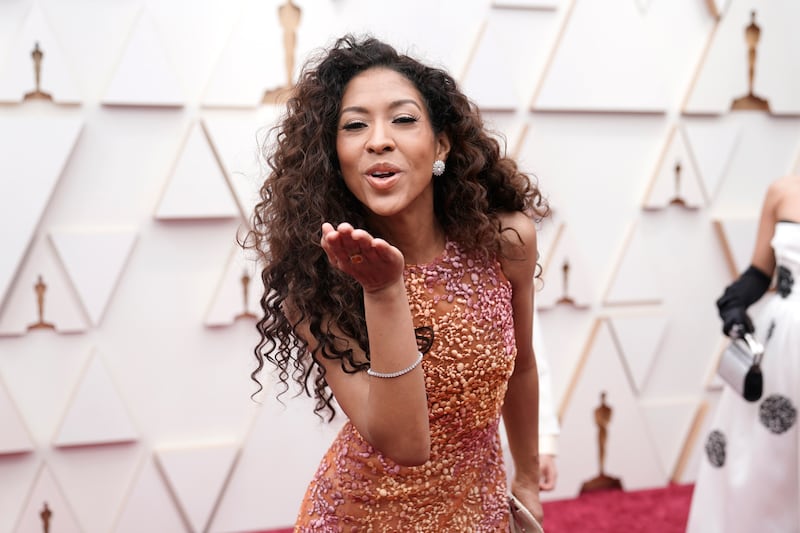
In March 2022, Adassa stepped onto the Oscars stage in a flowing red pleated gown, channeling Dolores Madrigal alongside Megan Thee Stallion, Becky G and Luis Fonsi. That night, “Encanto” won the Academy Award for best animated feature. This all felt out of reach to her as a child: the lights, the glamour, the validation of having finally arrived.
After “Encanto,” opportunities began pouring in. Some came with life-changing money enough to secure her children’s future, but the roles didn’t sit right with her. In one offer, she was cast as the provocatively dressed girlfriend of a narcotrafficker. “I don’t mean to say I get typecast, but in a way I am,” she said. So she started saying no. Those were the opportunities for others, she felt, but not for her.
She no longer thinks much in terms of dreams. “Sometimes, the dream can make you sad,” she said. Instead, she thinks in smaller, more manageable goals, things that can squeeze into the cracks of the chaotic family life.
She’d let go of the fantasy of being both a flawless mother and an artist waiting for perfect creative conditions. Still, she wakes up at 4:30 each morning to pray and study the scriptures before the house stirs awake, and she slips back into mom mode by 6:30. Motherhood is a bit like doing Olympic gymnastics, Adassa told me, doing the things you never thought you could do and being stunned that you can actually do them.
When Candiani moved into the screen at the end of our interview, the affection between the two was bleeding through the screen. Candiani and Adassa go on “grateful walks” together — for 2 miles, they point out birds and trees and talk about what they feel grateful for and what they want to accomplish. He sends her funny reels, they go on picnics, they play music together.
Adassa has now come to see her life as a string of moments of falling in love. “I’ve understood I have to fall in love with my kids and want to know everything that they’ve done,” she told me. “I want to fall in love with life, I want to fall in love with the gospel just like I fell in love with my husband. … But you also need to fall in love with yourself.”

Correction: The previous version of this story inaccurately stated the year that Adassa was baptized into the Church of Jesus Christ of Latter-day Saints.