

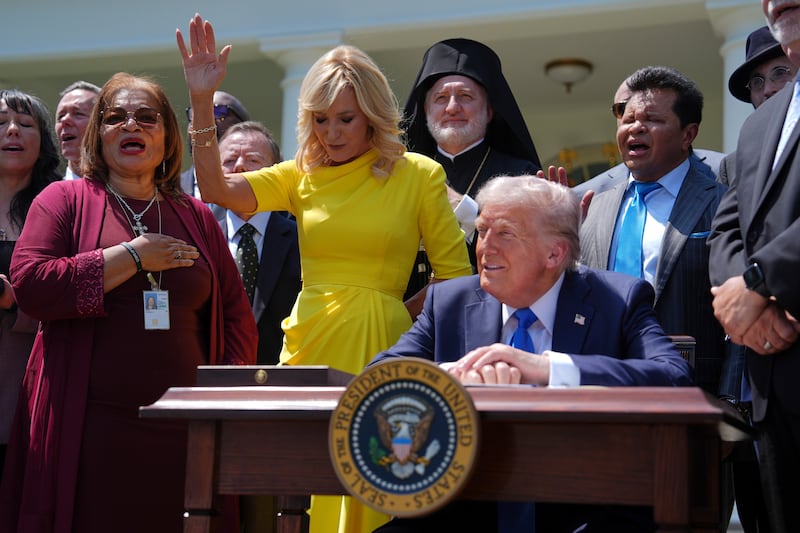

The Trump administration’s effort to elevate the role of Christian faith in public life will culminate Sunday, May 17, on the National Mall in Washington, D.C., where thousands are expected to gather for a daylong celebration honoring what organizers describe as the Christian roots of America’s founding.
The event, titled “Rededicate 250: National Jubilee of Prayer, Praise & Thanksgiving,” is framed by supporters as both a spiritual revival and a patriotic moment ahead of the nation’s 250th anniversary. President Donald Trump has described its purpose as a call to “rededicate America as one nation under God.”
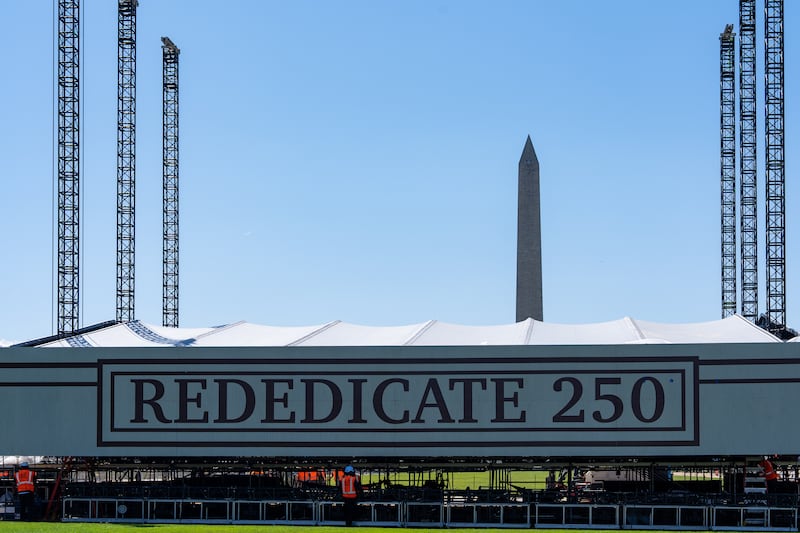
What the White House described as “once in a lifetime faith event” will kick off at 9 a.m. on the National Mall and the program is scheduled to go until 6 p.m. The event is free but requires registration.
The lineup includes members of Trump’s cabinet like Secretary Pete Hegseth and Secretary of State Marco Rubio as well as 19 faith leaders who are slated to speak throughout the day. Most come from Protestant Evangelical traditions, including the Rev. Franklin Graham, the Rev. Robert Jeffress and White House Faith Adviser Paula White. Among other faiths represented are two Catholic leaders, Bishop Robert Barron and Cardinal Timothy Dolan, as well as one Jewish rabbi, Meir Soloveichik. All three serve on Trump’s U.S. Commission on Religious Freedom.
The event has drawn criticism from some faith leaders and historians who argue that Rededicate 250 promotes a narrow vision of Christianity that sidelines other religious traditions in America and appears to be more akin to a political rally than a worship event.
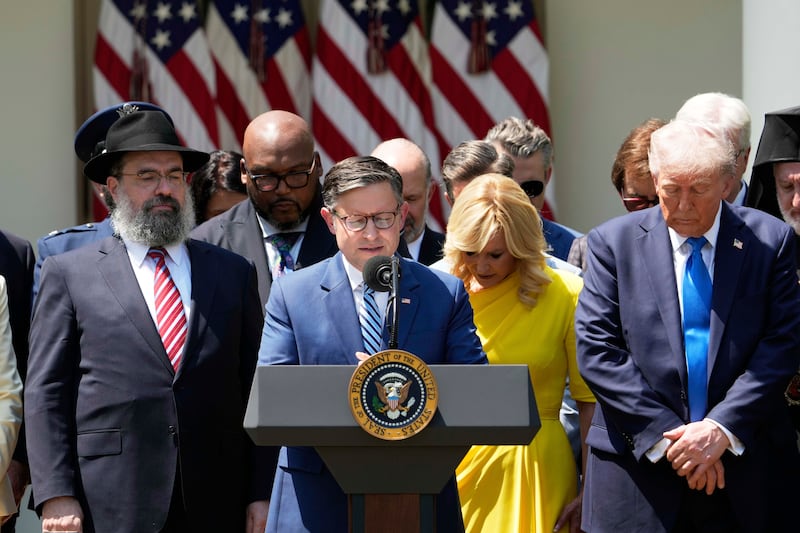
“Rededicate 250 is a betrayal of America’s founding values guaranteed in the First Amendment, which made clear that there should be no establishment of religion by the government, and that each one of us should be free to live out our beliefs in our own way,” said the Rev. Paul Brandeis Raushenbush, president and CEO of Interfaith Alliance, in a media briefing on Friday. “My prayer is that we rededicate ourselves to our Constitution.”
But according to the organizers, the festival is a continuation of the nation’s long tradition of public religious expression and divine origins.
“From the founding of our nation, Americans understood that our rights come not from government, but from God,” according to the statement from Danielle Alvarez, senior adviser for Freedom 250, Trump administration’s initiative to plan America’s 250th anniversary. Organizers consulted faith leaders across the country to create the event, Alvarez noted. “The First Amendment enshrined the freedom of every American to practice their faith freely, and Rededicate 250 will celebrate the fullness of that tradition.”
In light of these competing visions of faith in America, the question is — what does it mean to commemorate the role of faith in the country’s founding, and whose stories and traditions should be part of that celebration?
Debate over role of religion in America
The event arrives at a time when Americans are deeply divided over religion’s role in politics and public life. A new Pew Research Center survey released on May 14 found disagreements along partisan lines over how much Christianity should influence government and law.
Republicans are more likely than Democrats to say that Christianity should be the American official religion — 27% of Republicans subscribe to this view (the number has grown in the past two years.) Fifty-five percent of Republicans believe that the U.S. should not make Christianity an official religion, but should still promote Christian values.
Most Republicans surveyed also said the Bible should have at least some influence on American laws, and about 45% believe biblical teachings should supersede the will of the people when the two clash.
Most Democrats don’t agree with these views. Among Democrats, 66% believe the Bible should have little or no influence on U.S. laws, and 68% of Democrats believe that the government should enforce the separation of church and state. Among the Republicans, that belief is held by 41%.
At the same time, both Republicans and Democrats believe religion is gaining influence in American life. But whether that shift is a welcomed one depends on the political affiliation. Three-quarters of Republicans said religion’s growing influence is positive. Democrats were more divided: 37% viewed religion’s role negatively, while 38% viewed it positively.
Despite those disagreements, the survey also found broad agreement around keeping some distance between religion and electoral politics. Large majorities in both parties said churches should not endorse political candidates from the pulpit and should generally avoid partisan political involvement.
America as a Christian nation
Sunday’s nine-hour festival will be structured around three “pillars”: “Miracles that Made Us,” focusing on the founders’ faith; “The Miracles Still in Our Midst,” sharing personal testimonies of “God’s healing”; and a final pillar expressing collective gratitude for 250 years of freedom.
In recent years, the movement to define America as an explicitly Christian nation has shifted from the periphery of evangelicalism to the public conscience, according to John Fea, professor of American History at Messiah University in Pennsylvania and author of “Believe Me: The Evangelical Road to Donald Trump” and “Was America Founded as a Christian Nation?”
“Trump has brought these ideas and views of history and American identity to the forefront, to the center of power,” said Fea. The speakers represented during Sunday’s event aren’t just Evangelical Christians, said Fea who is an Evangelical Christian himself, but they are supporting Trump’s policies and embedding them with Christian language.
Fea acknowledges that religion played a significant role in America’s founding. “If you want to look for Christianity and the Founding Fathers talking about religion in the 18th century, you can find it, it’s there,” Fea said. “And you can also find things that kind of suggest that they didn’t want to necessarily create a distinctly Christian nation, too.” He pointed to the First Amendment, the separation of church and state and the influence of Enlightenment and classical thought on the founders.
Fea explained that it’s natural for leaders to look for “usable” past, drawing on parts of history that align with a particular worldview in the present. “But that doesn’t mean you’re representing the entire complexity of the time period,” he said. A 250th celebration under a Democratic administration might draw on different historical aspects that are closer to the worldview of the party.
Among various faith groups, according to the recent Pew survey, White Evangelicals are the most likely to say that the Bible should influence U.S. laws and that Christianity should be America’s official religion — 62% believe that the Bible should have more influence than the will of the people and 31% believe that the U.S. should declare Christianity as the official religion.
“We’ve never had a president do this,” said Rev. Franklin Graham in a video address posted on Facebook, referring to the prayer jubilee. While he will be joining the celebration by video, his daughter Cissie Graham Lynch is going to speak in person. “No president in history that I know of has called for a day of rededication and prayer.” He went on: “It will be an incredible moment and it will probably never happen again.”
A home for Jewish people
Rabbi Gilah Langner, president of the Washington Board of Rabbis, believes that Jews have found a home in America because even with the nation’s Christian majority, the U.S. has officially been a secular state.
“We have thrived here because of the separation between the church and state, because of the real equality across religions — that has been so good for my people here in America,” Langner said.
What worries Langner is not so much the Sunday celebration itself, but how tightly the government is involved in endorsing one faith.
Langner was uncomfortable with the president’s proclamation to hold a national Shabbat from sundown on May 15 to nightfall on May 16, she said. The announcement said that “Jewish Americans are encouraged to observe a national Sabbath.”
“I do not want the government telling me or my community how, what we should be doing vis-a-vis Shabbat, one of our core principles,” said Langner. “It’s none of the government’s business — that’s the whole point of the First Amendment.” Langner also took issue with the term “Judeo-Christian,” which she described as dated and “inappropriate at this point.”
Although Judaism and Christianity share historical roots, the term risks flattening the differences between two traditions and portraying Judaism as an extension of Christianity, according to Rabbi Jonah Pesner, director of Religious Action Center of Reform Judaism, who spoke at the media briefing on Friday.
“The word Judeo-Christian just tries to create a mashup, that doesn’t serve Christianity, nor does it serve Judaism certainly, nor does it serve the other religions in America, like the Islamic community,” Pesner said.
Langner recognizes that Christianity has long been the majority faith in the U.S., the involvement of the government in religion changes the dynamic entirely. “It’s a very dangerous fire to be playing with,” she said.
Celebrating faith in America
For historians like Fea, telling the story of faith and America’s founding should center on religious liberty. Fea points to examples such as William Penn and the founding of Pennsylvania in what he called a “holy experiment,” an effort to build a pluralistic society where people of different faiths could live together.
Or the story of Touro Synagogue, the nation’s first synagogue, established in 1763 in Newport, Rhode Island.
“You can think of the way in which the First Amendment has enriched the country by allowing freedom of expression for all religions,” Fea said.
Similarly, Eboo Patel, founder and president of Interfaith America, said that the commemoration of America’s 250th anniversary should celebrate Christianity alongside all other faith traditions.
“We should be celebrating Christians and Christianity, and all of the contributions that Christian communities make to America and have made to America,” said Patel, who is Muslim.
“And we should be celebrating Muslims, and Jews, and Buddhists, and Hindus, and Baha’is, and Jains, and Sikhs, and secular humanists, and atheists, and spiritual seekers.” What’s worth celebrating is not only religious diversity itself, but “the relationships and interfaith cooperation” between all faith groups in America.
“Faith, religious identity and religious diversity ought to be at the center of our public life and our public conversation,” Patel went on. “That is a positive thing, and we ought to do it in a spirit of widening the welcome and strengthening the bonds between people.”
Faith leaders participating in “Rededicate 250″:
U.S. Military Chaplain Corps
- Franklin Graham, president and CEO of Samaritan’s Purse and the Billy Graham Evangelistic Association
- Bishop Robert Barron, bishop of the Diocese of Winona–Rochester and founder of Word on Fire Catholic Ministries
- Cardinal Timothy Dolan, archbishop emeritus of the Archdiocese of New York and former president of the United States Conference of Catholic Bishops
- Pastor Jack Graham, senior pastor of Prestonwood Baptist Church
- Pastor Jentezen Franklin, senior pastor of Free Chapel, New York Times bestselling author, and host of the “Kingdom Connection”
- Pastor Jonathan Falwell, chancellor of Liberty University and senior pastor of Thomas Road Baptist Church
- Pastor Samuel Rodriguez, lead pastor of New Season Church and president of the National Hispanic Christian Leadership Conference
- Rabbi Meir Soloveichik, senior rabbi of Congregation Shearith Israel in New York City
- Dr. Robert Jeffress, senior pastor of First Baptist Dallas
- Pastor Jonathan “JP” Pokluda, lead pastor of Harris Creek Baptist Church, author, and host of the “Becoming Something Podcast”
- Gordon P. Robertson, chancellor of Regent University and president of Christian Broadcasting Network
- Pastor Paula White, senior adviser to the White House Faith Office
- Apostle Guillermo Moldonaldo, founder and senior pastor of El Rey Jesus
- Pastor Lorenzo Sewell, senior pastor of 180 Church in Detroit
- Pastor Lou Engles, co-founder of TheCall and founder of Lou Engle Ministries
- Pastor Gary Hamrick, senior pastor of Cornerstone Chapel and radio host
- Bishop Kelvin Cobaris, lead pastor of New Life Church International
- Pastor Andy Deane, lead pastor of Cornerstone Community Church
- Andy Frank, pastor and worship leader
Other highlights from the Pew report:
- The number of American adults, who report wanting to see Christianity as the official religion in the United States has also grown from 13% in 2024 to 17%.
- The view of religion in public life has been changing even since last year. In the past two years, the portion of those who think religion is gaining influence (about 37% of Americans today) has gone up by 19 percentage points — the highest it’s been in almost 20 years. And those people see it as a positive development. A little more than half, 55%, positively assess the role of religion in public life. Sixty one percent say that religion is losing influence in American life.
- The survey also found that a slim majority of Americans — 52% — believe “conservative Christians have gone too far in trying to push their religious values in the government and public schools.” But 48% of Americans also believe that the political left has gone too far in excluding faith from schools and government. One in 5 Americans agreed with both statements — that conservative Christians and secular liberals “have gone too far pushing their respective points of view.”
- Americans still want to see boundaries between church and politics. Still, most people believe that America should promote “Christian moral values” without officially endorsing Christianity as a state faith. Most people, about 79%, believe churches should not support candidates in elections and slightly less, 66%, think churches should keep politics out of church. “The public’s views on these questions have not changed very much in recent years,” the report noted.
- When it comes to the term “Christian nationalism,” the survey showed that more people are familiar with the term than before, but still most view it negatively (31% of U.S. adults think negatively of it and 10% have a more positive view).