


This article was first published in the State of Faith newsletter. Sign up to receive the newsletter in your inbox each Monday night.
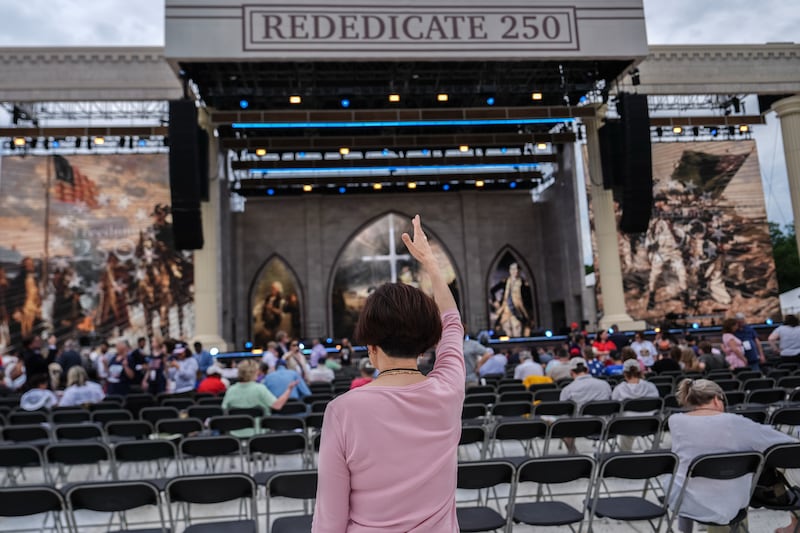
For more than nine hours on Sunday, the National Mall became a sprawling worship service as part of “Rededicate 250: National Jubilee of Prayer, Praise & Thanksgiving,” a government-sponsored event aimed at recommitting the country to God in line with what organizers described as the founders’ original intent.
The stage was framed by pointed Gothic-style arches and attendees spread blankets across the lawn and raised their hands in worship.
The celebration echoed the events of May 17, 1776, when the Continental Congress resolved to call for a national day of prayer and fasting, urging the colonies to seek divine guidance in the fight against Britain.
I thought this image featured in USA Today captured the spirit of the event: a woman in a total spiritual rupture, eyes closed and head tilted backward, wrapped in an American flag and a blue scarf adorned with a Star of David on her neck.
The celebration has been, for lack of a better word, controversial and has stirred a some strong responses from faith leaders, who felt that the worship was lacking the breadth of Christianity and presence of other faiths, and that it eroded the boundary between church and state. Supporters, on the other hand, saw the production as an affirmation of faith in America and a way to trace the roots of the country to “one nation under God.”
Although I hadn’t listened to the full nine hours of the event, the speeches I watched were largely devoid of partisan rhetoric. They blended history vignettes about the nation’s founders praying and relying on their faith in hard moments of the war and evangelical expressions like “Praise God” and “Hallelujah.” Several speakers mentioned the phrase “created equal by God” to trace divine origins of the nation.
Overall, the intermingling of politics and faith felt like a totally new genre of public event — not totally a political rally and not a typical worship service, but something in between.
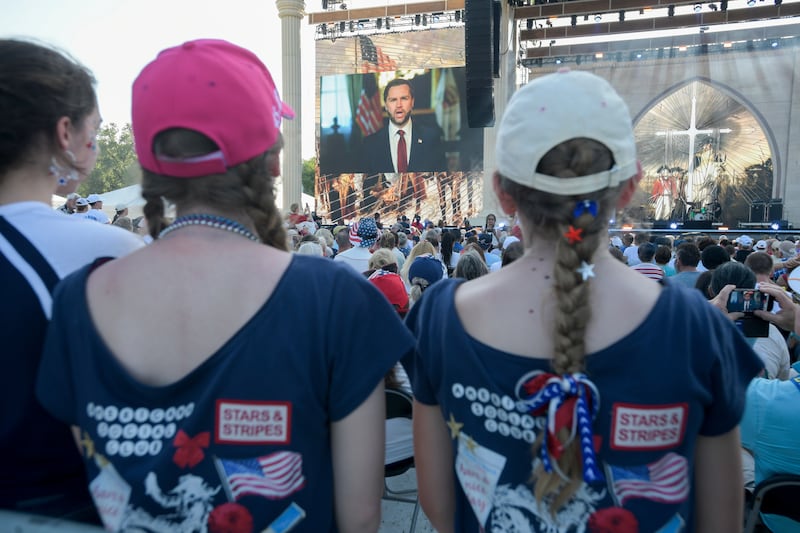
Messages from the stage:
Vice President JD Vance invoked the words of the late Charlie Kirk that “all law reflects morality” and that “law and morality … come from religion.” He went to say that “the morality and religion that formed the American consciousness were decidedly Christian.”
Southern Baptist pastor Dr. Robert Jeffress didn’t shy away from the title “Christian Nationalist,” interpreting it as a blend of patriotism and faith. “By the way, if being a Christian nationalist means loving Jesus Christ and loving America, count me in,” said Jeffress. “They were bold about their Christianity.”
Sociologists like Andrew Whitehead and Samuel Perry, and others, explain that Christian nationalism is more than personal faith or public religious expression, but a view that Christianity should be shaping national laws and national identity.
Trump himself refrained from a more personal message and instead opted for reading from the Old Testament, in particular — 2 Chronicles 7, which describes the dedication of Solomon’s Temple and God’s response to King Solomon after the Temple was completed.
The event featured an appearance by “The Chosen” star Jonathan Roumie, who told the audience that being a voice guide on the Hallow prayer app and his role playing Jesus in the series have taught him to pray. “If God hands you the assignment of portraying on a global stage his own son, the savior of the world, the alpha and omega, the great I am. And you do not have faith. Lord help you.” Roumie nudged people to pray directly to Jesus as opposed to paying “some random app $2 a minute to talk to fake AI Jesus, when the real Jesus is right in front of you.”
Rabbi Meir Soloveichik, the only non-Christian speaker, shared the history behind the song “God Bless America” written by Irving Berlin, a Jewish songwriter who fled pogroms in Russia and discovered his musical talent while serving in the U.S. Army. The 1938 song became a kind of anthem for American soldiers liberating Europe from fascism. “And it is a reminder as hatred of Jews makes itself manifest again that antisemitism is utterly un-American.”
Bishop Robert Barron, one of two Catholic speakers at the event, argued that Abraham Lincoln’s “theological addition” of “under God” in the Gettysburg Address reflected the belief that “God is essential to any coherent account of democracy, freedom and equality.” Barron said the idea that all men are “created equal” points to divine origins, making all people “equally children of God and therefore equal in dignity” and endowed with inalienable rights.
He also linked freedom to dignity and love: “If you’re forced to love, you’re not really loving. Freedom is required for this.” Barron distinguished between “freedom of indifference” and “freedom for excellence,” which he described as the disciplining of desire toward “the good.”
Trump’s ballroom made an appearance in Eric Metaxas’s speech: after mentioning that the White House was destroyed in 1812, he then invoked Trump’s grand project: “It’s hard to believe that it would take two centuries for the Lord to raise up a great man to bring that ballroom finally to stand where it needs to stand. … We only had to wait 200 years.”
Several interfaith leaders, who discussed the event in a Friday media briefing, said they did not oppose celebrating Christianity or faith and acknowledged the role of faith in the country’s founding — but that the celebration appeared to elevate one strand of Christianity in an especially prominent, government-sanctioned way, sidelining the foundational principle of religious liberty.
Fresh off the press
- I wrote more about the National Mall jubilee, ahead of the event, and what the Jewish community and other interfaith leaders had to say about it.
- Opinion: Who is to blame for the decline in ‘marriageable’ men?
- Analysis: Harvard Global Flourishing study compares Latter-day Saints with people of other faith and no faith
The Vatican and Anthropic joining forces
Much of the thought about AI’s moral and ethical direction has been coming from the Vatican. There was the Vatican’s “Rome Call for AI Ethics” with tech leaders and the “Minerva Dialogues,” a series of meetings bringing together scientists, philosophers and engineers to discuss how the emerging technologies are changing the world. Pope Leo XIV has made AI one of the central issues of his papacy.
On May 25, the Vatican will publish Pope Leo’s first major teaching document — an encyclical titled “Magnifica Humanitas” — “magnificent humanity” in Latin. The encyclical will focus “on the Protection of Human Dignity in the Age of Artificial Intelligence,” according to EWTN News. The timing is symbolic.
Pope Leo signed the document on May 15, which is the anniversary of Pope Leo XIII’s encyclical on labor and capital ahead of the industrial revolution.
The Pope is expected to present the teaching personally, which experts noted is unusual for a Pope, along with a series of cardinals and professors, as well Christopher Olah, co-founder of Anthropic — also an extremely unusual choice.
The company has recently turned to faith leaders to better understand how to draw on wisdom traditions to shape its chatbot Claude’s understanding of ethics and morality.
Anthropic has also sued the Trump administration after the Pentagon deemed the company a national security risk and prompted restrictions on its access to certain government contracts and procurement channels.
“Pope Leo XIV has chosen them as his partner anyway — not in defiance of the Trump administration, but to show that there are willing partners in Silicon Valley ready to work with the Church for the good of humanity,” writes Christopher Hale.
Over the weekend, the Vatican also announced that it would create an in-house study group on AI, according to National Catholic Reporter.
When I interviewed Meghan Sullivan, philosophy professor at the University of Notre Dame for this story, she told me that the Catholic Church has a wealth of social and moral teachings that can be helpful to technologists as they shape AI for the human good.
“And this is where I think faith communities also have something to offer — we care about safety, but we care about a whole lot more than safety,” Sullivan told me.
More on faith
- How one Christian fertility doctor in Knoxville, Tennessee, has handled ethical IVF dilemmas and is helping Christian couples navigate treatment and pregnancies. — AP
- The latest report from the Pew Research Center dove into public perception of how the role of religion is changing. It found that both Republicans and Democrats believe that religion’s role has increased in public life, but they disagree on whether it’s a good or bad thing. — Pew Research Center
- One theory behind the growing popularity of the Catholic faith among young people is more about lifestyle, fashion and, well, vibes. More on Clavicular, Gen Z and Catholicism:
- One Catholic diocese in Connecticut will be using an AI tool — they call it the “worldʼs first virtual engagement officer” — to help out with fundraising, where the tool will be asking parishioners for money.-—EWTN
End note
Next week, The State of Faith will be off for Memorial Day. I’m hoping to get some packing done for my upcoming move to Utah and maybe even sneak away to the beach with my children.
Lately, I’ve been thinking about the connection between rest and spirituality, especially through the lens of the Sabbath. Across many faith traditions, it’s a time set aside not only for God, but also for rest and renewal. But what does it actually mean to rest? And what kind of rest makes lays the ground for an experience of awe and transcendence?
I’d love to hear from you: What does a day of rest look like in your life? Are there particular rituals or practices that help you slow down and recharge?
Send me a note at mmanzhos@deseret.com