

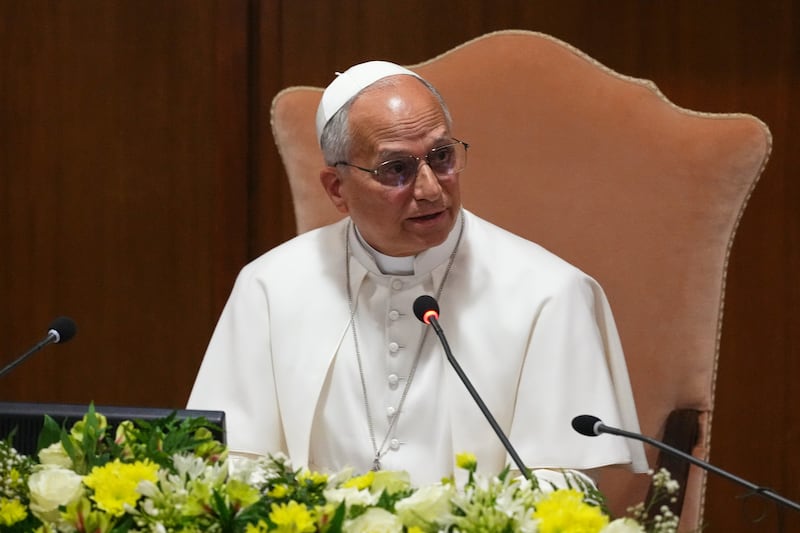

In a document spanning nearly 42,000 words, Pope Leo XIV warned that artificial intelligence poses a growing threat to human dignity and human equality, calling for stronger regulation and a more balanced approach to developing AI technologies that keeps human dignity at its center.
Pope Leo urged technologists and political leaders to remain committed to building AI “for the common good” while embracing human limitations and weaknesses “without considering them an error to be corrected.”
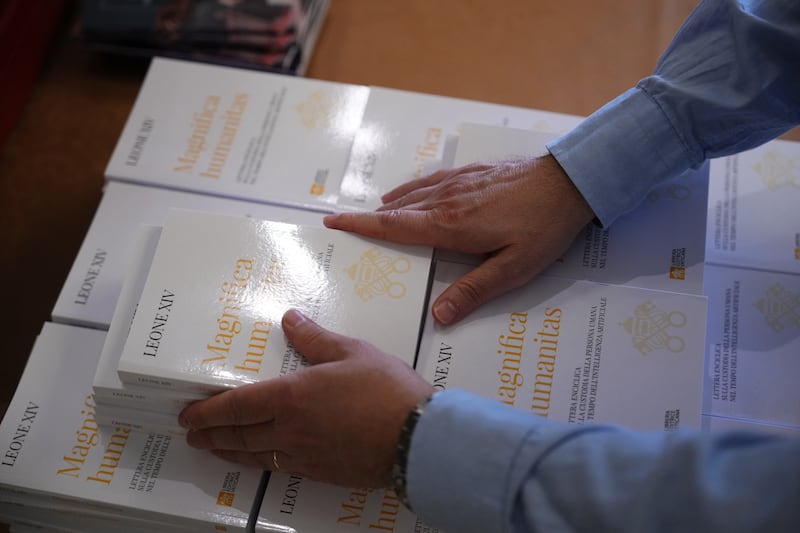
The comprehensive document called “Magnifica Humanitas” or “Magnificent Humanity” touched on AI’s impact on nearly every pillar of a healthy society — equality, the environment, democracy, employment, education and parenting, among others.
Pope Leo grounded his first encyclical, officially titled “On Safeguarding the Human Person in the Time of Artificial Intelligence,” in the concepts of human dignity and “the common good.” The document builds on and frequently quotes the teachings of Leo’s predecessors, including Pope Francis, Saint John Paul II and Pope Leo XIII.
In the introduction, Pope Leo framed his teaching about AI in two biblical stories. The Tower of Babel offered a warning: When human beings pursue power and self-sufficiency without reference to God or one another, the pursuit could lead to confusion and collapse. Nehemiah’s rebuilding of Jerusalem shows the opposite approach: a prayerful and collaborative work where every person plays a role, with the goal of restoring relationships and community. Leo framed these examples as a choice that societies are up against when approaching the development of AI tools.
“The primary choice is not between ‘yes’ or ‘no’ to technology, but rather between constructing Babel or rebuilding Jerusalem; between a power that claims to dominate the heavens and a people who work together in the presence of God to rebuild the wall of fraternal coexistence,” Leo wrote.
In simulating a human, AI-generated communications are merely an appearance of relationships and risk turning people away from “genuine human connections.” Leo also highlighted AI’s environmental costs, warning that its enormous demand for energy and water contributes to rising carbon dioxide emissions. He called for the development of more “sustainable technological solutions.”
Emerging technologies, including AI, are not neutral, he explained. “They can either foster participation and justice or exacerbate inequality, control and exclusion,” Leo wrote. “For this reason, they must be evaluated by asking a crucial question: Do they truly help individuals and peoples to become more humane and fraternal, while respecting our common home and future generations?”
Leo’s first encyclical — a formal letter written by the pope and addressed to the Catholic church — is symbolic. Leo signed “Magnifica Humanitas” on May 15, the same day that 135 years ago Pope Leo XIII issued his first encyclical “Rerum Novarum” on capital and labor that defended workers’ rights during the first industrial revolution. Pope Leo chose his papal name partly in honor of Pope Leo XIII, whose encyclical has become the foundation of the church’s social teaching.
Leo’s encyclical drew, too, on the social doctrine of the Catholic church and its key principles of the common good, universal destination of goods, of subsidiarity, solidarity and social justice.
Leo’s sprawling document is broken down into five chapters and details both the perils of the technology and its promises in society formation, governance, education and employment.
Leo also expressed concern about transhumanism, which envisions a “salvation” made possible by technology and apologized for the Vatican’s complicity in slavery. “It is impossible not to feel deep sorrow when contemplating the immense suffering and humiliation endured by so many in stark contrast to their immeasurable dignity as persons infinitely loved by the Lord. For this, in the name of the Church, I sincerely ask for pardon,” Leo wrote.
But he warned against the new form of colonialism, in which those who hold wealth and power harvest data from vulnerable populations without consent.
To correct the course, he called for transparent supply chains and ethical standards for companies and investors and joint commitment to refuse exploitation. “Furthermore, digital platforms must cooperate responsibly with authorities and civil society to prevent communication, payment and profiling tools from becoming channels for the recruitment and control of victims,” Pope Leo wrote.
Leo’s presentation of encyclical was notable given the presence Christopher Olah, co-founder of Anthropic, who played a key role in shaping Claude, Anthropic’s large language model.
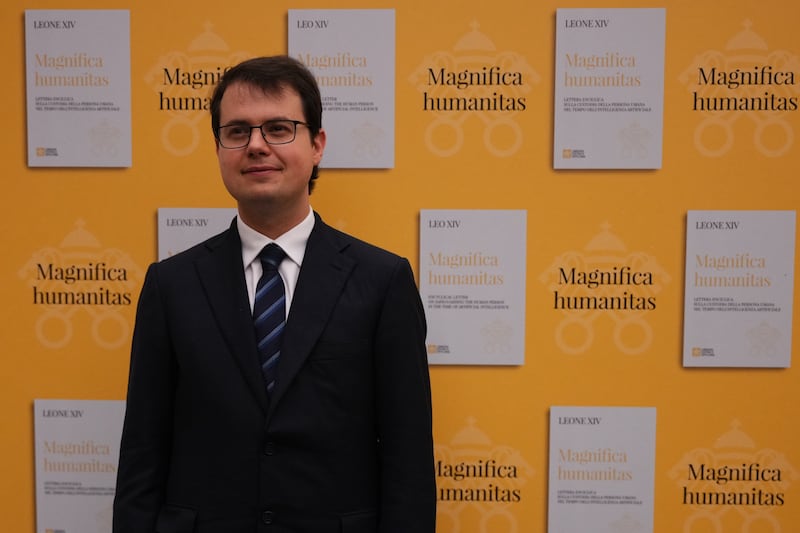
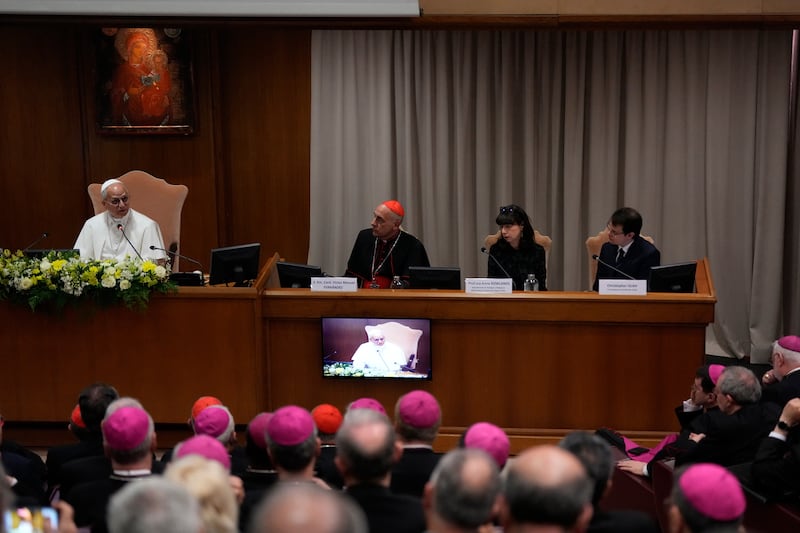
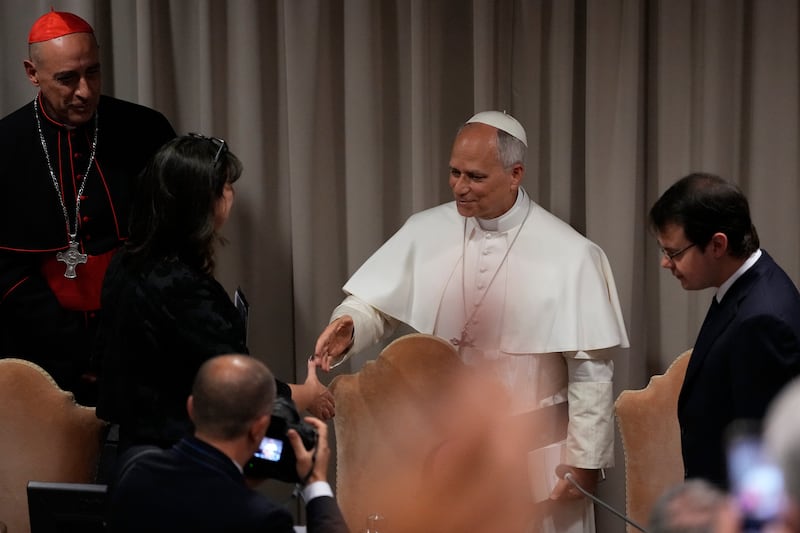
During the presentation at the Vatican Synod Hall on Monday, Pope Leo turned to Olah and thanked him for accepting the invitation to be there and extended a wider invitation to the AI community to continue the joint dialogue with the Vatican.
In his keynote, Olah acknowledged geopolitical and economic pressures of Anthropic and welcomes perspectives of those “outside those incentives.” “It is through dialogue and mutual effort through the push and pull that humanity will achieve great things,” Olah said while speaking on a panel alongside Pope Leo, two cardinals and two professors.
There is no good mechanism for distributing the “gains” of AI beyond the wealthy nations that benefit from it, Olah said.
Matthew Harvey Sanders, CEO of Longbeard and creator of Magisterium AI, a Catholic AI tool, was in the room during the presentation. “That was remarkable to see the pope turn to a head of an AI lab and say: ‘Let’s, let’s talk, and let’s work on this problem together,’” Sanders said.
Anthropic’s resident philosopher Amanda Askell was also in the room, Sanders said. “I think all of us realized that history was being made, which was very humbling,” Sanders said. “We’ve been waiting for something like this for so long.”
The encyclical is more than just the pope’s first teaching, Sanders said, but a signal and direction of where Pope Leo wants to take his papacy. Sanders found the encyclical to be about a broader vision for civilization and the role that AI plays in it. “ What kind of guardrails do we need to put in place in order to ensure that human beings flourish? And I think that’s exactly what the encyclical accomplished.”
Morality of AI tools
AI tools aren’t inherently objective and “morally neutral,” Leo wrote, but reflect the worldview and culture of the designers and developers who create them. When algorithms decide who gets opportunities or resources, no human is actually accountable for those decisions.
This creates a problem: Injustice gets hidden behind the “veneer of neutrality” and “objectivity,” making it hard to challenge. In this process, human responses to suffering like compassion, mercy and forgiveness could get dismissed entirely.
“The moralization of machines” or aligning AI with human values, Leo argued, is not sufficient. “A more moral AI is not enough if that morality is determined by a few,” he wrote. “What is needed is a more active political involvement that is capable of slowing things down when everything is accelerating, and of protecting the opportunities for communities still to be able to participate and ask questions.”
Call to ‘disarm’ AI
Leo called “to disarm” AI, or dismiss “the assumption that technical power automatically confers the right to govern.” The term doesn’t mean a rejection of technology, but it invites an approach to AI in which these tools don’t dominate humanity and monopolizes control.
Leo emphasized the need for stronger regulation, while making sure that AI remains “welcoming and accessible.”
“Ownership of data cannot be left solely in private hands but must be appropriately regulated,” he wrote.
In a call to the developers of AI, he compared innovation to “the divine act of creation” and emphasized both ethical and spiritual responsibility of the technologists behind this work.
Morality of AI
In the section on artificial intelligence, Leo explained the limits of the technology. While AI excels at imitating language, analytical skills, and even empathy, it lacks “rational and spiritual perspective” and the powers of AI are largely confined to data processing. “So-called artificial intelligences do not undergo experiences, do not possess a body, do not feel joy or pain, do not mature through relationships and do not know from within what love, work, friendship or responsibility mean,” he wrote. “Nor do they have a moral conscience, since they do not judge good and evil, grasp the ultimate meaning of situations, or bear responsibility for consequences.”
The shaping of AI, he argued, should be guided by “clear criteria and effective oversight,” including involvement of communities and various organizations.
Against technocratic vision
Pope Leo cautioned against elevating the value of efficiency as a way to measure someone’s value. While the technocratic vision wants people to see themselves as projects to be optimized, he called for a vision of “persons called to relationship and communion.”
He drew attention to the concepts of “transhumanism” and “posthumanism” that ultimately see human limitations as problems that need to be fixed. He contrasted the use of technology as something that keeps humanity at the center and is governed by a “relational vision” and a view that “devalues human limits.”
“If the human being is treated as something to be perfected or surpassed, it becomes easier to accept that some lives are less useful, less desirable or less worthy,” Leo wrote.
The case for human limitations
Pope Leo spent several paragraphs explaining why perceived “limitations” of human experience — such as illness, suffering and old age — are aspects of life to be experienced and not erased. Today, these parts of life are viewed as defects, he wrote, instead of “a reality through which our humanity matures and opens itself to relationship.”
He acknowledged the importance of alleviating the suffering but also said it was important to embrace “our fundamental finitude.” It is these limitations that create space for compassion, generosity, wisdom and closeness with God. Instead of rejecting these limitations — suffering, failure and disappointments — Leo invited believers to integrate them alongside life’s joyful experiences. “It is only thanks to the interplay of these elements that the wonders of the soul occur within us, allowing us to sense the richness of our humanity.”
Embracing finitude allows humans to recognize dignity in others and grow closer to God, he wrote.
On democracy, truth and education
AI and social media have made it much easier to spread false or misleading information. But truth is essential for democracy, Pope Leo writes. A healthy democracy needs more than rules and elections — it needs people who actually care about what is real and what is good. Disregard for truth, he noted, can lead to totalitarianism. “When questions about what is true lose their appeal, and a pragmatism takes hold that is content with what appears useful or effective, then democratic life is weakened,” he wrote.
He emphasized that truth is a common good and “not the property of those with power or influence.” He called for an alliance between policymakers, educators and families to begin forming policies that help protect children from harmful content on the internet and “creating protections against all forms of online sexual exploitation and violence.”
‘Hearts that love the truth’
In conclusion, Leo brought the focus back to humanity. He invited people to “cultivate hearts that love the truth,” “prefer what is right” and “pursue wisdom” amid the abundance of temptations online. He invited the believers to cherish in-person experiences like collective meals, Christian gatherings and visits with the sick.
“No computational system, however sophisticated, can create a heart that gives itself, or a conscience that discerns good from evil,” Pope Leo wrote. “Even when machines excel in efficiency, a human face that asks to be gazed upon remains the center of our history.”