


The last thing we expected in attending “The Gen-Z Debate with Harry Sisson and Isabel Brown” at the University of Virginia was that these ideological opponents would find common ground on the family. But a sharp exchange on feminism, family and marriage between the conservative Brown and the progressive Sisson ended on a surprising note of consensus.
Brown, a popular host for The Daily Wire, began the back-and-forth on family and feminism by saying that she had been attacked by the liberal hosts of “The View” for saying that “the best way to promote the human flourishing we’ve so desperately been missing in Western civilization is to have the courage to get married and have children.”
She went on to argue that feminists are telling women that “children will hold you back. They will destroy your career. They will destroy your relationships. They will destroy your friendships and so much more.”
Her broader point at the debate, sponsored by The Free Press, was that the political left is now a vehicle for anti-family messaging and values that are discouraging Americans, especially young women, from embracing marriage, motherhood and family life.
But Sisson’s response was striking. A Gen Z progressive commentator with 2 million TikTok followers, he was having none of Brown’s argument.
While embracing the mantle of feminism (“everybody should be feminist,” he said), Sisson disputed Brown’s claim that ordinary young adults on the left are anti-marriage or anti-family. He also rejected the idea that they are taking their marching orders from the most family skeptical voices on his side of the aisle.
“I don’t think anybody’s going to ‘The View’ or ‘Cosmopolitan’ to decide whether they want to have kids or whether they want to have a wife or a husband,” he said, adding, “You’re using these extreme examples of people in media who obviously have an incentive to get the most anger out of you.”
Ordinary liberals have nothing against marriage and family, according to Sisson, who said he doesn’t know any Democrats who say, “I don’t want to have kids. I don’t want to be a wife.” He went on to underline his personal desire to get married and have children, saying, “I’m a Democrat. I want to be a husband. I want to be a father one day.”
He then asked the dozens of UVA students at the debate — students who spanned the ideological spectrum from left to right — if they wanted marriage and a family for themselves. And it looked like everyone raised their hands. The seemingly universal interest in marriage and family from an ideologically diverse Gen Z audience lent credence to Sisson’s assertion that, outside the hothouse of some progressive media circles, ordinary liberals are not actually opposed to marriage and family.
Sisson is not alone in making this claim. Liberal journalist Matt Yglesias, who writes the Substack “Slow Boring,” recently conceded that “it’s true that there is a fair amount of marriage-skeptical content in highbrow media, and it’s almost all woman-focused.”
But like Sisson, Yglesias argued the anti-marriage vibes don’t translate into real-world behavior, at least not for the college-educated. Plenty of liberal grads, he pointed out, are still putting a ring on it.
Our recent marriage problems are really about class and not culture wars, according to Yglesias, and they especially involve the failings of working-class men who lack the smarts, conscientiousness and “financial and emotional stability” of their better-educated peers.
Yglesias is right to point to the class divide in marriage. It’s real. As shown in the recent book, "Get Married," a clear majority of college-educated Americans are married, compared with only a minority of the less-educated. But there’s a second divide that contradicts Sisson and Yglesias’ messaging on marriage: liberals have problems when it comes to embracing the beliefs and behaviors that make for a strong marriage culture.
Why are some liberals against marriage?
Over the past half century, elite liberals have led the cultural charge to devalue, deny and discount the institution of marriage. The anti-nuptial messaging, largely targeting women, continues today in mainstream media venues like Bloomberg (“Women who Stay Single and Don’t Have Kids are Getting Richer”), The New York Times (“Married heterosexual motherhood in America. . . is a game no one wins”) and The Washington Post ( “Divorce led me to my happily ever after”).
In fact, Yglesias himself once wrote a piece titled “The ‘decline’ of marriage isn’t a problem.” Messaging like this has poisoned our national appreciation of the values and virtues that sustain a strong marriage culture — and it has done so most thoroughly in left-leaning, college-educated circles.
That’s why liberals now face a marriage problem of their own.
No group of Americans is less likely to say marriage matters than liberals, especially the college-educated. Among college-educated liberals aged 18–55, only 30% agree that children are better off with married parents — barely 1 in 3. Even liberals without college degrees are only slightly more marriage-minded, at 36%.
Conservatives, by contrast, continue to understand the importance of marriage: More than 70% — and especially the college-educated — say marriage matters for children.
The most privileged liberals have become the most publicly dismissive of marriage’s cultural value.
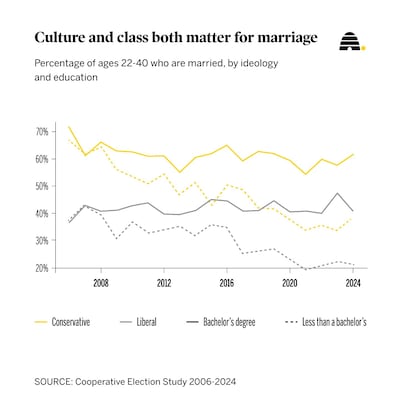
Even though elite liberals like Yglesias tell us that marriage’s sagging fortunes are all about class — especially the failures of working-class men — the evidence tells us that culture also matters here.
Liberals are less likely to be married than conservatives. This is true for both college-educated and less-educated Americans, as data from the General Social Survey show. College-educated conservatives aged 22-40 are 50% more likely to be married than their liberal peers, and college-educated liberals have similar marriage rates to conservatives without a college degree.
After controlling for education, race, ethnicity and age, for instance, liberal men and women aged 22-40 are 28% less likely to be married today than their conservative peers, according to the survey. Today, a majority of conservative men and women are married, and a majority of liberals are not.
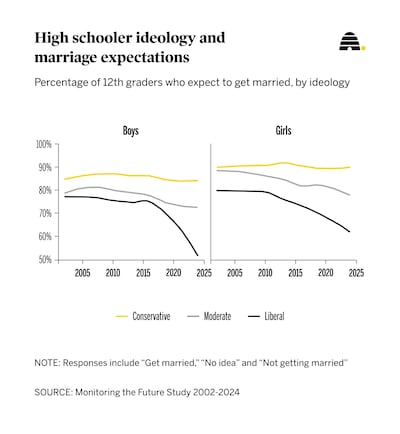
The values and virtues advanced by liberal institutions are much less marriage-friendly than those promoted by conservative ones. This helps explain why support for marriage is plummeting among liberal, but not conservative, teens.
Since 2010, expectations of marriage have dropped a staggering 16 percentage points among liberal teens, according to the Monitoring the Future Study. In pushing anti-nuptial ideas on left-leaning social media platforms, the digital revolution is clearly eroding interest and expectations of marriage at a rapid clip among liberal teens.
Unmarried young adults are less happy
What these young liberals haven’t been taught is that marriage remains a powerful predictor of living a meaningful and happy life — indeed, increasingly so for both conservative and liberal adults. Recent declines in young adult happiness have been greater for unmarried adults, according to the General Social Survey.
In 2000, more than 90% of young married men and women aged 22-40 were happy with their lives, compared to slightly more than 80% of their unmarried peers. But that happiness gap has surged since 2000, with unmarried happiness falling precipitously for young liberal singles.
Meanwhile, liberal young men and women who are married have remained happy at much higher rates. Clearly, liberal and conservative young adults who are married are markedly happier with their lives today, a point that Isabel Brown drove home in The Free Press debate.
That’s why the most surprising moment of the debate may also be the most instructive one. When Sisson asked an ideologically mixed room of students whether they wanted marriage and family for themselves, nearly every hand went up. The consensus he and Brown stumbled onto is real, but it won’t survive contact with the cultural headwinds unless liberals do their part.
Renewing marriage in America will take more than helping working-class men level up. It will require helping liberals see that marriage and family are not obstacles to human flourishing but powerful vehicles for it. This will require prominent liberals to push back against progressive journalists and influencers peddling lines like “The worst thing a woman can do, statistically speaking, is to get married to a man.”
Bridging America’s marriage divide will require data-driven liberals — pundits like Harry Sisson and journalists like Yglesias — to be willing to confront their own side, more boldly and more honestly, with the truth about marriage and family.
After the exchange at the debate, Isabel Brown said, “We deserve to be happy as a generation. We deserve to find purpose.”
Purpose and happiness are most likely to be found from getting married and starting a family, said this conservative Gen-Zer who is also a married mother.
The UVA students who raised their hands at the debate, saying that they too want to get married and start a family, are waiting for more liberals like Sisson to say and do the same.
Brad Wilcox, Distinguished University Professor of Sociology at the University of Virginia and senior fellow at the Institute for Family Studies, is the author of "Get Married: Why Americans Must Defy the Elites, Forge Strong Families, and Save Civilization." Grant Bailey is Research Fellow at the Institute for Family Studies.