

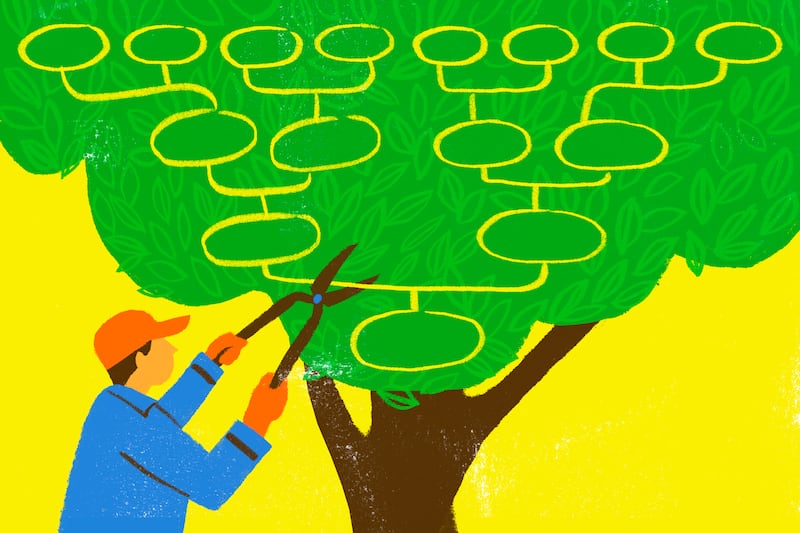

For children who have faced “unimaginable horrors” from parents, strong boundaries may be crucial to healing, therapist Geoff Steurer says. But the majority of parents are “absolutely good enough to work through challenging stuff with their kid,” he told the Deseret News, noting that “there are very few instances where you would need a complete cutoff from a parent.”
If that’s true, someone ought to tell the many grown children cutting off their parents nowadays — numbers that are rising compared to previous years.
In my reporting on the growing backlash against aggressive boundary setting, I’ve always made clear that boundaries can also be absolutely crucial. No one wants an abuse victim to feel like they need to keep “forgiving” or “reconciling” when that places them in danger of ongoing harm.
But it wasn’t until reading some remarkably divergent stories being shared online — all with the same “boundary” language — that a lightbulb went on: We’re simply not talking about the same phenomenon here.
See for yourself, in two responses to a New York Times commentary, “Cutting off your parents isn’t the answer.”
First scenario: Protecting against an abusive parent
Marie in North Carolina described fellow baby boomer peers who sought distance from parents by moving away from home and “dang sure didn’t let their parents near their own children.”
These people would give explanations like “Dad was a hard man to live with,” which was code for “Dad was an alcoholic who beat the snot out of us,” she wrote.
“What about the person who has been belittled or abused by a family member their whole life?” asked another in the same comment thread. The commenter, CM from Boston, wrote that their experience working as a therapist included hours of helping people who had experienced “horrors” at the hands of family members.
One commenter, Pk from Atlanta, referenced “years of emotional abuse” from their mother. “Sometimes cutting ties is self preservation,” they wrote.
Second scenario: Rejecting an imperfect parent
In the same comment thread, Susie Smith wrote from Portland, Oregon, “My adult daughter is a good person — she has gone out of her way in life to serve others and to be a good friend, wife, mother, co-worker and relative. We have been good, supportive parents, not perfect, but certainly not abusive, neglectful, addictive, or disapproving.”
Smith noted how she and her husband had supported their daughter “financially, emotionally, and in every other way in every goal she ever had for her life. We love her unconditionally.”
But their daughter cut them off, just like other grown children who have labeled their parents’ beliefs or personalities as “toxic” or psychologically harmful.
“It has been unbelievably painful to be cut off in this way,” Smith lamented. “It has been hell for us; there is not a minute when I do not feel extreme sadness and disappointment.”
5 trauma experts break down the difference
One of these things is not like the other. While the first scenario reflects understandable self-protection potentially crucial for healing, the other is more likely to expand hurt in its rejection of a workable relationship with someone imperfect.
How else are these “boundary setting” experiences different? According to several therapists and trauma experts, there are several clear ways to differentiate between the two.
1. Strengthening vs. diminishing
When a grown child goes into a sweat when they’re around their parents due to “trauma reverberations” from the past, that’s a physiological sign of something concerning happening, therapist Mark Chamberlain said.
In that case, continuing those interactions can send someone back into their life exhausted.
However, this is very different from the strength that can come from working through a challenging interaction or situation with an imperfect parent. Although it can be tempting to rely on space from a challenging relationship and “stay in a self-affirming place,” therapist Geoff Steurer said, this choice “limits their own growth.”
“Cutting yourself off from the vine of your family and people who have loved and committed to you forever,” he said, “it diminishes us.”
Noelle Mering, author of “No Contact: How a Seductive Ideology Broke Families and Friendships and How We Can Repair Them,” told the Deseret News that such avoidance can negatively affect the rest of your life.
“Avoidance breeds more avoidance,” Mering said. “The more we avoid relationships that challenge us, the more our capacity to navigate the inherent frictions of life diminishes.”
2. Clumsy vs. cruel parents
“Yes, some parents are genuinely abusive,” Christina Buttons wrote in her story about cutting off her parents for several years. “Some family relationships should end. Mine was not one of them. My parents made mistakes — as did I — but reducing our relationship to its worst moments gave me a distorted picture of the whole.”
Families inevitably produce conflict, Buttons reflected. “Parents inevitably disapprove of their children’s choices, lose their tempers, make mistakes, and say things they regret.
“Children do the same,” she added. “If people are taught to perceive these experiences as evidence of psychological harm, normal family relationships will never survive.”
“Most parents are clumsy, immature, and need opportunities to look at patterns and have conversations and stay in dialogue,” Steurer likewise said. “But I just don’t see that there’s a lot of distress tolerance anymore for having these kinds of conversations.”
3. Protecting against real harm vs. uncomfortable disagreement
No one disputes there are times and places where clear boundaries are needed and lifesaving. But Mering says that in many families she interviewed about being cut off, the “fundamental harm was one of disagreement.”
She sees this as reflecting a broader culture that insists belief can be a type of violence.
“One is about safety, and one is about immaturity,” therapist Jeff Ford suggested after reviewing these contrasting scenarios. “We don’t know how to handle the feelings in our body when someone doesn’t feel the same way we feel about something. That’s a lack of maturity, 100%.”
Mering compared this inability to tolerate disagreement to an autoimmune disease. In this case, our emotional self-protective system does not discriminate between a legitimate threat and “the normal friction of human relationships,” she said.
4. Old vs. expanded definition
Therapist Joshua Coleman, author of “Rules of Estrangement: Why Adult Children Cut Ties and How to Heal the Conflict,” highlighted two different definitions of trauma at play here.
Compared with an earlier, more targeted definition of emotional and physical harm, he said “there’s been an enormous expansion of what gets labeled as harmful, abusive, traumatizing, neglectful behavior” — citing Nick Haslam’s 2016 article, “Concept Creep: Psychology’s Expanding Concepts of Harm and Pathology.”
The proliferation of new diagnostic labels, he said, provides “many things to use as evidence against somebody,” such as “they’re a ‘narcissist’ or a ‘borderline’ or they’re a ‘gaslighter’ or ‘emotionally immature’ or whatever.’”
“Younger generations are using this kind of more contemporary definition of harm,” Coleman says, “whereas older generations are using this older definition of harm, which is more accurate.”
5. Due diligence vs. ideological haste
“How exactly are you considering cutting someone off?” Mering asked. She suggested that the way people approach this decision can be reflective of whether something healthy or hurtful is taking place.
For instance, are people seeking out objective voices who might raise other perspectives on the relationship? And “does it truly feel like I’m doing everything possible?”
Mering added, “Does it feel like we’re trying to examine our own conscience with real rigor to own what we can own in the relationship?”
All are good signs of a healthy process. By contrast, be wary of a black-and-white narrative or insistence that their decision must be seen as “unassailable and unimpeachable that no one could push back on it.”
Mering cited popular rhetoric promoted on social media that “if someone questions you, that person is toxic as well — that’s a sign that they are not safe either.”
Cherishing forgiveness, gratitude and family
Mering describes the no-contact movement as “an inversion of the commandment to honor father and mother — that we actually have duties to one another that are reciprocal as we get older.”
For those who go down this path, she added, “forgiveness starts to look like a type of weakness.”
This Christian author hopes people will recognize the no-contact movement as “a new way of disintegrating us” and more actively resist this “social contagion — one that preys upon our universal human temptations toward a negativity bias and being more grievance-oriented than gratitude-oriented.”