

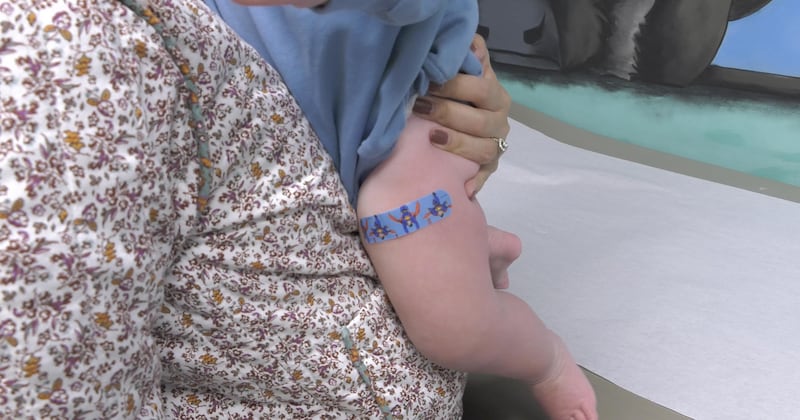
Dr. Per Gesteland said he can see a difference in how many infants are being admitted to Primary Children’s Hospital with RSV, respiratory syncytial virus, in the last two years due to a push to increase vaccinations.
The hospital system’s efforts have helped Utah lead the nation in the number of babies protected against RSV, with twice as many expectant mothers opting for the vaccine before their babies’ birth, Intermountain Health said in a statement on Wednesday.
Gesteland, director of acute care services for Intermountain Children’s Health, said he has been through many respiratory seasons, and although it is routine for him, it is not for the infants’ families or trainees who are not used to watching a baby in respiratory distress struggling to breathe, eat and needing to be sedated for medical care.
“It’s very traumatic, especially traumatic on the parents and families,” he said.
He said RSV season also causes stress to the health care system as intensive care admissions increase, and hospitals need to turn away patients who are less sick or older.
“Last year felt a whole lot better, and this year’s already starting to feel a lot better compared to prior seasons,” he said.
Making an impact
Carolyn Reynolds, executive director of the ambulatory clinical program at Intermountain Children’s Health, said implementing newly approved medications and systems can take 15 years, but Intermountain Health decided it was important to put this one into practice more quickly.
In 2023 — the year the RSV vaccines were approved — Intermountain Health launched a major campaign to promote RSV vaccinations for pregnant women and newborns, but realized the system lacked supply and scaled back the campaign. In 2024, however, it was ready, and the system has made a significant push through both 2024 and 2025 to educate families about RSV vaccines.
“If we know something’s going to work, and we have the science behind it, what can we do to jump on it and try to do it as quickly as we can?” Reynolds said. “And I would say, within the last two seasons, we’ve been able to show that we can make an impact.”
Intermountain Health is encouraging vaccinations in three different ways:
- Pregnant women can be immunized in their third trimester with the maternal RSV protection Abrysvo, passing immunity to their babies within two weeks.
- Babies born during the RSV season can be immunized in the form of Nirsevimab monoclonal antibodies shortly after they are born, giving immunity within a few days.
- Families of infants born between April and September, outside of RSV season, are invited to bring them to their pediatrician for a vaccination.
“If you haven’t heard from your pediatrician and you want (an RSV vaccine), call your pediatrician, and they can get you in and get that injection,” Reynolds said.
Vaccine effectiveness
RSV is particularly hard for infants because it causes bronchiolitis, making it very difficult to breathe and eat. Reynolds said a bad case of RSV can disrupt infants’ development and cause ongoing troubles with breastfeeding for some babies.
“Our moms know what RSV is like, and we all are scared of it. None of us, none of us wants a baby who’s sick. ... Because we know RSV, I think we’ve been more willing to do something to prevent it,” Reynolds said.
Without the vaccine, one in every 48 infants in their first year of life will be hospitalized with RSV in Utah, and one in every 200 needs intensive care, according to an Intermountain Health study.
But for infants who are immunized, only one in every 400 is hospitalized, and one in every 1,000 ends up in the ICU, she said.
Reynolds said national studies show the RSV vaccine is safe and effective, and parents can also look at Intermountain Health’s data showing it has made “a huge difference to us in our community.”
“The ability to keep babies well and out of the hospital with a single shot is a game-changer,” she said.