



- Amelia DeCoil is a powerlifter who competes in the lowest weight category.
- The Utah woman has overcome difficult challenges in her life.
- Weightlifting has built her confidence, work ethic and determination.
Perhaps the first thing that strikes you about Amelia DeCoil is her size. She’s a petite 4-feet 9-inches tall and 95 pounds. You might even mistake her as delicate if she weren’t a powerlifter.
She holds Utah state records in her weight class and age division for the U.S. Powerlifting Association and USA Powerlifting, two of the organizations that sanction competitions. She recently qualified for the USPA Nationals in California.
But this story is about more than a tiny woman competing in a predominantly muscle-bound male sport, though that’s changing. It’s about love, loss and lifting.
During a difficult period, two things saved DeCoil’s life: an American pit bull-Bassett hound mix named Colby and powerlifting. Colby is the reason she became sober. Pumping iron is what keeps her accountable.
DeCoil was a cheerleader through high school. She got into CrossFit, a branded exercise program that combines strength training and cardio, in college but discovered she hated cardio, so she moved to weightlifting. She tried Olympic lifting, which focuses on the snatch and the clean and jerk for a while before settling into powerlifting, consisting of bench press, deadlift and squat.
“That’s where my home is,” she said.
DeCoil, 32, moved to Utah last fall from her native Florida. She works out early in the morning before heading to the first of two jobs that account for 70 hours of her week. She also does CrossFit a couple of times a week. She consults with her coach in Florida when necessary.
The power in lifting

Powerlifting, she said, has “changed me in every possible way.” That and CrossFit helped her overcome anxiety, control her thoughts and become mentally tough. It showed her the benefits of hard work and determination. It has given her confidence inside and outside the weight room.
“Being a consultant, I work with all levels of management, from CEOs to operations management and everyone in between,” said DeCoil, who has an international business degree from Stetson University in Florida. “Because I have spent the hours building my confidence in the gym I’m able to carry that into every aspect of my life. My health is also significantly better when I’m working out and lifting than when I’m not.”
DeCoil has dealt with heart, stomach and nervous system problems all of her life. Sometimes she’s had to take time away from training but she’s never been injured in powerlifting — except for the time she dropped a bar on her toe.

“Always listen to your doctors. But you shouldn’t just assume you shouldn’t do something. See what can work for you and what can’t,” she said, adding her cardiologist and neurologist encourage her lifting.
She is a firm believer that an active body is a healthy body.
“It’s also really helped from getting trapped into the Hollywood and societal expectations of what a woman’s body should look like. Being a powerlifter, I have learned that skinny does not mean healthy,” she said.
DeCoil can easily be mistaken for a teenager. But that has never stopped her in a sport where everyone seems big.
“She’s not intimidated by the fact that everyone is so much bigger than her,” said Andrew “Pops” Yerrakadu, an attorney and longtime powerlifter who coached her in Tampa, noting the bar on the weight rack has to be on the lowest rung when she squats.
Yerrakadu, who serves as judge for USPA and International Powerlifting League competitions, recalled how DeCoil struggled in an early meet, so they went back to the drawing board. He said her attitude, determination and mental toughness impressed him. She never made a big deal about her health challenges or used them for an excuse.
“She never let it dissuade her from pursuing a fairly extreme sport,” he said. “It’s not for the faint of heart even when you’re very healthy.”
Yerrakadu described her powerlifting career as “quite promising” despite some of her obstacles.
Not another drop

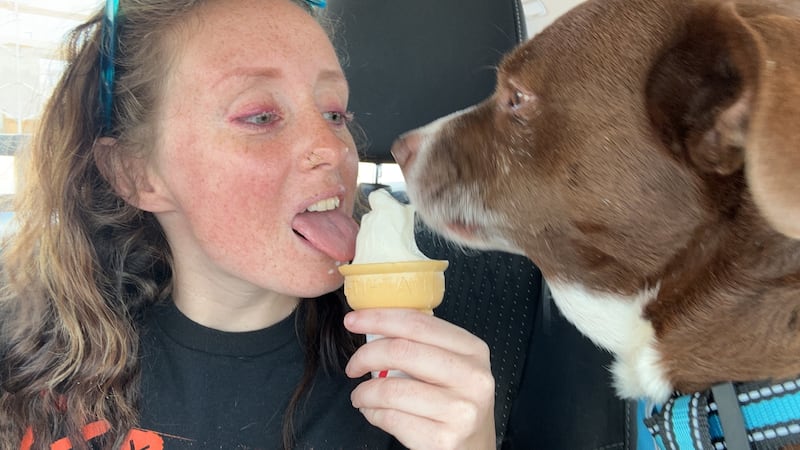
DeCoil’s dog Colby, nicknamed Grumps, came into her life about 10-1/2 years ago.
Away from her family for the first time at college, DeCoil woke up one morning and decided to get a dog. She went to the local Humane Society, paid $20 and drove away with her 2-year-old adoptee. They immediately became best friends. He was protective of her, even more so when she was drinking.
About 5-1/2 years ago, Colby and a second dog she had at the time got into a “really bad” fight. Colby had to get stitches in his neck. DeCoil was hurt trying to break it up. She doesn’t remember much about it because she was drunk.
That was the beginning of the end of her drinking.
Things didn’t work out between the two dogs, so DeCoil gave the other one to a friend.
“And then it was like why drink? Like what’s the point anyway?” she said. “Once I did get sober, I was like Colby, my dog, is like the most important thing in my life, and I would do anything to give him the best life . . . So I just decided to get sober and he really kept me there.”

DeCoil also figured out that she accomplished more in the weight room when she wasn’t hungover.
“So powerlifting, weightlifting in general really just kept me accountable and just it made me see like there’s so much more beyond just taking a drink. I changed my whole life, everything — everything that I was just changed. Obviously it wasn’t overnight and it was very difficult at first," she said.
DeCoil had her drinking under control, but another circumstance arose that she couldn’t control.
Letting Grumps go
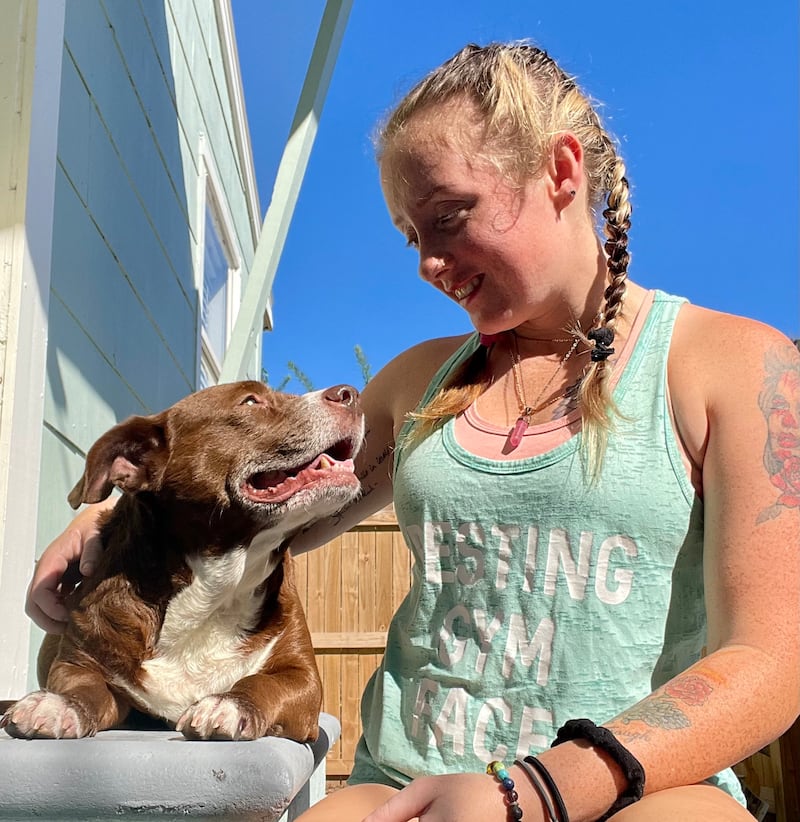
Earlier this year, Colby was diagnosed with end-stage kidney failure. Surgery might prolong his life but recovery would be rough and he probably wouldn’t make it long term. She made a heart-wrenching decision. A GoFundMe page helped her raise $1,155 for in-home euthanasia and cremation.
“He has been with me through everything — moving across states, heartbreak, rebuilding my life, and getting sober. I got sober for him, because he deserved the best version of me. And he gave me more love than I ever thought was possible in return," she wrote on the website.
DeCoil said putting him down was the most difficult thing she has had to do but she didn’t want to keep him around to suffer.
“I would do anything for him, and if that means I’m going to be the one dealing with the broken heart, then I’m going to do it to prevent him from dealing with pain and all of that,” she said.
DeCoil preserved his memory with a colorful tattoo of Grumps and herself on her right quad with the words “Until we meet again.”

Weightlifting has become her therapy since her beloved dog died. An unemotional person by nature, she found herself crying during workouts.
“It really helped me process a lot of things and just helped me give myself time to really feel and really accept what happened while continuing to build who I am,“ DeCoil said, who has been sober for more than five years now.
”If I didn’t have lifting, I would have nothing because Colby and lifting was my whole life. So when I was lifting after Colby, it truly was just like the best form of therapy that I could have possibly done and everything I do has always been to give him the best life and now like he’s with me all the time. I’m still making sure that I’m doing everything that I want to do because he’s still experiencing it with me. Just because his body’s gone doesn’t mean his soul’s not here.”
Lifting women

DeCoil, who’s always on the lookout for sponsors, has found a home in the powerlifting community, which she describes as “welcoming” and “beautiful.”
“I think the world of powerlifting. If you ever go to a competition, they’re cheering for me as much as they’re cheering for a guy who’s lifting a thousand pounds,” she said.
She’s happy to see more women taking up the sport, though it can be intimidating.
While exact numbers of how many women compete in powerlifting aren’t consistently reported across regions and federations, female participation in the sport has grown significantly. USA Powerlifting reported a record year in 2023 with more than 1,500 women joining the organization.
Powerlifting was a male-dominated sport when Yerrakadu got into it nearly four decades ago. He has watched more and more women participate in powerlifting, accelerated more recently with the advent of CrossFit.
Women found that powerlifting helped them develop a functional, muscular, yet feminine “Wonder Woman” physique, he said. “You hear all the time now, ‘strong is the new skinny’ and that sort of thing.”
Participation has grown to the point where drug-tested meets — women typically don’t use anabolic steroids — sometimes have more female competitors than male competitors, which Yerrakadu said was unheard of a few years ago. State-level meets that once had only 10 women out of 75 lifters might now have 80 women out of 150 lifters, he said.
“It’s been really great for the sport,” Yerrakadu said.
Beyond physical changes, he said, powerlifting provides women with a sense of confidence, autonomy and self-determination.
DeCoil can attest to that. She said she just wants to represent women and help them see what’s possible.
“I’m up there deadlifting double my body weight. I want them to be like, ‘If she can do that, why can’t I?’ I’m not doing this for the praise or anything like that. I want other people to see when you get into this world ... how much stronger than you ever could think that you were.”