

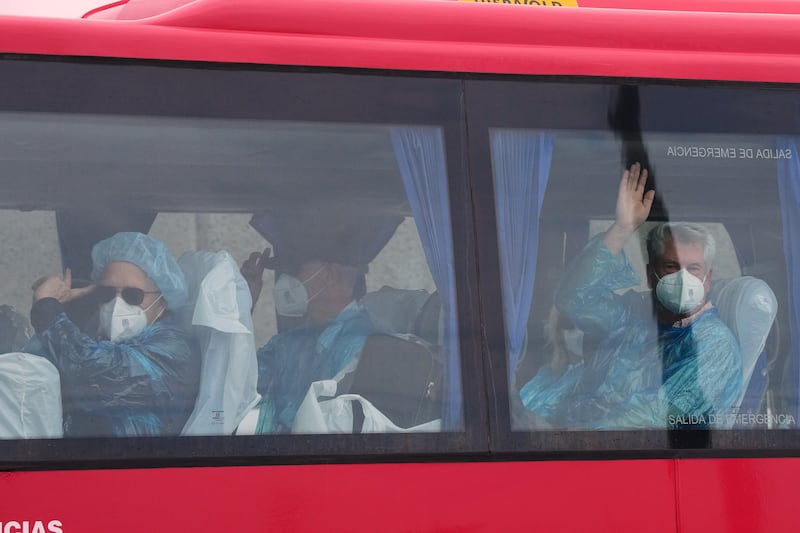

- Three Utahns are among the 17 U.S. passengers returning home from the MV Hondius cruise ship.
- One American has tested positive for hantavirus while another is symptomatic.
- Utah health officials are working with federal health agencies to prepare for the Utahns' return.
Among the 17 U.S. passengers who returned to America on Monday after their time aboard the MV Hondius cruise ship, three are Utahns.
The Utah Department of Health and Human Services said in a press release Monday that it is preparing for the eventual return of those passengers to the state.
“We want to reassure Utahns that while the risk to the public is minimal, DHHS is coordinating closely with our local health departments, the CDC, and the passengers to take the necessary steps to prevent risk to others,” DHHS Commissioner Tracy Gruber said.
All of the U.S. passengers who remained on the ship will undergo observation at a federally monitored facility and will only return to their home states when it is determined that it is safe to do so. When they do return, it is expected there will be daily monitoring for symptoms for at least six weeks and isolation if they become symptomatic, according to the state health department.
“I am concerned about the individuals exposed to this virus on the cruise ship, but I don’t have concerns about an infection spreading widely,” Utah state epidemiologist Dr. Leisha Nolen said. “While we are learning more about the Andes strain and how it is transmitted, we understand how to stop it from spreading.”
Who has tested positive?
In a post on X Sunday, the U.S. Department of Health and Human Services confirmed one American tested positive for hantavirus while asymptomatic and another has mild symptoms. As the group made its way to the U.S., the two passengers were “traveling in the plane’s biocontainment units out of an abundance of caution.”
The plane was en route to the ASPR Regional Emerging Special Pathogen Treatment Center at the University of Nebraska Medical Center. According to CBS News, “The flight to the U.S. landed at Eppley Airfield in Omaha, and a convoy, ambulance and multiple buses took passengers early Monday to the University of Nebraska Medical Center.” Two of the passengers were then flown to Atlanta where the Centers for Disease Control and Prevention is based.
The passenger who tested positive was taken to the Nebraska Biocontainment Unit, while the others were sent to the National Quarantine Unit for testing. Per CBS, the patient in the biocontainment unit was “doing well” and still did not have any symptoms as of Monday morning, according to Angela Hewlett, an infectious disease physician and the medical director of the Nebraska Biocontainment Unit.
Who needs to quarantine?
A press release from the University of Florida Health said some “nations are executing quarantine protocols” for passengers returning to their respective countries. The World Health Organization recommended quarantining for 42 days following last potential exposure to someone with hantavirus symptoms, which include “headache, dizziness, chills, fever, myalgia, and gastrointestinal problems, such as nausea, vomiting, diarrhea and abdominal pain.”
At a news conference Monday on the arrival of the MV Hondius passengers, Nebraska Gov. Jim Pillen said: “The rest of America can be satisfied that there is a strong plan in place.” He continued, “We’re working diligently to ensure no one leaves this security in an unsecured way at an inappropriate time. No one who poses a risk to public health is walking out the front door of the streets of Omaha or beyond.”
While some worry that this hantavirus outbreak is a repeat of COVID-19, Dr. Nicole M. Iovine, the chief epidemiologist and an infectious disease expert at UF Health Shands Hospital, said hantavirus and COVID are different.
“The way this virus transmits is not the same as the flu or COVID — these viruses affect the upper airways, mainly, so speaking and coughing can easily transmit it. The hantavirus and the Andes virus tend to infect very deep in the lungs, so it is not as easily transmitted through the air," she said.
The CDC said, “Andes virus is the only type of hantavirus that is known to spread person-to-person. This spread is usually limited to people who have close contact with a sick person. This includes direct physical contact, prolonged time spent in close or enclosed spaces, and exposure to the sick person’s body fluids.”
As Deseret News previously reported, the WHO’s Maria Van Kerkhove said: “This is not the start of an epidemic. This is not the start of a pandemic.”