

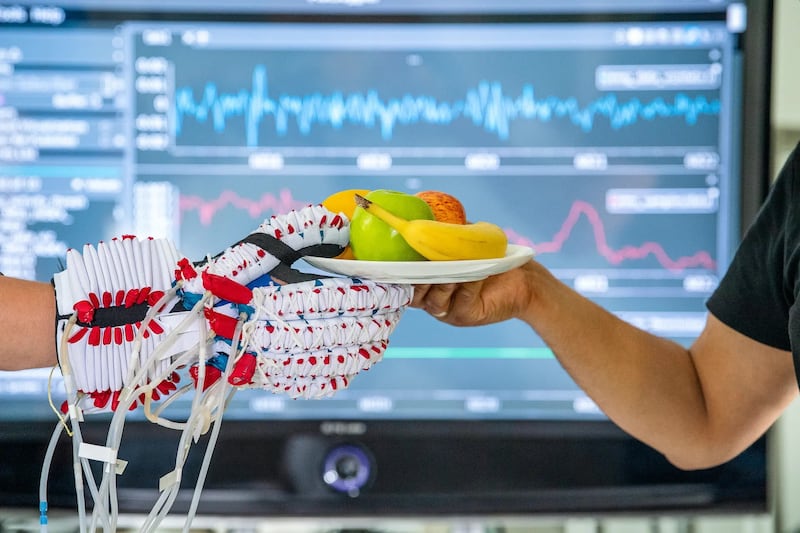

- Researchers at the Technical University of Munich created a glove for paralyzed hands.
- The glove uses forearm sensors to capture electrical signals and anticipate movement.
- It was made with a sewing machine using affordable fabric.
Researchers from the Technical University of Munich developed a glove that can help people with paralyzed hands use them again.
A homemade innovation
Dr. John Nassour, a researcher at the university’s Institute for Cognitive Systems, made the glove himself with a sewing machine. He told Deseret News that his parents, both tailors, taught him to sew as a child.
“I never imagined that those skills would one day become part of my research career,” he said. “Being able to design and sew the prototypes myself allowed us to test new ideas quickly, refine the glove based on patient feedback and keep the manufacturing cost low. It has been incredibly rewarding to see a skill I learned in childhood contribute to technology that can help restore independence to people with severe hand paralysis.”
Nassour’s sewing skills and the low cost of the fabric created “a solution that anyone can afford but still works very well,” according to professor Gordon Cheng, director of the Institute for Cognitive Systems, quoted in a news release from the university.
How it works
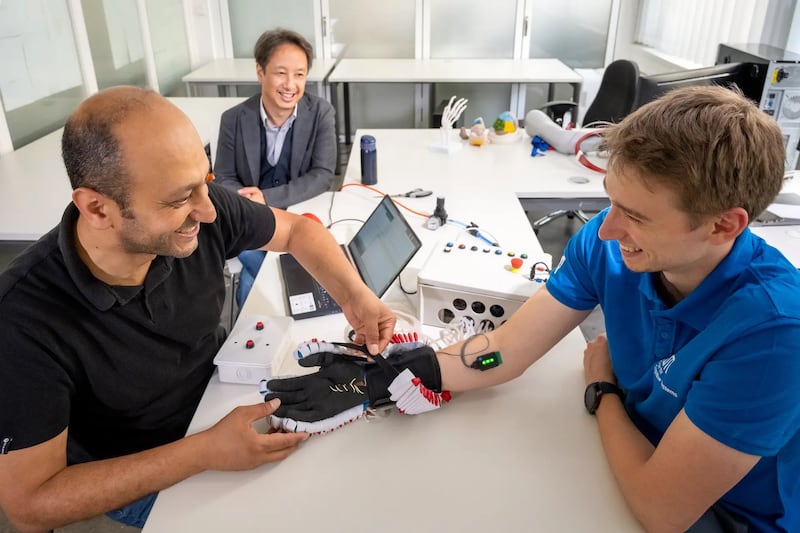
The glove has “air cushions” attached to it that inflate through 13 tubes. “The air-filled cushions allow each finger to be bent and straightened individually while also rotating the wrist, enabling objects to be held securely in the hand,” per the release.
The glove determines “when a person intends to grasp an object” through sensors on the wearer’s forearm. These sensors “capture electrical signals, which are analyzed using machine learning to reliably determine the intended movement.”
During development, the team worked closely with a patient diagnosed with amyotrophic lateral sclerosis (ALS).
“People with ALS gradually lose control of their movements ... because the nerve cells responsible for skeletal muscle contraction are damaged and continue to degenerate,” according to the article.
The researchers said that at the beginning of the project, the patient had very little control of his hands, but by the end, “He was able to reach for objects, hold a fork for the first time in four years and pick up small cubes and drop them into a container” while wearing the glove.
Nassour told Deseret News seeing the patient grasp objects with the glove was unforgettable. “After years of designing, sewing, testing and refining the system, that moment made every challenge worthwhile.”
In the future
Development of the glove is ongoing. “We are now adapting the concept for other patients, such as stroke survivors,” Cheng said in the news release.
Other researchers, including neurologist professor Tobias Wächter from the partner institution Klinik Passauer Wolf, are “convinced of the potential of the new specialized glove.” He believes, per the Munich university, that it will help many people in the future with different conditions.