


- A new analysis of alcohol consumption data found a higher share of females age 12 to 20 drink than males in that age group.
- Past-month alcohol use among females ages 12–20 was 14.3% vs. 12.4% for males; binge drinking was 1 in 12 girls vs. 1 in 14 boys.
- About 1 in 100 youths aged 12–13 drank in the past month, compared to 1 in 7 of those aged 16–17. Home is a big source of alcohol.
More females age 12 to 20 drink alcohol — including binge drinking — than do males in the same age group, according to a new analysis of federal data on alcohol use.
Past-month drinking among the females was 14.3%, which is roughly 1 in 7, compared to 12.4% or 1 in 8 young men, according to an analysis by the law firm Jones & Swanson of Marietta, Georgia.
Binge drinking found a similar pattern, with 1 in 12 young females binging, compared to 1 in 14 males.
The National Institute on Alcohol Abuse and Alcoholism describes binge drinking as three drinks for girls 9 to 17 and between three and five drinks for boys depending on their age. It is drinking that reaches a blood alcohol level of 0.08 g/dL or higher.
Nor was it only true of young females. The report found that lifetime alcohol use among underage drinkers was higher among females, at 34.4% compared to 31.4% for males. And 28.4% of females drank in the past year, compared to 25.7% of males. However, heavy alcohol use was slightly higher for the males, at 1.6% compared to 1.4% for females.
In 2024, per the report, 2,636 people in the U.S. were killed in crashes involving a teen driver, 825 of them over the “deadly days of summer” between Memorial Day and Labor Day, per the report titled “How U.S. States Vary on Teen Alcohol Consumption.”
Age mattered for the youths, with about 1 in 100 of those who were 12 to 13 imbibing in the last month, compared to about 1 in 7 among those ages 16 and 17. Per the analysis, “This sharp rise identifies the middle and later teenage years as a critical window for prevention, family conversation, school support and early intervention.”
About a third of the time, the young drinkers accessed the alcohol at home. The data showed that of those who drank during the past 30 days, just over 1 in 8 got the alcohol from a relative who was 21 or older, while a like number got it from a parent or guardian. Just under 1 in 12 sneaked it at home. “That a third of the underage drinkers combined got alcohol in those ways suggests that prevention cannot focus only on stores, parties or peer groups,” according to the law firm.
There were also some racial differences. Underage whites were more apt to binge drink, at 9.6%, compared to Hispanic youth at 6.5% and Black youth at 5.5%. Per the release, “These differences do not explain the gender gap, but they show that underage drinking risk is shaped by more than one demographic factor and that broad, one-size-fits-all prevention messages may miss important differences in exposure and behavior.”
What about the adults?
Based on 2021-2023 survey data, the report said women ages 18 to 25 “already outdrink men their age on binge drinking. That’s not new territory, either.”
The National Institute on Alcohol Abuse and Alcoholism has flagged alcohol use increasing in that age group among young adult women and decreasing among males in the same age bracket, the report said.
“The broader adult population tells a similar story, just slower,” per the background material. “Men still drink more overall, with about 68% reporting past-year alcohol use versus 64% of women, but that gap has been closing for two decades. Between 2000 and 2016, women’s binge drinking rose 14% while men’s edged down.”
Alcohol use — and rules — vary by state
The report notes that while the federal minimum age for alcohol consumption is 21, “many states allow teens to legally drink alcohol in specific contexts. These include, while accompanied by a parent, legal guardian or spouse, or for religious or educational reasons.” The report said that’s true in 31 states, based on data from the Alcohol Policy Information System.
Many states and the District of Columbia “do not allow minors to possess or consume alcohol under any circumstances.” Those are Alabama, Arizona, Arkansas, Florida, Indiana, Kansas, Kentucky, Maine, Michigan, Missouri, New Hampshire, North Carolina, North Dakota, Pennsylvania, Rhode Island, Tennessee, Utah, Vermont and West Virginia.
There are lots of variations. For example, Georgia lets an underage person possess but not consume it if accompanied by a parent or guardian and if they are at home. Massachusetts and New York have the same rule, absent the requirement it be at home. Meanwhile, in South Carolina, minors can possess and drink alcohol at home with a parent or guardian. Per the report, in Hawaii and New Jersey, minors can both possess and consume alcohol in a private setting. That’s just a sampling of a complicated mix of rules.
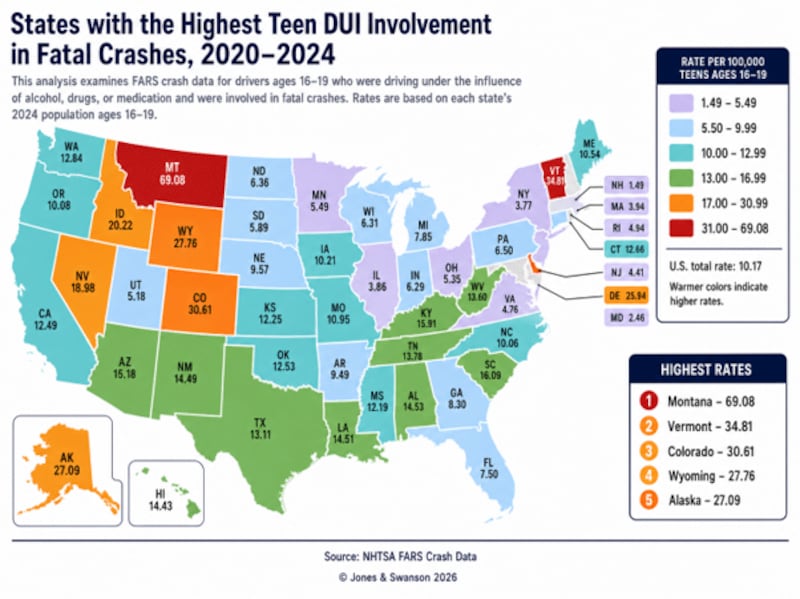
The 10 states with the highest rate of fatal crashes involving impaired teen drivers ages 16 to 19 in 2024 were Montana, Vermont, Colorado, Wyoming, Alaska, Delaware, Idaho, Nevada, South Carolina and Kentucky. Not all impairment was alcohol-related; drug use was also a factor.
Those with the least were New Hampshire, Maryland, New York, Illinois, Massachusetts, New Jersey, Virginia, Rhode Island, Utah and Ohio.
What underage drinking can do
The report shows that U.S. teens “tend to overestimate” how much their peers are drinking and that belief that “everyone else is doing it” can contribute to whether the young person chooses to drink.
Among those 12 to 17, 3% had alcohol use disorder in the past year. That’s 775,000 adolescents, per the analysis. An additional 2.9 million underage individuals had “indulged in a drinking binge during the previous month,” while 576,000 were heavy alcohol consumers.
Per the report, legal consequences of getting caught are not the only worries. Nearly 800,000 youths ages 12 to 17 had a major depressive episode and a substance use disorder at the same time, though the substance was not necessarily alcohol. Of those dependent on alcohol however, 25% had a personality disorder, 16% a mood disorder and 16% had anxiety disorder, based on data from the Substance Abuse and Mental Health Services Administration. The National Institute on Drug Abuse and SAMHSA research found about half of those with severe mental illness also have a substance use disorder — again, not always alcohol.
Research cited in the report found that those who start drinking when they are underage are “disproportionately likely” to become alcohol-dependent.
Underage alcohol consumption can also negatively impact brain development, which is ongoing to the mid-20s.