


When I enrolled in medical school, I considered myself an atheist. While I found the study of the human body fascinating on scientific grounds, it was harder to keep those deeper questions about the meaning of life at bay when I found myself dealing with life and death on a daily basis. I could see that many of the patients I was assigned to were facing the end of their lives, and that our medical interventions were unlikely to save them for long. Some of them were angry, some depressed, but some who had strong faith in God seemed oddly at peace.
One afternoon, an elderly woman with advanced heart disease shared her faith with me, explaining in deeply personal ways how her belief in Jesus provided her with a sense of comfort as she prepared to die. I was silent, awkwardly not knowing what to say. But then, in a moment when time seemed to stand still, she looked directly at me and asked, “Doctor, what do you believe?” With an intense and unexpected flush of discomfort, I realized I had just been asked the most important question of my whole life. Struggling to provide an answer, I realized that down deep I had nothing to say.
This interaction tormented me over the next few days. I still thought atheism was the only rational option for a thinking person, but then why did her question make me so uncomfortable?
In my quest to answer that question, I realized I had lived out the predictions of a quote attributed to the Nobel Prize-winning physicist Werner Heisenberg, the author of the famous uncertainty principle: “The first gulp from the glass of natural sciences will turn you into an atheist, but at the bottom of the glass God is waiting for you.” I had reached the bottom of the glass and, in my subsequent study of religion, I converted to Christianity.
Rediscovering the past
I didn’t know much about the historical relationship between science and faith when I became a believer, and I assumed that the conflict I saw around me in the late 20th century had always been there. To my surprise, I learned that the more serious tensions are relatively recent in the span of history (less than 200 years), and are particularly prominent in the United States. I did not realize until later that faith and science were once tightly aligned — in fact, many of the foundations of modern science were laid by devout Christians.
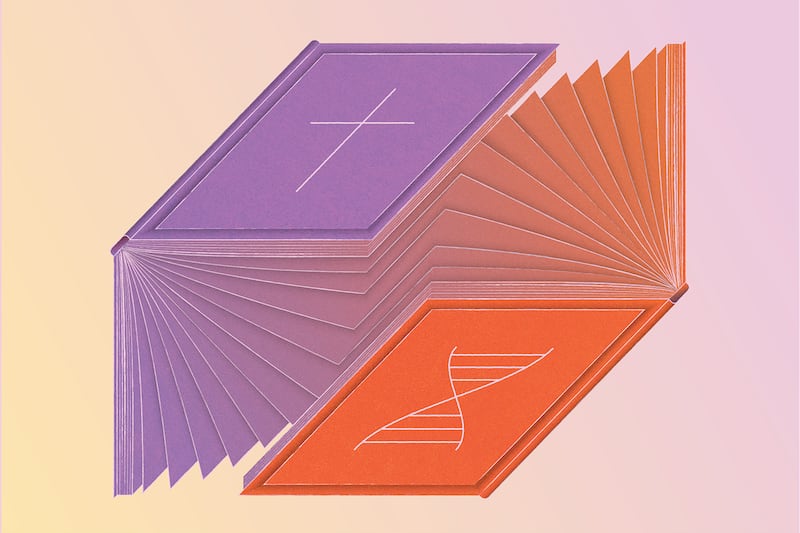
In the 13th century, Franciscan friar Roger Bacon challenged the Aristotelian view of nature, pointing out the importance of skepticism about philosophical claims, and the need to carry out empirical testing. He basically formalized the principles of the scientific method. Three centuries later, another Bacon, Francis Bacon, pressed further the importance of the scientific method. A devout Anglican, though not without flaws that once landed him in the Tower of London prison, Francis Bacon wrote memorably about the relationship between science and faith: “God has in fact written two books, not just one. Of course, we are all familiar with the first book he wrote, namely scripture. But he has written a second book called creation.”
Bacon urged us to consider both of these books as providing insight into the creator God. He argued that they could not be in conflict, since they were provided by the same author. I find this metaphor compelling, so I was delighted to visit the recent exhibit “Scripture and Science” at the Museum of the Bible in Washington, D.C., where the theme of the whole exhibit was “The Two Books.” The exhibit included copies of notes from Nicolaus Copernicus and Galileo Galilei, a description of the critical role played by Catholic priest Georges Lemaître in the discovery about the Big Bang, and historical materials documenting the early reaction of the American church to Charles Darwin’s “On the Origin of Species.” As part of the exhibit, a copy of the 2001 publication in Nature magazine that first described my team’s analysis of the sequence of the human genome was displayed next to my personal Bible (with the pages turned to John 1:1, “In the beginning was the Word”), making the visual point of how those two books can joyfully coexist.
To be sure, there have been some discordant moments in the relationship between science and Christianity. Most people have heard about the clash between Galileo and the Roman Catholic Church, but that story deserves closer analysis. This was not simply a collision of science and faith worldviews; it had significant roots in poor communication and an insulted pontiff. Decades before Galileo, Copernicus had studied the motions of the planets and concluded that all of them, including Earth, revolve around the sun. At his death this conclusion was published, eliciting little outcry from the church — though some found this model inconsistent with certain biblical verses such as Psalm 104:5: “He set the earth on its foundations; it can never be moved.”
This interaction tormented me over the next few days. I still thought atheism was the only rational option for a thinking person, but then why did her question make me so uncomfortable?
Galileo, a brilliant but somewhat irascible scientist, further extended the case for heliocentricity by his telescopic observations of Jupiter’s moons and of craters on our own moon, concluding that Copernicus was right. Galileo then sought somewhat aggressively to persuade Catholic authorities about his conclusion. That discussion might have gone much better — but Galileo wasn’t very diplomatic in making his point. He managed to alienate the pope by portraying him as intellectually dim and ended up under house arrest.
But that was the exception. Leading scientists and architects of the Enlightenment like Isaac Newton saw the discovery of natural laws as a way of appreciating the awesome nature of God’s creation. When he wasn’t deriving the laws of force and gravity, Newton actually wrote more about theology than he did about science. Science at this point was called natural philosophy; the word “scientist” wasn’t coined until 1834.
For me, one of the most compelling examples of a brilliant scientist-Christian of the Enlightenment was the French mathematician, physicist and inventor Blaise Pascal. A child prodigy who was already making fundamental contributions to geometry by age 16, Pascal was one of the first to invent a mechanical calculator. Making additional contributions to probability theory and fluid dynamics, he was also the first to show that barometric pressure depends on altitude.
Plagued by ill health his whole life, Pascal had a profound religious experience at the age of 31 and began to record his thoughts on scraps of paper that were found at his death eight years later, and collected into a publication called “Pensées.” This collection of reflections on science, faith and truth is well worth reading today. Here’s just one example: “Men despise religion; they hate it, and fear it is true. To remedy this, we must begin by showing that religion is not contrary to reason; that it is venerable, to inspire respect for it; then we must make it lovable, to make good men hope it is true; finally, we must prove it is true.”
Darwin’s turning point
Perhaps the greatest potential for disruption of the harmony between science and faith came in 1859. Darwin’s insights about the origin of species through the process of evolution certainly provided a challenge to those whose faith was heavily dependent on arguments about design of the human body, and who saw Genesis 1 and 2 as describing creation ex nihilo of humans and other species. But again, the actual history of that initial response has been blurred over time.
By the mid-19th century, many Christians were already increasingly comfortable with the concept of an old Earth, based on analysis of the fossil record. Many prominent Christian American scientists like botanist Asa Gray saw Darwin’s theory as providing insight into the mechanism that God used to carry out creation, using God’s own natural laws. Conservative theologian B.B. Warfield argued that evolution was quite compatible with scripture. These leading voices and others embraced the process of evolution as a remarkable insight into the “how” of the creator’s work.
But not all agreed with this interpretation. Advocacy for a young Earth reemerged, particularly from the founding prophet of the Seventh-day Adventists, Ellen G. White, who argued from a personal vision that the fossil and geologic record could be explained by the laying down of sedimentary layers in the aftermath of Noah’s worldwide flood. That view was not accepted in the early 20th century by most Christians, however. In a collection of papers called “The Fundamentals,” a group of conservative Christians put forward what they believed to be the essentials of the faith, accepting an old Earth as compatible with biblical interpretation. Nevertheless, the anti-evolution young Earth movement began to gain momentum, particularly in the American South.
I did not realize until later that faith and science were once tightly aligned — in fact, many of the foundations of modern science were laid by devout Christians.
This came to a head in the 1925 Scopes trial in Dayton, Tennessee. The state of Tennessee had prohibited the teaching of evolution. John Thomas Scopes was a high school biology teacher who was encouraged by the American Civil Liberties Union to challenge the law. It is not clear that Scopes had ever taught evolution, but the trial became a national spectacle. Former presidential candidate William Jennings Bryan served as the Presbyterian defender of the faith, working with the prosecutor’s team. Bryan went further than making the case that Scopes had broken the law. He argued that serious harms were being done to Christianity and to morality in general by the consideration of Darwin’s theory. The agnostic Clarence Darrow was the main defense lawyer. He used the opportunity to ridicule the creationist position. In an unusual development, Darrow called Bryan to the stand to explain why evolution and Christianity could not be compatible. It did not go well for Bryan.
The trial was a circus. The jury declared Scopes guilty after nine minutes of deliberation, and the judge required him to pay a fine of $100. To the great shock and distress of everyone, Bryan died suddenly five days later, leading the provocative reporter H.L. Mencken to quip that God had aimed for Darrow and missed.
The Scopes trial provided a national opportunity to highlight what then seemed to be deep divisions and irreconcilable conflicts between the worldviews of science and faith. Given the outcome, most biology textbooks removed the word “evolution.” Suspicion about the motives of science took deeper root in many conservative Christian communities.
Sputnik’s shock
The first human-made satellite to orbit the Earth was named Sputnik and was launched by the Russians in 1957. The space race was on, providing a wake-up call about science competitiveness to the United States. To prepare the next generation of scientists and engineers, a major effort was undertaken to update science teaching and science textbooks. That was responsible for the introduction of a new curriculum in chemistry, which had a major role in attracting my interest to a career in science. In life sciences, the new curriculum included an emphasis on evolution as a central unifying principle of biology. Christians troubled by evolution were alarmed. In an effort to provide a response to claims that Christian belief in a young Earth was unscientific, engineer Henry Morris and colleagues put forward a perspective outlined in “The Genesis Flood” that interpreted findings from geology and biology as consistent with a literal reading of the first book of the Bible and a planet that is only 6,000 years old.
With its apparent appeal to science, the book was embraced by many Christians who had felt under attack from secularism. Unfortunately, and I say this with great regret because of the hurt that has been caused, “creation science” as outlined in that book — and other writings by the Creation Research Society, the Institute for Creation Research and Answers in Genesis — is based upon a vast number of indefensible premises. While many young people attending fundamentalist churches are still taught that this perspective honors both science and faith, those who have the chance later to see the compelling data about the actual age of Earth (more than four billion years) find that the young Earth perspective simply cannot be defended. Sadly, this propels many of those young men and women into a wrenching and unnecessary faith crisis. Some of them lose their faith, concluding that the whole edifice of Christianity must be flawed if this part was so wrong. Others try to hang on to their faith but conclude that their interest in science needs to be suppressed, because it is too dangerous.
Perhaps as a response to the recognition that creation science was failing to convince skeptics, another alternative that sought to preserve God’s supernatural actions in biology appeared in the last decade of the 20th century. Called intelligent design, or ID, this approach highlighted certain nanomachine marvels found in biological systems as demonstrating what the ID leaders called irreducible complexity. A favorite example is the bacterial flagellum, a spectacular nanomotor that allows bacteria to zip around in a liquid environment. The flagellum has more than two dozen protein components. Until all of those parts come together, however, there’s no motor. Therefore, the evolutionary drive that would be needed for their individual development would seem to be lacking.
To remedy people’s fear of religion, French mathematician Blaise Pascal wrote that believers must show that religion is not contrary to reason.
This was indeed an interesting dilemma, and was identified by ID founders as a possible circumstance that required supernatural intervention. Yet, since the original highlighting of that paradox by authors like Michael Behe in his book “Darwin’s Black Box,” progressive scientific advances have shown that nanomachines like the flagellum have actually been assembled from components that had their own previous important functions, making the outcome understandable on the basis of traditional evolutionary mechanisms. Irreducible turns out to be reducible.
Ultimately, ID theory has fallen victim to advances in science that reveal natural explanations for constructs that were claimed to require supernatural explanation. In the long and unfortunate tradition of postulating a role for God’s divine intervention in phenomena that are not yet understood, ID has turned out to be another “God of the Gaps” theory, a shaky hook on which to ask believers to hang their faith.
If creation science and intelligent design have failed to provide a credible scientific alternative for Christians to resist a purely naturalistic explanation of human origins, what recourse remains? There is no need for a sense of doom for people of faith, and no need to reject science. God as the creator of the whole universe, using natural laws that make evolution possible, is still an entirely consistent, beautiful and intellectually satisfying formulation.
Evolutionary creation fits together the biblical story and the most recent findings of science in a way that adds rich details to Francis Bacon’s concept of God’s two books. The BioLogos Foundation, which I founded in 2007 after seeing the intense interest in how rigorous science and serious Christian faith can fit together, now hosts one million to two million individual visitors each year to a website that addresses the most commonly asked questions and provides insights and testimonials. Led by astrophysicist Deborah Haarsma, BioLogos organizes large-scale meetings and topic-specific workshops, hosts a science and faith podcast called “Language of God” (named after my 2006 book), and provides a curriculum that is scientifically sound and scripturally anchored for homeschoolers and Christian high schools.
Though the question of human origins still inspires uneasiness for many Christians, progress is being made: A survey carried out in 2024 by the secular American Enterprise Institute documents that conflict about evolution is not the flash point for believers that it was 15 years ago.
From “The Road to Wisdom on Truth, Science, Faith, and Trust” by Francis S. Collins, published by Little, Brown & Company & Worthy Books, an imprint of Hachette Book Group. Copyright © 2024 by Francis S. Collins.
This story appears in the April 2026 issue of Deseret Magazine. Learn more about how to subscribe.