

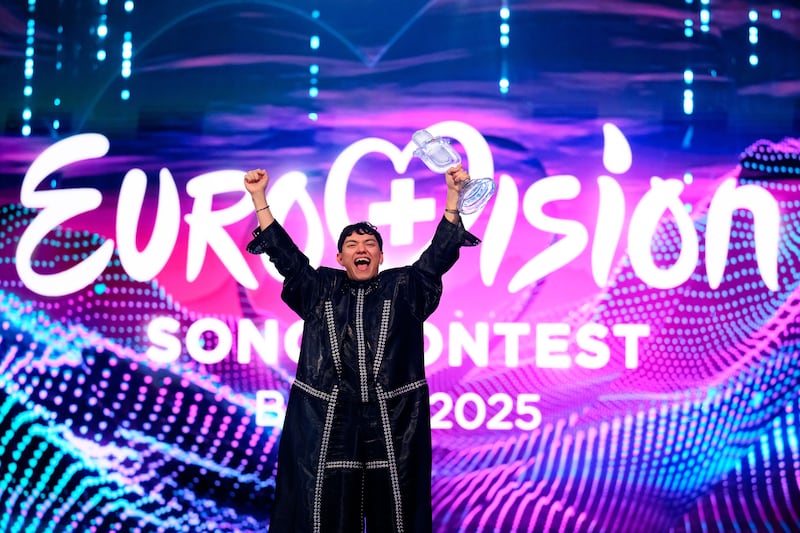

On April 6, 1974, millions of people from Dublin to Helsinki and Palermo gathered around radios and televisions to root for their countries, but this wasn’t the Olympics.
A British woman clad in pink introduced the contest in English, then French. One by one, acts from 17 countries took the stage, decorated in high ’70s style. Olivia Newton-John, draped in a long blue gown, crooned for the United Kingdom.
Peret strummed a Spanish guitar, rumba-style, and wiggled in black velvet bell-bottoms. Six men wearing sweater vests sang hopefully in Hebrew: “there’s enough air for one country or two.”
The music was upbeat at the 19th edition of the Eurovision Song Contest, but times were troubled.
The Cold War cast the darkest shadow; the U.S. and Soviet Union conducted 46 nuclear tests that year. Military regimes in Greece and Portugal were teetering. An oil embargo had quadrupled the price of crude.
The U.K. had responded to labor unrest among coal miners with a nationwide three-day workweek to conserve energy. Irish revolutionaries had bombed an English bus carrying British soldiers and their families, so security was beefed up that night at the Brighton Dome.
Eurovision has become an accidental symbol of Western values and a touchstone for a continental identity that did not exist before.
You wouldn’t guess any of that from the broadcast.
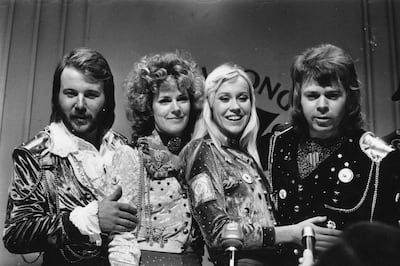
A Swedish conductor took his turn at the baton dressed up as Napoleon. On stage, a man in knee-high silver boots played a star-shaped guitar while his bearded bandmate hunched over a piano and two women dotted with sequins and sparkling chains started singing a pop song as jaunty as their get-ups. Eurovision songs often have a hopeful tone, even saccharine, calling for unity and compassion, mixing romantic and political metaphors.
“Waterloo” fit right in. “The history book on the shelf,” ABBA sang, “is always repeating itself.”
This May, as Eurovision celebrates its 70th anniversary in Vienna, Austria, the region is again in turmoil. Wars rage in Ukraine and the Middle East. Old alliances are strained and new ones threaten to alter the landscape as economic turbulence erodes once-mutual trust.
Spain, Ireland, Slovenia, Iceland and the Netherlands are all boycotting the event to protest Israel’s war in Gaza. Still, viewers will watch in every corner of the globe, from parties in Seattle to cafes in Bangkok (which will host the finale of a new Asian edition this fall). Perhaps they’ll see someone like ABBA, whose victory that night in 1974 made them an international sensation. Or maybe they’ll just find a little hope.
A broadcast experiment
Eurovision began as a technical experiment. Television was young when the European Broadcasting Union created the contest in 1956. The EBU, an alliance of the region’s public media organizations headquartered in Switzerland, wanted to test their new international infrastructure with an audience, creating a live broadcast across Europe and the Mediterranean rim. There seemed to be a growing demand for programming that brought the world into viewers’ living rooms. But the exact format and outcome were largely afterthoughts.
The continent was still reeling from World War II, which had destroyed infrastructure, dismantled economies and displaced tens of millions of people. In its wake, the Cold War had divided East and West. The North Atlantic Treaty Organization was founded in 1949, the Warsaw Pact in 1955. In the democratic West, economic cooperation was seen as a boon for peace and stability. The European Coal and Steel Community, formed in 1951, laid the foundation for what later became the European Union. The EBU was just one more example of pragmatic collaboration across borders.
The EBU’s committee of executives was no cabal of creativity, so they copied something. Italy’s Sanremo Music Festival had first graced a television broadcast in 1955, and its contest format seemed to work. The first Eurovision was held a few hours north in Lugano, Switzerland. Acts from Italy, France, Belgium, Germany, Luxembourg and the Netherlands each played, but the host country prevailed, with Lys Assia singing the plaintive “Refrain” in classic French Swiss chanson style. More importantly, the broadcast was a hit.
The show didn’t bring peace — a few months later, the Soviet military killed thousands in a brutal crackdown on Hungarian rebels — but it offered respite from a dreary and frightening period in global affairs.
Over the next seven decades, Eurovision showed that music is a shared language that can transcend cultural divides. It launched sensations like Italy’s “Volare,” which became history’s biggest non-English pop hit after placing second in 1958. It expanded into the Mediterranean in the 1960s and 1970s as aging dictatorships crumbled and economies boomed, and into Eastern Europe after the Berlin Wall fell in 1989. Even Iran has made indirect appearances, via emigres representing their countries of residence.
Today, Eurovision has become a global symbol of progress and solidarity. It offers unique costumes, intricate stage design and original music to an audience of 200 million people — more than the population of Russia. In 2020, Ipsos found that more than a third of people in China and Saudi Arabia had watched the contest, which now represents some 40 countries, including geographic outliers like Australia. And it’s attracting a new generation. Last year, 58 percent of the audience was ages 15-24, the highest rate of young viewers on record.
It’s a way for the European countries to negotiate their centuries of war-torn animosities.
The contest is pretty unique in the world. The Soviet Union did launch its own “Intervision” contest in 1965. It was held sporadically across the 1960s, 1970s and 2000s, and revived again by Russia last fall, near Moscow. Vietnam’s Đức Phúc won with the hip-hop-tinged “Phù Đổng Thiên Vương,” choreographed like a scene from a video game. “He remained in history for thousands of years,” the lyrics say, “like a young man who saved his own.” Stateside, the American Song Contest, a private attempt at replicating the format in 2022, lasted for a single season. Some may see echoes in “American Idol” or “The Voice,” but these shows focus on individual success and fame, whereas Eurovision comes back to common values.
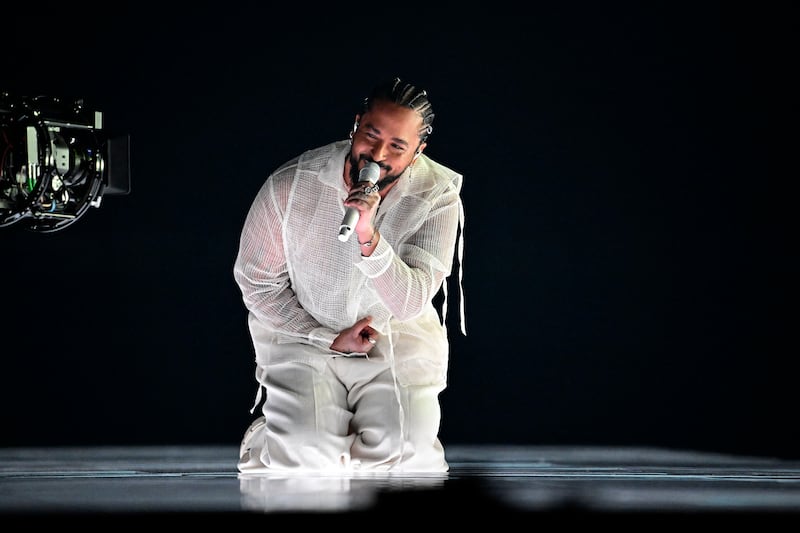
The viewing public and professional juries share equal power in determining the winners. Participants and voters alike transcend borders, cultural divides, political tensions and linguistic barriers. “It’s about European identity,” says Christina Öberg, a professor at Sweden’s Linnaeus University and author of the article “Eurovision Song Contest: From Apolitical to Mega-Political?” in the journal Politics & Policy. “It has always been celebrated for its ‘we can do this together’ attitude.”
That’s one big reason the contest endures. Not to mention the bouncy, family-friendly, feel-good music.
A personal obsession
Ivan Raykoff received a video cassette in the mail in 1998. At the time, he was struggling to find any information about Eurovision. The results weren’t printed in any of the newspapers available to him in San Diego, where he was studying music performance. So he’d gotten friends in Europe to send him a recording of the show. It took him a week to get it converted from the European PAL system to the American NTSC. It was all worth it when he could finally watch as the Israeli artist Dana International, with long brown hair and a shimmering gray dress, wowed the crowd with “Diva,” dedicated to strong women in history.
Raykoff’s parents had fled Eastern Europe as refugees after WWII. He grew up stateside, but became eager to unscramble his own continental identity. So he turned to academia — and to Eurovision. He became a professor of music at The New School in New York City. He co-edited “A Song for Europe: Popular Music and Politics in the Eurovision Song Contest” and authored “Another Song for Europe: Music, Taste and Values in the Eurovision Song Contest,” a follow-up focused on the music itself. “Even though I’ve been European American since my childhood, I’m still going into Eurovision not knowing most of the languages,” he says. “It teaches me and reminds me I’m a foreigner wherever I am.”
That kind of realization can become the seed of empathy — seeing others for who they are, but also recognizing who we are to them. Music is uniquely effective at reflecting our identities and representing them to the world. In a 2018 study by Live Nation, respondents across three generations and five continents reported that “music expresses more about who they are as people than their hometowns, religions, political beliefs, race, cultures or social media profile.” In the modern world, it’s a mental, physical and social thumbprint.
No wonder scholars have come to see Eurovision as a tool for soft power, global influence and public diplomacy. Ph.D. theses have explored the subject, spawning an entire field known as “Eurovision Studies,” and annual conferences devoted to dissecting the contest. A 2024 study published in the Journal of Contemporary European Studies found that the contest had become an effective if unintended diplomatic tool, increasing sympathy for the EU among viewers outside the continent. “A cultural event,” the authors write, “unrelated to the EU but reflective of the cultural notion of Europe, is evidently relevant for external perceptions of the EU,” showcasing principles like tolerance and democracy.
Raykoff agrees. “It’s a way for the European countries to negotiate their centuries of war-torn animosities, which culminated in World War II, in a healing, unifying process through culture and music,” he says. “Music is a convenient vehicle for this attitude of peaceful unification and overcoming old rivalries and wars. … On one hand, it’s so subjective. We all have our personal understanding and interpretation of the music we love. And yet it’s a very familiar language in terms of tonality or certain rhythms that’s very accessible to people.”
A defining performance

A woman in white stood on a grid of blue and purple lights that crossed the stage floor in a darkened auditorium. “You who are flying towards the year 2000,” she belted out in French with shocking vocal power, “don’t leave without me.” With curly brown hair and a bevy of awkward but earnest gestures and facial expressions, Celine Dion blew away the crowd in the same part of Dublin, Ireland, that hosts many foreign embassies. She won the Eurovision title for Switzerland that night in 1988, with “Ne partez pas sans moi,” a ballad of hope for the future.
That was an optimistic time in Europe. Spain, once a dictatorship, had joined NATO. The Cold War was thawing, amid visible camaraderie between the Soviet and American heads of state, Mikhail Gorbachev and Ronald Reagan. And within a few years, the EU would unite most of the continent under a shared government with common values, a sea change from their history of violent disagreement. This would all mean, among other things, changes to Eurovision itself.
That can become the seed of empathy — seeing others for who they are, but also recognizing who we are to them.
“Success in the Eurovision Song Contest has often come as countries move toward the liberal, inclusive, pluralistic, democratic ideals of Europe,” wrote Robert Deam Tobin, Raykoff’s co-editor on “A Song for Europe” and a former professor at Clark University. Spain won the contest in 1968 and 1969, in the waning years of dictatorship under Francisco Franco. Turkey won in 2003, as the country campaigned to join the EU. When Estonia became the first former Soviet Republic to win in 2001, Prime Minister Mart Laar bragged: “We are no longer knocking at Europe’s door. We are walking through it singing.”
If anything, the EBU has tried to keep politics at a safe distance, but ideas and opinions have a way of finding platforms for their expression. Franco was accused of rigging Spain’s first victory. Portugal’s song in 1974 was used as a code to trigger a coup against its own dictatorship. In 2009, Georgia withdrew in protest after the EBU deemed the lyrics of its song, “We Don’t Wanna Put In,” an attack on Russian Prime Minister Vladimir Putin. Explicitly political lyrics are banned, but in 2016, Ukraine won the contest with “1944,” widely considered a veiled response to Russia’s annexation of the Crimea two years earlier. Russia was banned in 2022 following its latest invasion of Ukraine. Some speculate that the U.K.’s last-place finishes in 2019 and 2021 were backlash for Brexit. Even this year’s protest over Gaza — the largest and most organized yet, though its impact remains to be seen — speaks to the contest’s political resonance.
It is perhaps a happy accident that Eurovision has become a symbol of Western values and a touchstone for a continental identity that did not exist when the contest was created. “It was a rare example of Europeans watching the same television show at the same time,” says Dean Vuletic, a historian who also lectures the world’s first university course on Eurovision at the University of Vienna and Charles University in Prague. “That coincidence between the development of television technology and that of European integration meant that Eurovision did take on a Europeanist meaning, even though the organizers never had that intention.”
This story appears in the May 2026 issue of Deseret Magazine. Learn more about how to subscribe.