

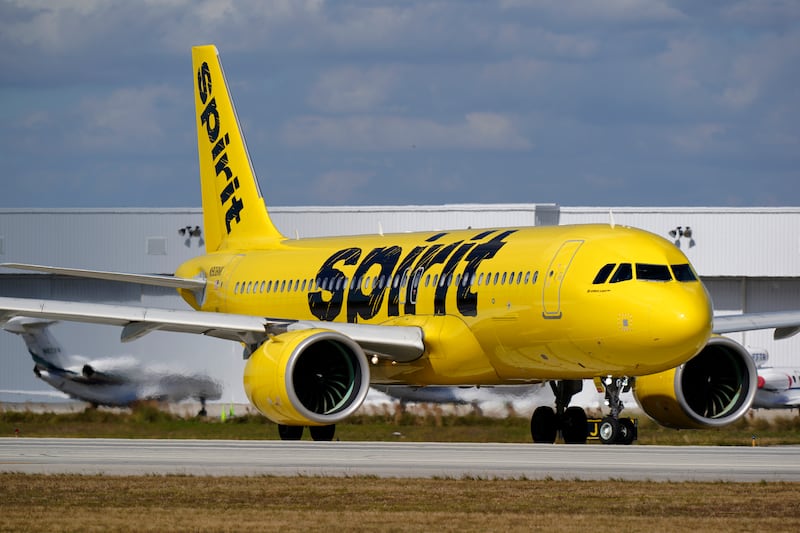

The Trump administration is considering a bailout for Spirit Airlines, which has declared bankruptcy twice in less than two years.
The deal, according to press reports, would lend the carrier $500 million in return for warrants to buy up to 90% of the company’s equity.
“We’re thinking about doing it, helping them out, meaning bailing them out or buying it,” President Donald Trump told reporters on Thursday. He reasoned, “I’d love to be able to save those jobs. I’d love to be able to save an airline. I like having a lot of airlines, so it’s competitive.”
Without intervention, the airline will likely lay off 14,000 workers.
From the Oval Office, the president said that he already has someone “who wants to run it ... if they run it properly, prices come down, all the sudden it’s a valuable asset,” he said.
Spirit CEO Dave Davis responded to the possible bailout in a statement, Thursday: “We are grateful for President Trump’s support and look forward to continuing to work with him and his administration on a solution that protects thousands of jobs, preserves and enhances competition, and helps ensures Americans continue to have access to affordable fares.”
“If no one else wants to buy them, why would we buy them?”
— Transportation Secretary Sean Duffy
Spirit has been dealt a difficult hand through federal intervention
In 2022, JetBlue offered $3.8 billion to buy Spirit in hopes a merger would create a fifth major airline, but the move was blocked by former President Joe Biden’s Justice Department.
The administration reasoned that the U.S. relied on the lower-cost airline seats Spirit provides.
“JetBlue’s plan would eliminate the unique competition that Spirit provides — and about half of all ultra-low-cost airline seats in the industry — and leave tens of millions of travelers to face higher fares and fewer options,” the DOJ wrote in its complaint. “Spirit itself put it simply: ‘A JetBlue acquisition of Spirit will have lasting negative impacts on consumers.’”
The Justice Department ruled in January 2024 that the deal violated antitrust law, and in March, JetBlue abandoned the acquisition.
Upon the announcement, Spirit’s stocks fell significantly.
By November 2025, the airline had amassed $2.4 billion in long-term debt, most of which is due in 2030. Spirit is canceling 11 routes across the Caribbean and Central American, while reducing flights on 22 others.
The U.S. could soon have its first nationalized airline
Cato Institute policy analyst Tad DeHaven criticized Trump’s proposal, describing it as both a buyout and a bailout.
“I never had it on my bingo card that in 2026 the democratic socialist mayor of New York would open up a government-run grocery story, and at the same time, a Republican president of the United States would be looking to nationalize a budget airline, but that’s where we’re at,” he told Fox News on Friday.
In an essay for Cato at Liberty, DeHaven said the potential takeover of Spirit Airlines could normalize “bailouts and government ownership claims.”
“If Spirit cannot survive without politically engineered financing, then bankruptcy law and market restructuring should be allowed to run their course, whether that means reorganization, liquidation or asset sales to other companies,” he wrote.
The Wall Street Journal’s editorial board expressed similar concerns that the proposal could set a precedent for nationalizing private industry.
“The mooted Trump bailout would fuel moral hazard. Don’t be surprised if JetBlue seeks a rescue too,” they wrote. “Government ownership would also lead to regulatory and political favoritism that harms competition. That’s no doubt why stocks of other airlines fell following reports of the Trump intervention.”
Legislators and administrators debate the idea
During a private White House meeting on Tuesday night, Commerce Secretary Howard Lutnick defended the bailout. The Wall Street Journal described him as “the architect of the proposal.”
Lutnick presented the bailout as a potential boost to Republicans during the midterm elections, since it would save thousands of jobs.
Transportation Secretary Sean Duffy took the opposite view during the meeting, describing it as both a fiscally and politically unwise decision.
Duffy told Reuters on Tuesday, “If no one else wants to buy them, why would we buy them?”
Meanwhile, lawmakers have similarly debated the proposal.
Sen. Tom Cotton, R-Ark., said on Wednesday, “If Spirit’s creditors or other potential investors don’t think they can run it profitably coming out of its second bankruptcy in under two years, I doubt the U.S. government can either.”
“Not the best use of taxpayer dollars,” he wrote in the post, which garnered more than 440,000 views.
Sen. Ted Cruz, R-Texas, similarly described the proposal as “an absolutely TERRIBLE idea.”
He referenced the U.S. government’s intervention during the 2008 financial crisis. “The TARP corporate bailouts were a huge mistake & the government doesn’t know a damn thing about running a failed budget airline (that the Biden admin killed),” he wrote on X.
Sen. Elizabeth Warren, D-Mass., referenced the Journal’s reporting in an X post, then wrote, “Donald Trump’s war with Iran caused the sky-high fuel prices that finally did Spirit Airlines in. What do the American people get out of this taxpayer bailout? Will the failed airline executives be held accountable?”