

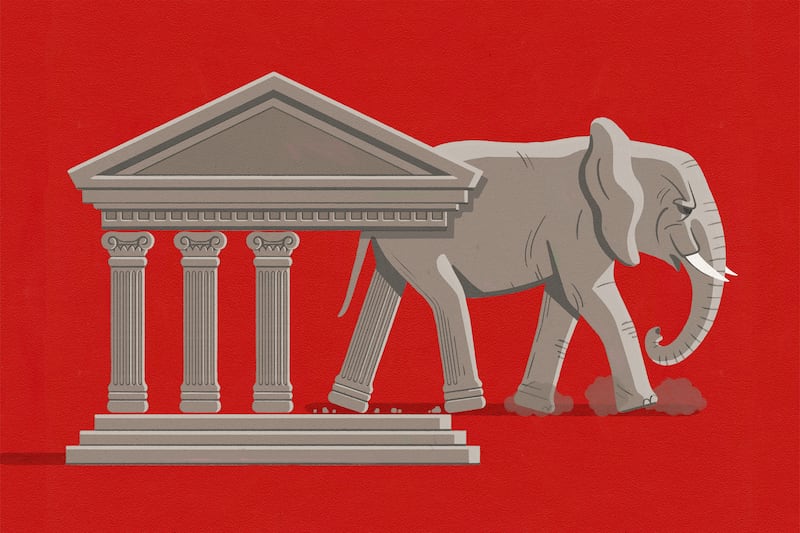

A warm, gusty wind was whipping through Washington that morning, rattling the bare branches along Massachusetts Avenue and sending scraps of paper skittering down the sidewalks. The National Weather Service had issued a red-flag warning — gusts up to 45 miles an hour in air so dry that any spark could run. The sky had that washed-out autumn glare that makes the city feel brittle.
Inside the Heritage Foundation’s headquarters, the air felt just as charged.
The all-hands meeting had been called in the foundation’s main conference room, paneled in dark wood. Roughly 200 chairs faced a small stage, where deep blue curtains framed a marble backdrop, lending the room an institutional gravity, as if it were an annex of the U.S. Capitol a few miles away. By the time the meeting began, every chair was filled and staffers who couldn’t get a seat stood in the back.
A bitter internal dispute had erupted inside the conservative think tank — one that pitted Jewish staff members and their allies against younger nationalist colleagues. Six days before, on October 30, 2025, the Heritage president had posted a video defending the foundation’s close ties to Tucker Carlson, the former Fox News host who had recently come under intense fire for hosting extreme figures on his popular podcast.
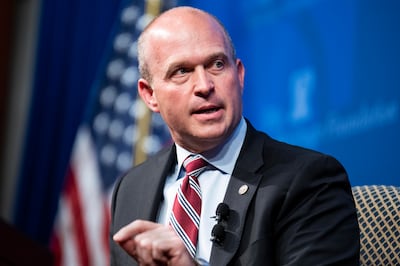
Rather than disavowing Carlson, or the figures he’d platformed, the Heritage president, Kevin Roberts, had doubled down. Now he stood at the front of the room, hoping to calm the maelstrom before it devolved into open mutiny.
“This old professor wants to have office hours with you,” he said, smiling faintly.
He assured the staff that there would be no recriminations. Tough feedback was welcome, he insisted. Turning slightly, he gestured toward Richard Stern, at the time the Jewish director of Heritage’s federal budget program, who sat in the first few rows.
“I think Richard Stern has proved that over the last few years,” Roberts said.
Then, addressing Stern directly, he added, with a tone that was meant to sound jovial, “If I may, sir … I not only don’t mind it. You’ve probably discovered I kind of like it.”
The room was silent, not even a ripple of nervous laughter. The tension hung — palpably unbroken for a beat or two. Then he opened the floor to questions.
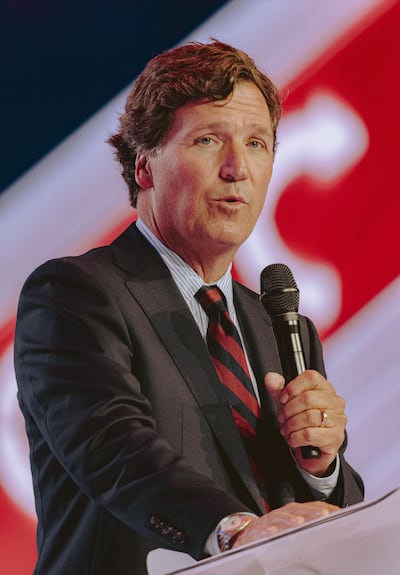
For some time, Carlson had been problematic for Heritage. Since leaving Fox News in 2023, his influence within segments of the conservative movement had, if anything, grown. Unbound by network constraints, he now leaned fully into conspiracy theories. His podcast increasingly featured figures and ideas Fox would never have allowed. Carlson hosted Daryl Cooper, who has promoted Holocaust revisionism and narratives sympathetic to Adolf Hitler. He welcomed Alex Jones, the Infowars founder whose conspiracy theories include claims about global cabals controlled by Jews.
All of that was already festering when Carlson hosted the far-right provocateur Nick Fuentes, an openly antisemitic podcaster who has said “Jews have no place in Western civilization” and that women should not have the right to vote. Fuentes once mocked the Holocaust — asking how long it would take the Cookie Monster to bake six million cookies — and he openly embraces authoritarian imagery. “My problem with Trump,” he had said in one podcast, “is that he is not Hitler.”
Fuentes touched on some of these themes in a rambling dialogue with Carlson in which he professed his admiration for Joseph Stalin. Carlson listened respectfully and didn’t push back.
What was unfolding inside Heritage was not just an internal dispute but rather a fight over the future of the conservative movement.
To many long-time Heritage employees, including some of the most prominent policy analysts, the interview crossed a line. Heritage had spent significant sums advertising on Carlson’s podcast. Carlson himself had been the keynote speaker at the foundation’s lavish 50th anniversary gala in 2023.
But instead of disavowing Carlson or even distancing Heritage, Roberts had released a video defending him. Carlson, he said, would “always be a close friend of the Heritage Foundation.” His critics, on the other hand, belonged to a “venomous coalition” and a “globalist class.” And while he said he abhorred some of Fuentes’ views, he declined to condemn Carlson for giving them a platform. Twice, he invoked Christianity to frame his defense of Carlson.
Now, in the conference room that windy morning on Massachusetts Avenue, those words hung in the air — unspoken but unmistakably present — as Roberts opened the floor to questions. A hand shot up. A veteran of the foundation spoke next, invoking William F. Buckley, a lion of the conservative movement, who had insisted conservatism must expel its “lunatics.” As an example, he brought up David Duke, the Ku Klux Klan grand wizard whose brief ascent within the Louisiana Republican Party in 1989 ended in total repudiation. “Did we cancel David Duke? Yes. You don’t even know who David Duke was, probably most of you,” he said to junior staffers, some of whom were in their early 20s.
From there, the meeting devolved into a fracas. Jewish employees and their allies said bluntly that the institution they worked for was now amplifying figures who trafficked in antisemitism, echoing his warning. Younger staffers aligned with the movement’s rising nationalist wing pushed back, arguing that their religious convictions and anti-interventionist views were being unfairly policed and that legitimate disagreements over foreign policy were being recast as bigotry.
At one point, the argument turned to a Shabbat dinner suggested as a gesture of solidarity with Jewish colleagues. A young Catholic staffer said he could not attend, explaining that Fridays were reserved for “prayer” and “abstinence.” He also worried the dinner might become an “informal litmus test.” Victoria Coates, a senior Heritage official who co-chaired the foundation’s antisemitism task force, called that claim a “gross mischaracterization,” saying he had twisted what was meant as a “generous offer” into a “personal attack.”
As the disputes droned on, Roberts tried to hold a stoic face while gripping his hands tightly together. He had called the meeting in hopes of restoring his squandered authority, but little that transpired seemed to confirm those hopes. That afternoon, to no one’s surprise, the leaked full video of the two-hour meeting appeared on the Washington Free Beacon website.
Many conservatives inside and outside Heritage saw the leaks as justified, even necessary, because what was unfolding inside Heritage was not just an internal dispute but rather a fight over the future of the conservative movement.
For half a century, the Heritage Foundation has shaped conservative thinking — translating ideology into policy, staffing Republican administrations, influencing judicial selection, and, at critical moments, deciding which ideas and allies belonged inside the coalition and which did not. From Ronald Reagan to Donald Trump, no think tank in Washington has exerted more influence (Heritage, after all, was the architect of Project 2025, the policy blueprint for a second Trump presidency).
The institution that had long enforced the movement’s boundaries was struggling to define them. Facing a frayed staff on that gusty November morning, an embattled Roberts tried to contain the damage. He acknowledged a “terrible choice of words” and his use of antisemitic “tropes.” He blamed the video on his since-demoted chief of staff. He said he had not known Fuentes’ body of work. He did not accept blame, nor did he call out Carlson.
Once the video of the two-hour meeting leaked, the fallout was immediate. The Atlantic described the episode as a conservative movement “convulsed” by its own contradictions, while The Wall Street Journal warned that Carlson’s embrace of Fuentes had triggered an “earthquake” inside the right.
Across the conservative movement — among think tank staff, donors, pundits and elected officials — the same question was beginning to surface: What, exactly, did the label “conservative” still mean, and who had the authority to define it?
Origins of a movement
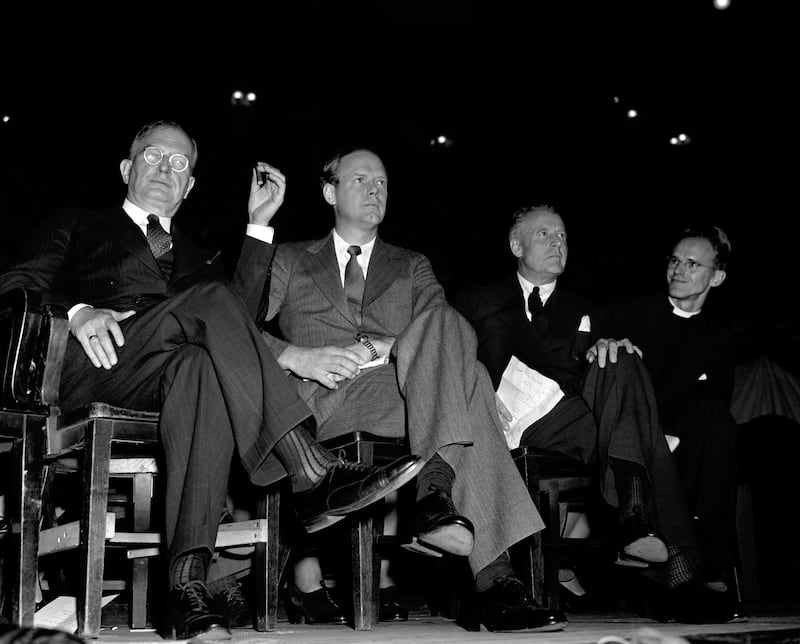
On October 30, 1941, Charles Lindbergh took the stage at Madison Square Garden, the cavernous arena packed with 22,000 supporters of the America First Committee. Thousands more stood outside in the cold, listening over loudspeakers as his voice echoed through the streets of Midtown. Inside, the crowd rose in waves — applause rolling up toward the rafters, flags and placards lifted above their heads.
Somewhere in the audience sat an adoring fan: William F. Buckley Jr., a lanky teenager with a wide, toothy grin and a penchant for tailored clothes, weeks shy of his 16th birthday. “It was all terribly exciting,” he would later recall.
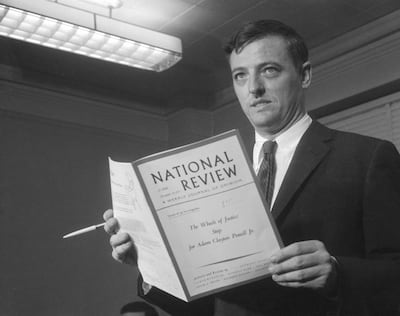
Buckley, who would go on to found the National Review and become the de facto gatekeeper of American conservatism, had already started an America First chapter at his high school in Sharon, Connecticut.
Buckley may have been too young to grasp the darker side of Lindbergh’s appeal. Weeks before the rally, Lindbergh had warned that the push toward war came from “the leaders of both the British and Jewish races,” adding that Jews wielded outsized influence over American media and government. The speech triggered national denunciations and threatened to fracture the anti-war coalition.
Pearl Harbor ended America First overnight. What remained was not a movement so much as a loose collection of impulses: hostility to FDR and the New Deal, Midwestern isolationism, Southern resistance to integration, suspicion of international institutions, religious traditionalists, philosophical libertarians, and country club conservatives. After two years in the Army and four at Yale, Buckley set out to bring those strands together. The challenge was not simply to unite these factions but to decide what did not belong.
Buckley’s answer was enforcement.
In 1955, with the founding of National Review, he set out to define the boundaries of American conservatism — who was inside the coalition, and who had to be kept out. That required drawing lines against figures whose rhetoric or ideas threatened to discredit the movement.
He began with the fringes. When The American Mercury, once a respected conservative journal, drifted into open antisemitism, Buckley severed ties, barring anyone from serving on both mastheads. He refused to give oxygen to Jew-hatred.
The insurgent movement William Buckley had fought to shape was no longer scrappy. It had money, real estate and a permanent address in Washington.
He moved next against conspiracists. In 1962, he publicly confronted Robert Welch, founder of the John Birch Society, after Welch accused President Dwight Eisenhower of being a communist agent. Anticommunism, Buckley insisted, had to remain grounded in reality. Otherwise, the movement risked becoming what he called a “lunatic asylum.”
These decisions carried real costs. The Birch Society had thousands of members and deep grassroots energy. But Buckley understood the tradeoff. Influence required credibility. And credibility required boundaries.
He did not always draw those boundaries cleanly.
In 1957, National Review defended segregation in the South, arguing that federal intervention was unwarranted. Buckley later repudiated that position, acknowledging that he had been wrong and that federal action had been necessary. The episode revealed both the limits of his judgment and the difficulty of holding together a coalition built from incompatible parts.
Even at his peak, Buckley never fully resolved those tensions. In 1963, he set out to write a definitive statement of conservative principles. After two months and 60 pages, he abandoned the effort. As his biographer Sam Tanenhaus discovered when he examined the manuscript, Buckley’s problem was that he “didn’t know where to begin.” The failure became “the single greatest disappointment in Bill Buckley’s intellectual life.”
Power takes shape
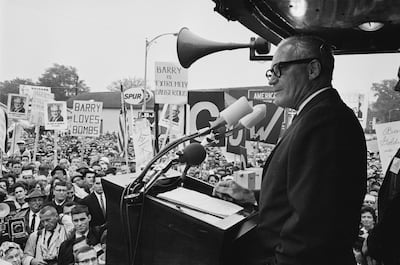
By 1970, the conservative coalition was gaining momentum. After the GOP nomination of Barry Goldwater in 1964 — and especially after Ronald Reagan became governor of California in 1966 — real power appeared within reach. But translating electoral victories into governance is another matter.
A set of allies in the business world had already begun working out that problem, and had begun laying the policy groundwork. In 1938, a group of New York businessmen opposed to the New Deal launched the American Enterprise Association, which produced studies on taxes, housing, regulation and labor policy, distributing them to congressional offices, not as manifestos but as usable analyses. In 1962, it renamed itself the American Enterprise Institute for Public Policy Research. It built on what Buckley had started with National Review but took it a step further, translating ideas into governing tools.
This represented a breakthrough, and yet, as influential as AEI would become, it could also frustrate policymakers.
In the spring of 1971, for example, a young GOP congressional aide named Ed Feulner watched his side lose a heated floor debate over the supersonic transport, or SST. The next morning, a detailed study arrived on his desk — fully persuasive and completely useless because it arrived too late. When Feulner called the think tank to ask about the delay, its president replied that they “didn’t want to try to influence the vote.” The tardy paper is widely understood to have come from AEI. Feulner drew a lesson. AEI knew how to get the policy right. The institution he would build would make sure it got there before the vote.
Feulner imposed the “briefcase test”: policy papers short enough to fit in a congressional briefcase and be read during a debate. In emergencies, the think tank produced one-page memos within 24 hours.
Occasionally, the briefcase burst. When Ronald Reagan won the presidency in 1980, Heritage handed him a 20-volume, 3,000-page handbook titled “Mandate for Leadership,” with more than 2,000 recommendations. At his first Cabinet meeting, Reagan distributed the massive “Mandate” to his Cabinet secretaries.
Heritage opened its headquarters in 1983, two years after Reagan took office. The insurgent movement Buckley had fought to shape was no longer scrappy. It had money, real estate and a permanent address in Washington. It had moved from the margins to the center of power.
The “Mandate for Leadership” would become a governing blueprint. By Heritage’s own accounting, roughly 60 percent of its recommendations were adopted or attempted in Reagan’s first year. Roughly 15 Heritage staff moved into roles across the administration.
And yet, the relationship was at times tense. One Reagan official described Heritage as both “very helpful” and “a hindrance,” the White House guest who sleeps on the couch and criticizes the cooking.
Heritage didn’t just advise — it evaluated, publicly grading Reagan’s performance against conservative priorities (The Washington Post reported that the new Heritage report card scored Reagan at “about 60 percent” his first year).
The tension was a sign of something larger. The movement Buckley had tried to discipline now had an institutional engine — one capable of shaping policy, staffing government and enforcing expectations from the outside.
For a time, it worked. And then came the end of the Cold War. The question was no longer how to govern. It was what the movement actually believed.
What held it together
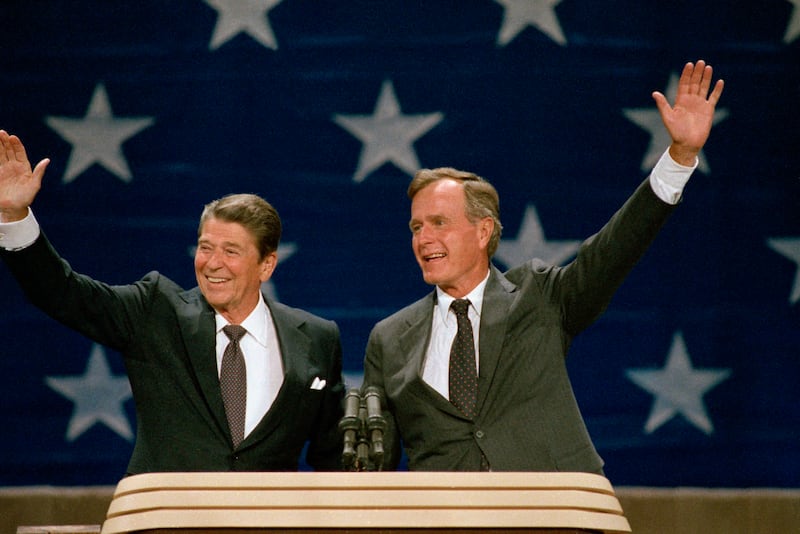
The Buckley-Reagan coalition was built on a shared commitment to free markets and cultural traditionalism. But what truly unified it was anticommunism. When the Cold War ended, that unifying force disappeared.
George H.W. Bush inherited the movement at precisely that moment. His presidency was marked less by ideological ambition than by pragmatism — budget deals, compromises and a governing style that prioritized stability over transformation.
Ed Feulner warned that the conservative message was in danger of being “sullied by a visionless White House pretending to be conservative.” By October, The Atlantic called Bush “the gravedigger of the revolution.” In other words, Bush had abandoned the hallmarks of the Reagan Revolution — small government, free markets unburdened of meddlesome regulations, low taxes. To movement conservatives, Bush was neither an ideological conservative nor a revolutionary. He was a caretaker of the status quo.
In December 1991, former Richard Nixon speechwriter Patrick Buchanan declared his candidacy and challenged Bush in the New Hampshire primary the following February. Buchanan’s announcement speech blended nationalism, immigration restrictions and foreign-policy isolationism. “Americans must have first claim on American jobs, American resources and American markets,” he said. The America First message that had captivated Buckley way back in 1941, listening to Charles Lindbergh at Madison Square Garden, had returned.
And with it, some familiar baggage. As war against Iraq loomed in 1990, Buchanan published a column claiming that the diesel engines at the Nazi Treblinka death camp could not have produced enough carbon monoxide to kill 900,000 Jews. The diesel story had circulated in Holocaust-denial polemics for decades.
Months later, during the Gulf War debate, Buchanan blamed the conflict on “the Israeli Defense Ministry and its amen corner in the United States,” at the expense of American lives. The tropes, dating back to Lindbergh, were difficult to ignore.
Buchanan was not alone. In December 1991, Buckley revived his role as enforcer, publicly rebuking Joseph Sobran, a National Review editor who had grown increasingly fixated on Jews. Buckley concluded that Sobran had become “contextually antisemitic” and, after a prolonged dispute, forced him out of the magazine.
But when it came to Buchanan, Buckley hesitated.
The difference appears to have been political. Buckley believed Bush needed to be disciplined, and Buchanan was the instrument at hand. On the eve of the New Hampshire primary, National Review urged a “tactical vote” for Buchanan.
It was a revealing compromise. The man who had spent decades policing the movement’s boundaries was now bending them.
The result was collapse. In November 1992, Bush won just 37.6 percent of the popular vote — worse than Barry Goldwater’s showing in 1964, long considered the low point of modern conservatism. Buckley had tried to discipline Bush without breaking the coalition. Instead, the coalition broke anyway.
Republicans retook Congress in 1994, holding on to the House until 2006. But the movement’s fiscal discipline and sense of purpose were fading. The federal government moved from a $128 billion surplus in 2001 to a $412 billion deficit by 2004. Conservatives still held power, yet increasingly seemed unsure what conservatism required in practice.
In September 2008, the financial markets crashed, followed by controversial corporate bailouts. On February 19, 2009, CNBC commentator Rick Santelli erupted from the floor of the Chicago Mercantile Exchange, denouncing the bailouts and calling for a “Chicago tea party.” The outburst ignited nationwide protests. Much like Buckley had wielded Buchanan against Bush, the tea party movement now began targeting Republican incumbents. Its first scalp was Utah Sen. Bob Bennett, a three-term incumbent. Others followed, including veteran Indiana Sen. Richard Lugar in 2012 and House Majority Leader Eric Cantor in 2014.
Other tea party-related groups began targeting incumbents, and the Heritage Foundation joined in. In 2010, it launched Heritage Action to pressure Republican lawmakers. Party leaders were not amused. Senate Minority Leader Mitch McConnell urged donors to cut off Heritage funding. For years, Heritage scholars had been regular participants in the Republican Study Committee’s weekly meetings. But in 2013, after Heritage Action helped derail a major farm bill, the committee barred Heritage representatives from the room.
One kindred spirit in the Senate was Sen. Jim DeMint of South Carolina. He openly preferred ideological purity to winning elections, often quipping that he would “rather have 30 Marco Rubios in the Senate than 60 Arlen Specters.” (That was before Rubio himself joined a bipartisan immigration reform effort and got hit by Heritage attack ads.) In early 2013, DeMint resigned his Senate seat to become president of the Heritage Foundation. Years of factional warfare followed, as Heritage turned its fire on Republican incumbents.
After 2016, DeMint hoped to forge a close partnership with the new Trump administration. Instead, DeMint was himself pushed out in April 2017, amid complaints that under his leadership the think tank had become too “bombastic and political” at the expense of its research mission. Heritage tried to recover its institutional gravitas, hiring Kay Coles James, a former George W. Bush administration official. During her brief tenure, James attempted to refocus on policy analysis, while broadening the foundation’s appeal and softening its tone. In the summer of 2020, after the killing of George Floyd, she wrote a column describing Floyd’s death as “senseless” and calling racism America’s “cancer.” Some populist conservatives, including powerful voices in MAGA, took umbrage to those comments, making clear how narrow the space for moderation had become.
The institution Buckley had imagined as a stabilizing force was now struggling to hold the movement together.
A movement unraveling
By early 2020, Tucker Carlson was routinely attacking Heritage from his Fox News perch. In December 2019, he had told his audience that Heritage “no longer represents the interests of conservatives.” He urged Heritage donors: “You may have sent them money — hopefully for the last time.”
The clash revealed a shift in the power balance. William F. Buckley Jr. had launched National Review in 1955 to give conservatives a voice and elite gravitas. Heritage had then inherited and institutionalized Buckley’s mantle as both legitimator and enforcer. Now, Heritage was itself under fire from populist media figures who answered to no one.
The morning after the January 6, 2021, Capitol riot, James called the violence the work of “a band of criminals” and warned that conservatives must never abandon the Constitution “to maintain power for a preferred candidate.” Carlson ran the other way. While not endorsing violence per se, Carlson framed the rioters’ motives as understandable. “Millions of Americans sincerely believe the last election was fake,” he told his viewers. “You can dismiss them as crazy, call them conspiracy theorists, kick them off Twitter. That won’t change their minds.”
Carlson left unsaid how those millions of voters came to believe the election was stolen.
Of course, Carlson himself repeatedly told them so in the weeks between the election and the riot. In particular, he warned viewers not to trust voting machines. “The people now telling us to stop asking questions about voting machines are the same ones who claimed that our phones weren’t listening to us,” he said. “They lie. We all know that.”
For decades, Heritage had graded elected officials using consistent principles. Now, it was celebrating MAGA figures whose positions veered opposite directions.
James’ ouster in March 2021 was one more symptom of coalitional drift. The leadership swings from DeMint’s insurgent activism to James’ recalibration and on to the combative hire that followed reflected a deep identity crisis. For decades, Heritage had served as the movement’s policy engine, translating ideology into governing proposals. Now it seemed unsure whether it was a conservative policy tank or a platform for pushing emerging populist waves.
James was replaced by Kevin Roberts, the combative former head of a conservative Texas policy shop. He brought Carlson with him, not as an employee but as a sort of mascot. On April 21, 2023, Carlson headlined Heritage’s 50th anniversary gala. The timing was strange. That same evening, his final broadcast aired on Fox News. Three days later, the network fired him, just a week after it settled a $787.5 million defamation lawsuit with Dominion Voting Systems over false claims about the 2020 election. No statements were made, but most assumed Carlson’s dismissal was linked to that settlement. Reports also suggested that emails surfaced in the Dominion case had bled into another lawsuit by a former Carlson producer alleging antisemitism in Carlson’s Fox program.
A lot of the new right is about lockstep. You’re with us or against us.
None of this dampened Heritage’s enthusiasm for Carlson. Soon Heritage was promoting Carlson’s new independent media platform, paying advertising fees to the same pundit who had recently urged donors to cut off the institution’s funding.
As Donald Trump began his second presidency, Heritage expressed unqualified support. In January 2025, Michael Warren argued in The Dispatch that Heritage had “sold its birthright.” For decades, Heritage had graded elected officials using consistent principles. Now, it was celebrating MAGA figures whose positions veered opposite directions. Heritage produced a video praising Trump’s choice to put Robert F. Kennedy Jr. — a longtime supporter of socialized medicine and abortion on demand — in charge of national health policy. Heritage produced a similar video for Tulsi Gabbard, Trump’s choice for director of National Intelligence. Her congressional voting record had earned a 10 percent score from Heritage itself, and Heritage had pilloried her foreign policy positions.
After Russia invaded Ukraine, Heritage flew a Ukrainian flag. Now, as MAGA energy favored Moscow, the flag was gone. Heritage now favored tariffs — rejected by Heritage scholars in dozens of studies over decades of work defending free trade — as necessary corrections to “globalist-crafted, America-last policies.” With pivot after pivot, Warren demonstrated that the Heritage Foundation now seemed intent on proximity to MAGA power — at any cost to coherence.
After the fallout
In the weeks that followed the fracas at Heritage, the fallout came hard and fast. Three board members resigned, along with several key policy analysts. More than a dozen members of the foundation’s legal and economic brain trust departed soon after, many landing at Advancing American Freedom, a group founded in 2021 by former Vice President Mike Pence.
On a rainy Friday morning three months after that incendiary Heritage meeting, the city felt more settled. The rain had passed, but the streets along Pennsylvania Avenue were still slick, shallow pools gathered along the curbs, reflecting a slowly clearing sky. The city was unusually quiet, and not just from the weather. Congress was out of session. The usual churn of staffers, aides and motorcades had thinned.
A few blocks from the Capitol, inside a polished office building on Pennsylvania Avenue, the growing staff of Advancing American Freedom was settling into an expanded headquarters. The main offices occupied the eighth floor, but the influx of staff from Heritage had forced a quick expansion. The new space was functional, with no security at the door and none of the polished woodwork or high ceilings that defined the Heritage Foundation.
It was in a conference room on that lower floor — functional, recently assembled, still carrying the feel of a temporary solution — that economist Richard Stern and legal expert John Malcolm, two of the Heritage exiles, met. They had convened just moments after a 6-3 Supreme Court decision striking down Trump’s sweeping trade tariffs, imposed under emergency powers. Two of the three Trump appointees had voted against the president. The ruling had sent a jolt through Washington and framed their conversation.
Stern, the Heritage economist Kevin Roberts had referenced in the November all-hands meeting as proof that leadership welcomed dissent, now worked out of these offices. Malcolm, who for years had led Heritage’s legal program, joined him that morning. A former federal prosecutor, Malcolm framed the court’s decision in constitutional terms. “Separation of powers, individual liberty and the rule of law are very important,” he said. The test of a policy, in his view, was not simply whether the president wanted it or whether the base demanded it. “I don’t feel comfortable with ‘the president wants to do it and therefore it must be fine.’”
When the conversation turned back to Heritage, the same concerns surfaced. Stern and Malcolm described an organization that had ratcheted up internal conformity, echoing the fealty Trump demanded from his base. As Heritage lost coherence, they said, conformity tightened further. “Your value was how much you serviced their interest,” Stern said of senior leadership. “If you were speaking up against it, you were mad. There was no intellectual freedom.” Conformity without coherence. The ends justified the means, and even ends were fungible. “Conservatives understand that good outcomes follow from good process,” Stern said. “But a lot of the new right is about lockstep. You’re with us or against us. There’s no room for process.”
Malcolm also objected to the rhetoric of national emergency that now infused Heritage. Roberts and his team often spoke as if the country faced a final, existential struggle requiring immediate and sweeping victories at whatever cost. Malcolm rejected that premise. The United States had worked through crises before, and its system was designed to manage change through law and persuasion. “A lot of that is going to be through the rule of law,” he said, “and just plain trying to persuade legislators and fellow Americans that my vision is the right one. It’s not going to be by bludgeoning them.”
Stern suggested the deeper problem was a trade of principles for proximity to power. “A lot of what happened at Heritage,” he said quietly, “was a naked sacrifice of principles to chase influence — really to chase the perception of it.”
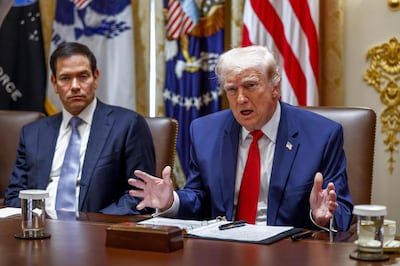
Both Stern and Malcolm expressed cautious optimism that Vice President JD Vance and Secretary of State Marco Rubio — the leading candidates to succeed Trump — would prove more constructive once Trump has left the scene. Malcolm pointed to Vance’s personal background as a Catholic convert married to a Hindu as a likely indication of less extreme views. “I certainly have not given up on JD Vance at this stage,” Malcolm said. “I wish he would distance himself a little bit more from Tucker Carlson. ... I have no hope for the Tucker Carlsons and Candace Owens of the world. I still have hope for JD Vance.”
The role that AAF plays in the conservative movement and the GOP going forward may depend on how Malcolm’s hopes are borne out.
For decades, the conservative movement relied on legitimating institutions like National Review, AEI and Heritage. Those institutions did not eliminate factional conflict, but they imposed intellectual authority and coherent boundaries. Someone had the authority to steer the ship and repel boarders. If the crisis at Heritage revealed anything, Stern and Malcolm suggested, it was that capacity was gone — and the movement was now grappling with what comes next. Malcolm reflected on the role Heritage once played in shaping conservative policy debates and preparing conservative leaders to govern. In recent years, he suggested, the emphasis had shifted — from building to breaking, from persuading to prevailing. The instinct now was to dismantle, to clear the field, to win the immediate fight. What would follow — what would replace what had been torn down — was less clear.
Outside, the city moved on as it always does, the gray afternoon settling into evening. The ruling would be parsed, the factions would realign and the arguments would continue, louder and more certain than before. But inside rooms like this one, among the people who had once tried to give the movement its shape, there was a quieter recognition: It is one thing to blow something up. It is another thing entirely to build it back.
This story appears in the May 2026 issue of Deseret Magazine. Learn more about how to subscribe.