

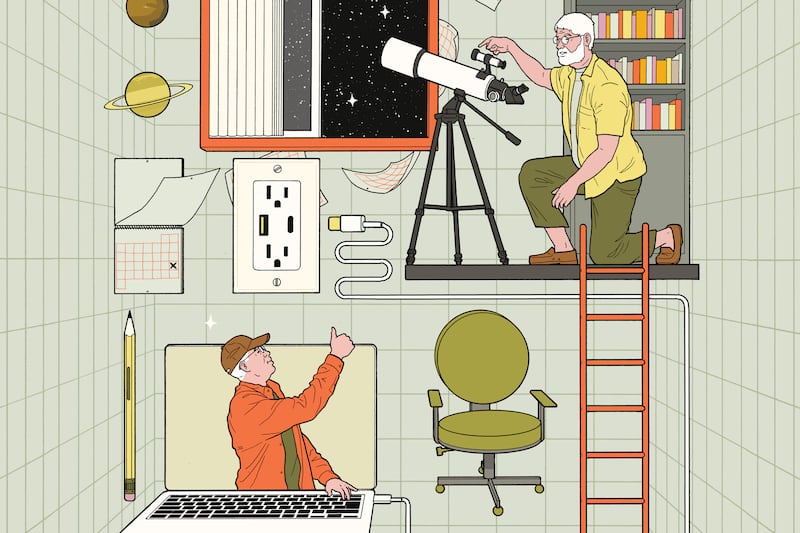

My dad and Gene Kritsky have known each other since second grade. They met at a parochial school in Miami, Florida, sponsored by the Seventh-day Adventist Church, where they bonded over a shared interest in astronomy. They had the same telescope and once stayed up all night to watch what they thought was a lunar eclipse. It turned out to be a “penumbral eclipse,” which is very difficult to see with the naked eye. So basically, they’d stayed up all night to see nothing — and still remember it today.
They also took advanced math classes together and once skipped school to attend a Richard Nixon rally. “He had the biggest nostrils of any person I’ve ever seen,” Gene remembers. At that, my dad laughs as hard as I’ve ever heard. I wonder if Gene would be able to hear it all the way in Ohio, where he lives, even if they weren’t on Zoom right now.
It had been a long time since they had talked like this. Gene left their shared school halfway through 10th grade and, not long after, moved to Illinois. He stayed in touch via long-distance calls, and when he’d visit Miami, they’d still get together for some stargazing. But things got busy with families and careers, and 40 years flashed by. “Life is what happens while you’re busy making other plans,” Gene says, a phrase made famous by John Lennon, over Zoom.
Maybe there was the occasional email that came through, just checking in, but in the intervening years of middle age, between the carpools and career moves, their friendship was mostly dormant. In fact, almost all of my mom and dad’s friendships went that way. Growing up, I didn’t see either of my parents — but my dad especially — spend much time with friends.
But life slowed down when retirement rolled around. My dad tried to fill his newly vacant time with trips to the gym, sporting events, a new, state-of-the-art telescope.
But more often, he ended up watching a lot of TV. Then, last June, Gene reached out with a question about buying a new telescope. “If you would like, we can Zoom to discuss this,” he wrote, “or just to catch up.” They’ve been talking over Zoom every few weeks since.
The calls last two or three hours each, which was striking; my mom mentioned my dad was talking more with Gene than he’d ever talked in his life. There was a new spark in his interests. I even noticed it in our conversations, when he’d recount their far-ranging chats about memories or stars or religious philosophy.
It was like he’d rediscovered some part of himself I’d never seen. Or at least seen so connected.
Approaching 30 and knowing all about the loneliness epidemic that’s disproportionately consuming men, I thought maybe I could learn something from my dad and Gene.
Loneliness and isolation
I am my father’s son. In many ways, but certainly when it comes to my generally shy, reserved nature. And that scares me, because modern research on loneliness is sobering.
A notorious 2010 study by Brigham Young University psychology and neuroscience professor Julianne Holt-Lunstad found lacking meaningful friendships is as much a risk factor for premature death as smoking 15 cigarettes per day. More recently, a 2023 study led by researchers from Harvard, Boston University and the University of British Columbia found social isolation was particularly predictive of mortality risk, while loneliness was more related to psychological distress.
Loneliness and isolation seem to be built into our everyday lives, as we engage in endless scrolling and endless television and fewer occasions to gather. The effects are particularly pronounced among the young, and among men. But the only way out, it seems, is through.
Men can feel lonely because they’re isolated or because they don’t feel like they really know their friends, or their friends really know them.
— Marisa Franco, psychologist and friendship maintenance expert
If you break it down into its most basic, not-very-human bits, friendship requires three things: repeated interactions, shared space and emotional vulnerability, all of which come naturally to school age children. None of those things, least of all emotional vulnerability, is inherent to modern American adulthood.
“You can’t rely on the same assumption you had when you were a kid that friendship is just going to happen,” says Marisa Franco, a psychologist and bestselling author whose work explores making and maintaining friendships in adulthood. “It will only happen,” she adds, “if you make an effort toward it.”
Sometimes, the easiest way to do that is to reconnect with old friends. “Most friendships don’t end because there was incompatibility,” she explains, “but rather because people are busy.” They move and have kids and take care of aging parents. That’s what happened with Gene and my dad.
I’ve noticed it in my own life, too. It’s harder to keep up with friends as I get older — but when I do reconnect with old friends, even after many years, it’s much easier to feel like I can pick up where we left off. That this is someone who knows me — and who I want to know me.
Whether they know it or not, that’s what underpins my dad’s Zoom calls with Gene. “We already know each other,” Gene said. “The only thing different is we’re a little grayer, and we have more bread.” And now, in retirement, time. “I don’t really make a lot of friends,” my dad added. “But when I talk to Gene, it’s like he said. I just know him.”
And it’s technology, the thing most responsible for the isolation that exists in tandem with loneliness, that is growing their friendship. Their conversations, framed by generated Zoom backgrounds and meeting room links, are technology at its best.
Social media, born of a desire to foster connection between people, no longer prioritizes such noble goals. Most mainstream platforms are explicitly designed to create engagement with the platforms instead of with other people, often inverting their founding purpose into a funnel of isolation.
“People who use a lot of technology are either the least lonely or the most lonely compared to people who don’t,” Franco says. Getting swept along by algorithmic feeds and a vague awareness of what your friends are up to without any direct contact allows loneliness to fester. However, when used deliberately, like Dad and Gene’s online regulars table on random weekday afternoons, technology can bring us back together.
I watch the two men, with their cumulus white beards, talk about telescopes as if they’ll never run out of things to say. There are little zingers about photos of the moon that aren’t quite in focus, and those sincere chuckles that travel across several states, from Gene to Dad and back again.
Old friends and new beginnings
In April, while getting dressed for Easter brunch, my old grad school roommate FaceTimed me out of nowhere to chat about a new movie he’d seen. He wanted to ask what I thought of the premise, as well as to give me a tour of his new condo. I said hello to his two cats, and I caught up on his latest dates, and by the time we hung up after 18 minutes, I was telling him how excited I was to catch up in person soon enough.
Yet while physical proximity matters, emotional proximity seems to matter more; it’s a much harder thing to cultivate. “(Men are) half as likely to express affection towards a friend, and half as likely to be vulnerable with a friend,” Franco says. “Men can feel lonely because they’re isolated or because they don’t feel like they really know their friends, or their friends really know them.”
Lacking meaningful friendships is as much a risk factor for premature death as smoking 15 cigarettes per day.
Thanks in part to FaceTime, I haven’t had to worry about that. Since turning 18, I’ve moved 11 times across five states, from Utah to Delaware, Florida to California. I’ve chased jobs and opportunities, for myself and for my wife. But with another likely move approaching this summer, and who knows how many more after that, plus a son who just turned two, staying rooted in a physical community has proven unthinkable at the moment.
Even if we joined a church, or started attending sports practices, or invited fellow daycare parents over, the investment required to build real friendship, not just neighborly respect, would be tremendous. Perhaps we’ll get there someday. But for now, I like the idea of growing into middle age alongside pixelated friends.
There’s room to reminisce, just like Dad and Gene do, about that “lunar” eclipse or their old math classes. There’s room to look ahead, too. To ask about what you hope or plan to do tomorrow or next year or before you die — and to get a real answer that can be supported (even if it’s with a jest, first). Learning about a friend at whatever stage of life they’re in is just as sweet as reminiscing about an old memory or as fun as making a new one.
Gene, it turns out, practices beekeeping. He got started as a high school student when he stumbled upon a collapsed beehive on the side of the road. He returned to the hive with some test tubes, collected samples of larval bees, then put their development on display in his high school’s chemistry classroom. “A lot of kids got excited about it,” he remembers. “Met a lot of nice girls that way, too.” Again, my dad laughs.
Later, after the call is over, my dad and I are chatting. He’d never heard that beehive story before.
New things, it turns out, can still be found in old places.
This story appears in the June 2026 issue of Deseret Magazine. Learn more about how to subscribe.