

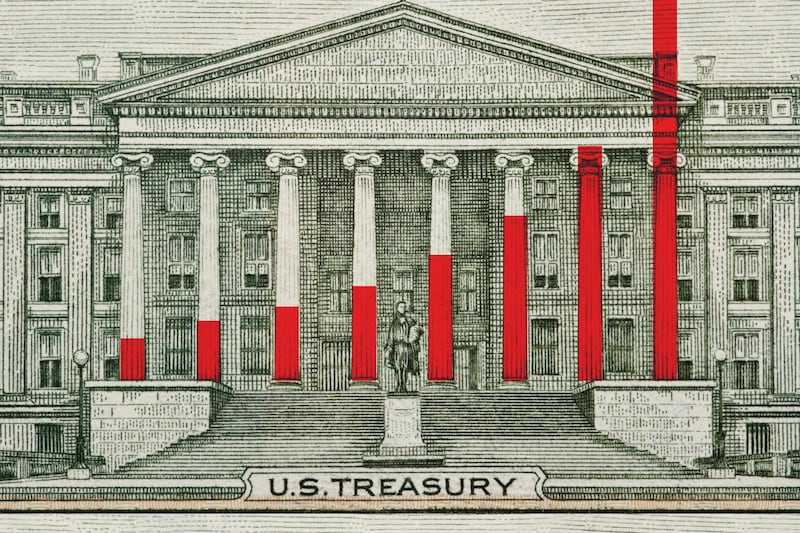

- The U.S. national debt is projected to reach $40 trillion before the end of the year.
- Deficit hawks argue that the national debt is contributing to inflation, high interest rates and slower growth.
- A new branch of economics postulates that the government needs to spend more in targeted areas to stimulate growth, which will help pay down the debt.
The U.S. national debt, which is quickly approaching $40 trillion, recently hit a new milestone when, in March, the total surpassed the nation’s GDP.
It has been more than 20 years since the government has balanced its budget.
While most economists believe the nation’s massive debt is already hurting Americans, some lawmakers and economists believe overspending won’t hurt the national economy.
Tom Hoenig, former chief executive of the 10th District Federal Bank and former vice chairman of the Federal Deposit Insurance Corporation, said that the national debt hurts everyday Americans by contributing to inflation and higher interest rates while slowing the growth of the economy.
Hoenig said that the concern with the debt is “not that you necessarily have a crisis, it’s that you slowly undermine the growth of your economy.”
A newer branch of economics called Modern Monetary Theory, or MMT, embraced by some Democrats, theorizes that governments that mint their own currency, like the U.S., hold no risk of defaulting on their debt because they can always issue more currency to meet their obligations.

L. Randall Wray, a senior scholar at the Levy Economics Institute and leading proponent of MMT, told the Deseret News that he believes increasing spending in targeted areas would stimulate the economy enough to increase revenue and eventually bring down the debt. The debt, in his view, does not create a problem for growth or inflation.
According to Wray, the debt poses a much different problem. “The government spending is not necessarily well targeted. It’s mostly targeted to people who don’t need it.”
Each year, the U.S. now pays more than $1 trillion in interest to sustain its debt. Wray said that while this money boosts the economy to a degree, interest payments redistribute money to the wealthiest individuals and institutions.
MMT is not embraced by most economists, who still believe deficits and the debt are problems American lawmakers need to address.
The traditional view of why the debt poses a problem
Hoenig, who has been characterized as an inflation hawk, made his case for why the national debt is problematic.
“I have been a strong critic of the national debt because it has compromised monetary policy and has made monetary policy an enabler of running debts like we have,” he said. “The national debt today … could not have become $40 trillion without the help of the Federal Reserve printing money.”
Hoenig said that when the U.S. went off the gold standard in 1971, it took away an external discipline on both Congress and the Federal Reserve. This move, he said, led to increased debt and inflation. “Our gold stock was going down. And therefore, rather than address our printing of money and our creation of debt, we went off the gold standard.”
These actions from Congress and the Fed, Hoenig said, “gave us A, consistent inflation or consistent crises and B, a national debt that we can ill afford to continue to carry.” It would be difficult to return to the gold standard now, but to reverse the problems, the Fed will have to “take its mandate seriously, and that is price stability,” he said.
Beyond inflation, Hoenig also argued that the national debt has reduced the growth of the U.S. economy.
“When you have debt at these levels,” he continued, “100% of GDP, 108%, even 90%, we have found that the, the real growth rate of your economy slows. … The real growth rate of the economy (in the 1950s) was closer to 4%. Today, we’re happy to have 2%. So we’re giving up enormous wealth as we think we can do more by increasing our debt.”
For the last 40 years, he said, politicians have argued that their policies would grow the economy enough that tax revenue would increase enough to pay down the debt. “That’s wishful thinking. I wish it were true … yet the debt is higher (and) the growth rate is suffering.”
Is deficit spending ok if it’s targeted differently?
Wray holds a different view about the way that the national debt influences the economy. Wray said that seeking to pay down the debt through increased taxes and decreased spending could actually harm the economy.
“The only way to reduce the debt is to run a surplus, and you would have to keep doing it,” said Wray, “(and) every budget surplus that the U.S. has had was followed by a depression. Budget surpluses for the United States have not been a good thing.”
Most economists, like Hoenig, see high inflation as a consequence of deficit spending, with some pointing to the inflation the U.S. experienced after massive government spending increases during the covid-19 pandemic.
Wray argued that the inflation under President Joe Biden was not from increased spending, but rather from the way the money was spent.
“It wasn’t well thought out,” Wray said. “We should have developed a very targeted response, make sure people who couldn’t go to work still got pay, make sure that food could be delivered to people’s houses … maybe it would have amounted to the same amount of money, but it wouldn’t have been inflationary if we had targeted it.”
Why is the debt being ignored?
Addressing the national debt is not an issue that necessarily brings voters to the polls. According to Gallup, only 1%-2% of voters see the national debt as the most important issue facing the U.S.
The remedies, like the ones suggested by Hoenig, would require reining in spending on major programs like Medicare and Social Security and would likely include increasing taxes as well.
The Trump administration has attempted to tackle the national debt through means that have so far proven ineffective or at least inconsequential. The Department of Government Efficiency reported to have saved $215 billion. Even assuming this figure is accurate, it has done little to counteract the increase in spending.
Until the consequences of the debt are felt more acutely by American families, taxpayers will likely continue to quietly foot the bill.