

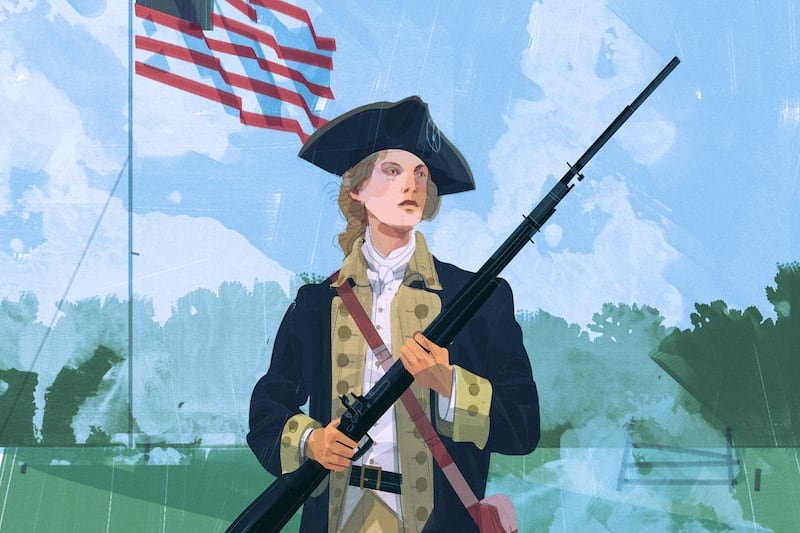

The 42-year-old looked out at the audience in Boston’s Federal Street Theater, at the men and women who had gathered to hear a story — her story. She gripped her firearm, held it perpendicular to her body, then swung it up to meet her shoulder, cocked the gun and adjusted her stance as if she were about to shoot.
That night, on March 22, 1802, Sampson performed the Continental Army’s manual of arms with unusual familiarity for a woman of her time. A familiarity she’d earned in secret on the battlefield.
By the time she stepped into the theater, she was technically Mrs. Deborah Gannett, a farmer’s wife and mother of four living in poverty in Sharon, Massachusetts. But two decades earlier, she’d sewn her own suit and disguised herself as “Robert Shurtliff” to enlist in the Revolutionary War.
She fought British forces and loyalists for 17 months in a unit filled with men. She did so despite the fact that 18th century women were not allowed to serve in combat roles and had no political rights, few legal rights and fewer opportunities to work outside their presumed roles as wives and mothers.
A newspaper reporter named Herman Mann worked with Sampson to publish her biography, “The Female Review,” in 1797. The popularity of the book — more of a semi-embellished biography stitched together by Mann than a memoir penned by Sampson — granted Sampson the audience and material necessary to embark on a speaking tour, the first woman in American history to do so.
“I awake from the tranquil slumbers of retirement,” she told the crowd that evening, revisiting her story publicly for the first time since the biography was published, “to active, public scenes of life, like those which now surround me.”
Her performance, later preserved for posterity by the Sharon Historical Society, marked the first of four nights in Boston’s neoclassical theater. Afterward, Sampson planned to travel more than a thousand miles to every major city in the greater Hudson River Valley on a two-year tour. More than 1,500 people bought tickets to hear her speak in Massachusetts, New York and Rhode Island.
Everyone wanted to witness firsthand the story of the so-called female soldier.
Each night, in the same uniform she first wore as a brash 21-year-old, risking her freedom, reputation and life to fight in Gen. George Washington’s army, Sampson revisited her experience of combat. She recounted her injuries and what it took to earn them. And in each telling, as the memories came flooding back, she might have smelled gunpowder or felt phantom pains.
She and her audience might have felt transported, as if the theatre and the world around them fell away to reveal the past and the breadth of Sampson’s experience, starting, maybe, with one summer morning, when she was on the cusp of charging out of the shadows.
A soldier with a secret
She hid under the final moments of darkness before dawn broke on July 3, 1782, her blue coat and breeches obscured by the 4 a.m. twilight. Her captain, George Webb, had ordered 20 fellow infantrymen and two sergeants to scout Westchester County for British troops. They made it more than 40 miles from West Point, New York, in the Hudson Highlands as far as Eastchester without detection. This so-called “neutral ground” sat between British-controlled New York City and upstate Patriot territories.
Her peers jokingly called her “Molly” on account of her lack of facial hair, though other than the missing beard, her femininity didn’t stick out enough for anyone to notice. Sampson was taller than most women she knew, standing at 5 feet, 7 inches. What helped more than anything else, though, was the simple fact that she was as tough as any of her comrades.
Sometimes tougher.
Just the month before, Sampson — or “Shurtliff” — led about 30 foot soldiers on an expedition that resulted in the capture of 15 Tories, colonists who remained loyal to Britain and fought alongside the Crown in the war.
So when her infantry stumbled across a large party on horseback in the early hours of the day that Wednesday, no one doubted her ability to act. Historians disagree on many details about Sampson’s role in the military, but according to her 1797 biography, the enemies were well armed but fled on their horses into the valley to escape Sampson’s unit, who were on foot.
As she and her band of patriots pursued, a few, including Sampson, came across riderless horses, which they mounted. The sound of musket fire cracked and hissed; bullets whizzed through the humid air and into bodies.
The enemies were stopped, finally, when they reached a bog their horses couldn’t traverse. A skirmish ensued, but Sampson and her team surrounded and captured at least nine prisoners.
That’s when she felt something warm run down her neck.
Sampson touched the left side of her head and her hand came back damp with blood. As she dismounted her borrowed horse, she realized she didn’t have the strength to stand; her right boot was filled with blood, and she had two bullets lodged in her leg.
She let her sergeant know she was injured, but she had no interest in seeking treatment. She knew that if a doctor were to treat her, she’d put herself at risk of having her true gender and identity discovered. And for a moment she thought to herself that she would rather die than leave the army and return to her pathetic life back home.
An escape from destitution
Her parents had lived a transient life all throughout her upbringing, desperately trying to claw themselves out of poverty by moving from town to town across southeastern Massachusetts, seeking job after job. They fought. And when Sampson was five years old, her father left her mother alone with their seven children to seek fortune overseas. He never returned.
He may have remarried and started a new family. He may have died in a shipwreck. Sampson didn’t care to know which it was. After he left, her mother couldn’t afford to care for the children on her own. Sampson and her siblings were split up and rehomed. She bounced around other families’ homes until she was 10 years old, when she became an indentured servant, then lived out the rest of her childhood in servitude until she turned 18.
She had no family to lean on, no dowry to attract suitors and no marriage prospects. It didn’t matter that her family descended from the first Pilgrims to sail on the Mayflower and found Plymouth; she had nothing to show for it.
She taught classes at a Middleborough schoolhouse in the summers and wove clothes for wealthy families. Even then, she was chronically underpaid and struggled to support herself. So when she learned that recruiters were offering men 50 to 60 British pounds if they signed up to fight for the Continental Army, she was intrigued.
Maybe it was the allure of a life-changing sum of money, or the genuine belief in an independent United States she wanted to fight for, but Sampson decided to take an unheard-of risk by joining the Revolutionary War.
A hand-written diary belonging to Massachusetts Revolutionary War Cpl. Abner Weston later revealed that Sampson actually had the gall to attempt enlisting not once but twice. “There happened an uncommon affair at this time,” Weston wrote in his journal on January 23, 1782, “for Deborah Sampson of this town dressed herself in men’s clothes and hired herself to Israel Wood to go into the three years service. But being found out returned the hire and paid the damages.”
This first attempt was thwarted by a neighbor identifying Sampson, but the incident shows her commitment to the cause ran deeper than historians first realized.
“This was not something she attempted to do once. It was something she had attempted to do multiple times,” says Philip Mead, who served as the founding chief historian at the Museum of the American Revolution from 2014 to 2022. He discovered the diary in 2018 while at an antique show in New Hampshire. “I thought that was revealing of her character, of her commitment to the revolution and of her willingness to go to those unusual lengths of dressing like a man to do it.”
For too long, Sampson had considered herself destined to be unfortunate. A victim to circumstance. She knew enlisting would bring the promise of danger and the stress of constant disguise. All risks she had deemed worth taking.
But she’d soon learn how much the war would demand of her willingness to survive, and the lengths she’d go to in order to choose life — whatever shape it took.
An uncertain path forward
After sustaining her injuries that summer in the Hudson Highlands alongside several other men in her infantry, Sampson rode to a nearby French encampment to seek treatment. The hospital reeked of sweat, iron and alcohol, which the doctors doled out to disinfect wounds.
One of the medical personnel used a bottle of rum to wash her forehead, which had been sliced open with a sword. While the four other troops were busy tending to their own injuries or seeking help from doctors and surgeons, Sampson, according to the biography written by Mann, cleaned one of her gunshot wounds with alcohol, then dug into her thigh with a penknife and needle to remove the bullet herself.
She did so to avoid detection and continue fighting. No matter how adept or invaluable a soldier she’d proven to be, she would not have been able to return to battle if anyone discovered her secret.
Before her body had fully healed, Sampson was cleared to rejoin the army. She continued performing guard duty, dug trenches until her skin blistered, marched, fought, even nursed other soldiers back to health in the winters. Her service lasted until the summer of 1783, when, on duty in Philadelphia, she came down with a fever. An epidemic had been spreading across Pennsylvania then — maybe malaria, maybe yellow fever — and it grew so severe one day that Sampson fell unconscious.
By the time a doctor rushed to her aid, Sampson was nearly in a coma. He placed a hand on her chest to see if her heart was still beating. In doing so, he discovered that she was a woman in disguise and notified her direct superiors.
When Gen. Henry Knox found out, rather than punish her, he appeared impressed that she’d been able to hide for so long and fight so well alongside the men. She faced no criminal consequences and was honorably discharged when the unit disbanded in October.
She didn’t know it, but Sampson became among the first women to take a bullet for her soon-to-be country, regardless of the fact that the cause she risked her life for didn’t even recognize her yet. She also didn’t realize that after she left the army, she’d have to fight another war. One far longer and more personal than the last.
One final fight
Rejoining society in the winter of 1783 after the glory of fighting for her country initially felt like a cruel case of déjà vu. Sampson struggled, again, to find a job, a place to live and companionship. Only after she moved to Sharon, a farming community in Massachusetts, in the fall of 1784 did she meet Benjamin Gannett. They married the following spring and by 1796, she had birthed a son and two daughters, and adopted an orphan whose mother died in childbirth.
The family lived in a single-story home and subsistence farmed on a small plot of land. Sampson taught classes at a schoolhouse and relied on a small pension the General Court of Massachusetts awarded her for demonstrating an “extraordinary instance of female heroism and by discharging the duties of a faithful and gallant soldier.” But it wasn’t enough to survive, especially since she was disabled as a result of her service, having lost most of her mobility by failing to remove one of the musket balls lodged in her leg.
Publishing a biography and joining the lecture circuit were more of a survival tool than a passion — a means of earning some extra money and gathering character references to use in an application for more financial support from the government.
In 1804, Sampson appealed for a military pension for disabled veterans. She connected with Paul Revere, famous for warning colonists of the arrival of British troops at midnight, who also happened to live near her farm. He visited Sampson that spring before writing a letter to her local congressman in support of her petition, still preserved through the Massachusetts Historical Society.
“Humanity and justice obliges me to say that every person with whom I have conversed about her, and it is not a few, speaks of her as a woman of handsome talents, good morals, a dutiful wife and an affectionate parent,” Revere wrote. “She is now much out of health; she has several children; her husband is a good sort of a man, ’tho of small force in business; they have a few acres of poor land which they cultivate, but they are really poor.”
The next year, her pension increased to about $100 in back payments and $48 a year moving forward.
Eventually, even that wasn’t enough. Sampson was drowning in medical bills. A report filed by the Committee on Revolutionary Pensions in December 1837 found that some of her physician visits cost her family as much as $600, the equivalent of more than $20,000 today. It got so bad that only one year after she won a higher pension, she wrote to Revere to ask if she could borrow $10.
Congress passed a general pension act in 1818 that granted her $96 a year. In her application for that pension, the only possessions she listed of value was $20 worth of clothing.
“One of the few items we have preserved from her adult life is this dress, and it’s probably her wedding dress. You can look at the lining of the dress on the inside and see that she took it in and let it out half a dozen to 10 times in the course of her adult life,” says Alex Myers, author of “Revolutionary,” a fictionalized novel based on the true story of Sampson’s 17 months as a soldier. He’s also a distant descendant of Sampson on his maternal side. “She was married in that dress, and she wore it until her dying day.”
This battle for fair pay stretched on for decades, but Sampson never found her way to financial stability, much less fortune. She died at 66 years old on April 26, 1827.
Few newspapers made note of her death. Her family couldn’t afford a funeral or even a headstone, so she was laid to rest in an unmarked grave. “It was not a happily ever after, and I think we like our heroes to settle down and have that ending, but she didn’t,” Myers says. “There’s something bittersweet and American about the way that she ends her life.”
Sampson’s story almost died with her. But eventually, she got her flowers.
Ten years after her death, Congress declared Sampson a hero, going as far as to say the Revolutionary War “furnished no other similar example of female heroism, fidelity, and courage.” Later, when historians in the 20th century reexamined her legend, Sampson became officially known as the first “Heroine of Massachusetts,” and May 23 marks “Deborah Sampson Day” in the state.
In 2021, Congress passed the Deborah Sampson Act, which expanded healthcare and benefit programs for female veterans nearly 250 years after Sampson enlisted in the army. Those benefits include access to counseling and legal services to connect veterans with opportunities for childcare and relief from homelessness. She’s been immortalized with everything from statues to postage stamps.
In honor of the 250th anniversary of America’s independence, the Boston Lyric Opera rebooted its comedic opera “Daughter of the Regiment” to center on Sampson’s story. Another play that tells her story, “A Revolution of Her Own!” has already been performed over 2,500 times across the country and graced stages again in Massachusetts in May.
Today, women occupy nearly 20 percent of the American military. Thousands are enlisted in combat roles. There are now more than two million women veterans and climbing, making them the fastest-growing veteran population in the country. It’s possible none of this would have been possible if women like Sampson hadn’t forced their way onto battlefields and proven themselves capable.
“Women were pushing these boundaries much earlier than we even knew about,” says Kelly Dittmar, director of research for the Center for American Women and Politics. “Every piece of that is challenging these institutions that are very stubborn in terms of their change and willingness to engage in and promote gender progress and equality.”
Doing so did not grant Sampson a life of luxury, or even comfort. What it did grant her, albeit posthumously, was a lasting legacy and an updated resting place.
At her gravesite in Sharon, Sampson is buried beneath a gravestone that now reads: “Deborah Sampson Gannett, Robert Shurtliff, The Female Soldier.” In the summers, visitors place pebbles on her tombstone, decorate it with flowers and stick American flags into the surrounding soil.
Those 50 stars and 13 stripes would look new to her if she could see them, an evolved symbol for a nation she helped create.
This story appears in the July/August 2026 issue of Deseret Magazine under the headline “Sampson Unbound.” Learn more about how to subscribe.