

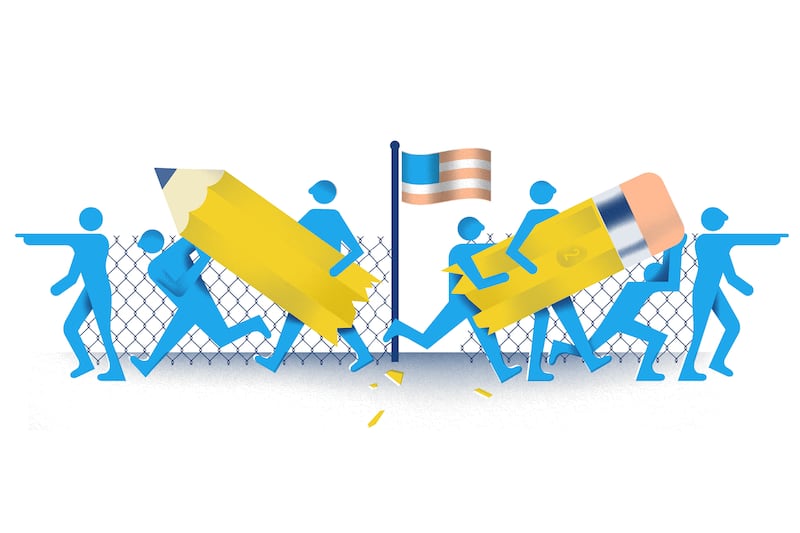

America is losing faith in its schools. Just 35% of adults are satisfied with K-12 education, a historic low. Decades of reforms, from new standards to expanded testing, have delivered mixed results and failed to reverse a nationwide learning recession. Students are tethered to screens, teachers are burned out, and schools are pulled into disputes over AI, politics and the future of work. If schools are meant to prepare the next generation for adult life, the question isn’t whether change is needed but how far it should go. Does America need to reinvent education, or commit to repairing the system it has?
Break the mold
The education system needs to adapt. Large classes, long days and rigid benchmarks were designed to prepare factory employees in the industrial age, not for tech-savvy modern students with varied interests, strengths and career paths. New models like microschools — mixed-age groups of 10 to 15 students, now serving up to two million students — offer flexible, efficient schedules that can be run by educators or parents. It’s one example of the innovations we need so students can realize their potential. The single system method is obsolete.
Schools should prepare students for the future. The World Economic Forum ranks creativity, resilience and technological literacy among the fastest-growing skills by 2030, yet our classrooms still reward memorization. Today’s kids need to integrate modern tools with visionary skill sets. At Alpha School in Austin, Texas, students spend two hours each day on AI-assisted lessons and the rest building businesses with mentors. “To thrive in the economy of tomorrow, children need to learn how to both harness and rise above the robotic,” writes Kerry McDonald of the Foundation for Economic Education.
Students need to get outside the classroom and its routines. As screen time replaces outdoor play, kids’ attention spans and mental health are waning. Outdoor learning, from forest schools to wilderness programs, can break that cycle for the next generation, boosting well-being and academics. The American Institutes for Research found that sixth graders in California outdoor science programs improved their scores by 27%. Meanwhile, students at Montessori-style elementary schools, who engage in hands-on learning without grades, gained two months of academic growth in first grade and an entire school year by sixth grade, according to federal data.
Families today want more say in how their kids learn. EdChoice’s 2025 Schooling in America survey found that 56% of parents prefer alternatives to public schools. Some choose homeschooling or charter programs, seeking values-based education aligned with their faith or simple safety from rising violence in schools. Expanding choice, through vouchers and education savings accounts, can restore their trust. “We need freedom, which is the most basic human right and the key to delivering the best education for the entire society,” writes Neal McCluskey for the Cato Institute.
Back to basics
Schools are more than academic engines. Measuring their effectiveness with only test scores overlooks many essential services and benefits that they provide, from meals, counseling and extracurricular activities to healthy routines and social development. In a shared classroom, students learn to work together, resolve conflict, compete and build independence. One longitudinal study by psychologist Angela Duckworth found that self-discipline — a habit that naturally develops within classroom walls — was more than twice as likely to predict both performance and attendance among eighth graders than IQ.
Public schools are central to America’s promise of opportunity. Providing education to every child, regardless of ability, income, race or immigration status, equips them to compete and contribute to the country’s future. That commitment is particularly crucial in the rural counties where 1 in 5 Americans live and alternatives are scarce; 80% of charter and private schools are clustered in cities and suburbs. Well-funded public schools are linked to higher graduation rates, lower crime and longer life expectancy, outcomes that benefit all of society.
Education is essential to democracy. “The qualifications for self-government in society are not innate,” Thomas Jefferson wrote in 1824. “They are the result of habit and long training.” Our ability to make sound decisions as voters and participants in an open society hinges on shared values and knowledge of certain facts, typically inculcated through our common schooling. Yet even in today’s highly polarized climate, 80% of Democrats and Republicans agree that civics is underemphasized in schools. We must recommit to giving today’s students a shared foundation, molding a generation who can work through society’s differences.
American schools need help. The system should be improved, not dismantled. Trendy alternatives are costly and difficult to scale. Separating students today risks increasing division in our society down the road. Public school remains a national cornerstone, but we need to invest in proven reforms to update it: modernized buildings, higher pay to attract and keep the best educators, and more autonomy for local districts. “The best way to understand the classroom frames it as an updated tradition,” writes American Enterprise Institute fellow Daniel Buck. “If we try to innovate past it, we may only discover that we’ve lost something essential.”
This story appears in the September 2026 issue of Deseret Magazine under the headline “Schools of thought.” Learn more about how to subscribe.