


This article was first published in the On the Hill newsletter. Sign up to receive the newsletter in your inbox on Friday mornings here.
Quick catch up: The Supreme Court on Monday reversed a lower-court ruling and said President Donald Trump could begin carrying out parts of his executive order that intends to restrict mail-in voting, but left open the possibility of additional challenges by Democratic states.
That challenge came Friday, when another block was put in place by Massachusetts-based U.S. District Judge Indira Talwani, who issued a temporary order blocking the U.S. Postal Service finalized rule for at least 14 days.
Trump signed the executive order earlier this year that would create a federal database of U.S. citizens eligible to vote and implement restrictions on mail-in ballots.
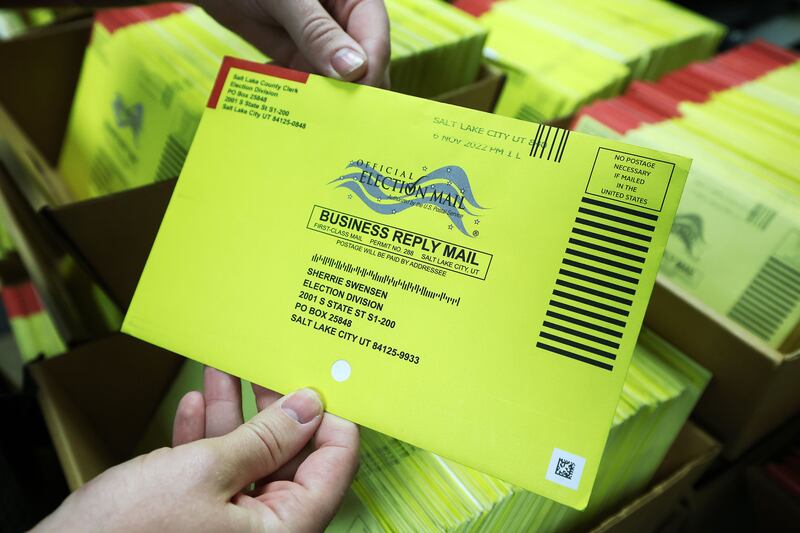
The order directs the USPS to establish a new standardized system for mail-in ballots. There would also be trackable ballot envelopes with individualized bar codes that are clearly labeled “official election mail.”
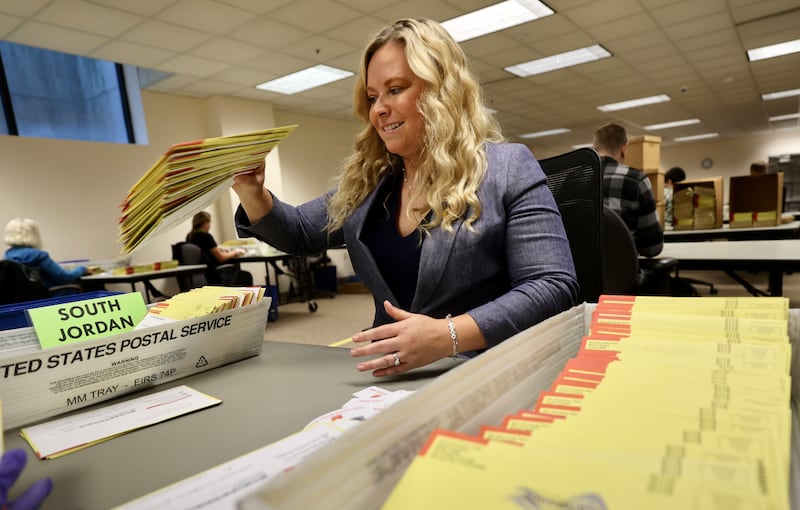
There have been some conflicting responses to this ruling, particularly by lawmakers in Utah — a state that has utilized some form of mail-in voting for over a decade and is the preferred method for a majority of Utah voters.
Utah Sen. Mike Lee praised the Supreme Court’s decision, calling it a major win for Trump as well as for the senator’s efforts to crack down on voter fraud.
“The Supreme Court has delivered a national victory for election integrity,” Lee told me in a statement. “They recognize that President Trump can fight to ensure accountability for mail-in voting, and that American elections should be determined only by American citizens.”
Lee also touted the decision in a slew of social media posts, which he also used to renew his efforts to pass the SAVE America Act, which primarily focuses on removing noncitizens from voter rolls.
But other Utah lawmakers are still waiting to see what this order will mean for states.
“The record shows, at least in Utah, that secure elections are not at odds with a mail-in voting system,” Sen. John Curtis said. “Commonsense measures to ensure election integrity are always welcome, but they shouldn’t unnecessarily disrupt how states like Utah have chosen to administer safe and honest elections. We’ll see how the case plays out now that it has been kicked back to lower courts.”
Rep. Blake Moore had a similar sentiment as he defended how Utah administers its elections and called the mail-in voting system crucial for voters in rural areas.
“Utah has an exemplary mail-in voting system that has been revised and audited,” he told me in a statement. “State and local leaders do a great job administering our elections, and the mail-in option is vital for our rural communities. Utah has long prioritized transparent, secure, and accessible elections, and while there is still more to come on the legality of the executive order, I support Utah’s ability to continue managing its elections.”
The decision on Monday would have allowed the U.S. Postal Service to move forward with the new ballot method, but after a lower court blocked it in a separate case, and after Friday’s injunction, there will be more court action before any changes can actually be made.
The justices declined to comment on whether Trump’s order was legal, after blocking the lower court ruling because the USPS rule was not yet finalized, noting that “time will tell.” The president himself acknowledged there would be legal challenges to the order, but argued it was “foolproof.”
Now that there is a block against the finalized USPS rule, the Supreme Court may once again weigh in on the matter.
Under the Constitution, only Congress can pass laws related to elections and state legislatures are given the authority to conduct elections how they see fit, meaning there are different procedures across the country.
Even if the order does survive legal challenges, it’s not clear if states can make the changes necessary before the November midterms — especially as some states are set to begin early voting as soon as next month.
Stories Driving the Week
- Midterm mania: A plurality of Utah voters (48%) said the economy and jobs were their top concern and would have the “biggest impact” on how they vote, according to the most recent Deseret News/Hinckley Institute of Politics poll conducted by Morning Consult. Another 41% said inflation was their top issue.
- Will the real Dan Sullivan please stand up? When Alaskan voters fill out their ballot in November, two of the four candidate choices will be Dan Sullivan. A third Dan Sullivan is telling voters which one to pick.
- Water watch: The Church of Jesus Christ of Latter-day Saints released a statement Wednesday regarding the “extended drought” in areas across the Western United States and its impact on Utah’s Great Salt Lake. The statement was released nearly two months after the church’s Utah Area Presidency called on Utah members to do their part to conserve water.
Recess Recs: History through tweets
As hard as it is to believe, this is the final edition of Recess Recs (for now).
The House returns on Monday for a brief stint; they’ll adjourn again for Labor Day week, and then get right back to it on Sept. 14. The Senate will be back then as well.
But the recommendations may make another appearance in October when the House and Senate leave for five weeks ahead of Election Day.
For this week, it’s a recommendation for my fellow X users. There’s a group of accounts documenting historical events as if they are happening in real time; one for 25 years ago, 50 years ago, 100 years ago, and, in honor of the Fourth of July this year, 250 years ago.
The accounts act as a reporter embedded in history. So the “25 years ago” reporter is currently in 2001, documenting major news events on the day they occurred.
I especially enjoyed the 250 years ago account earlier this summer as we neared the Fourth of July because you got to see everything in real time.
It’s fun as a reporter to envision yourself in that period of history, but it’s also fun to brush up on your history and learn some fun facts every day.
Check them out if you haven’t already.
Quick Hits
From the Hill: Darline Graham snags Republican nomination for South Carolina Senate race in big win for Trump. … Blake Moore: Tackling the national debt requires both budget reform and fraud crackdowns. … Congress pushes to require social media influencers to disclose some payments.
From the White House: The quiet Republican divide over whether Trump’s multibillion-dollar family empire is a conflict-of-interest crisis. … Secret Service confirms it is aware of Iranian threat targeting Barron Trump. … Trump administration plans to revoke up to 200,000 visas for asylum seekers.
From the courts: Judge drops mail-in ballot block but Democratic states quickly sue again. … What to know about the Lindsay Clancy trial as it nears its end. … Washington Post ordered to rehire columnist fired over Charlie Kirk posts.