


A substitute teacher walked into a pre-K class somewhere near Dallas. “Gather around,” she told the group of four-year-olds. Then she held up a picture book. “Can we just do it on the screen?” one student said. “That’s what our teacher does.”
The teacher went home, but couldn’t get the moment out of her mind. So she called up her friend Christina Mehaffey, the principal at nearby Faustina Academy. It distilled what Mehaffey had long suspected: Something as simple as a picture book read aloud asks things of children that a screen does not — a certain level of attention, imagination and engagement — and technology is changing their capacity to focus and reshaping their childhoods.
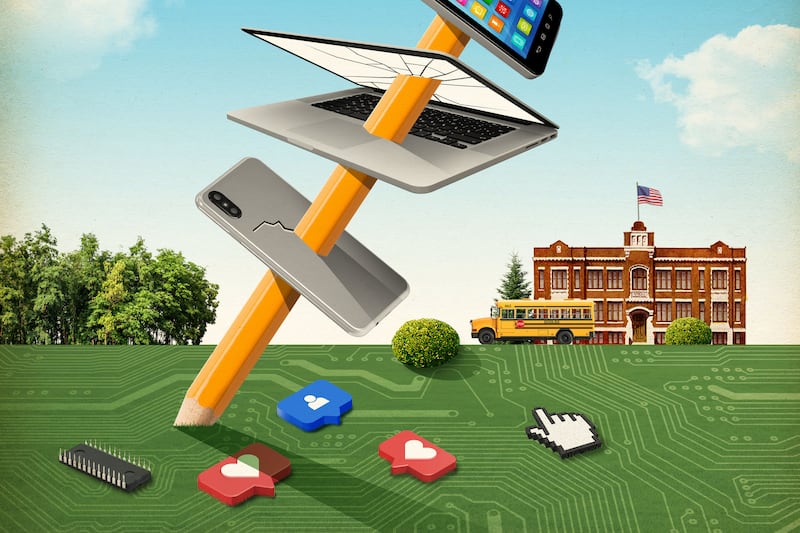
Over the past 15 years, American schools have undergone one of the most dramatic transformations in the history of education since Horace Mann declared that all children were worthy of learning and pioneered our nation’s public school system. Tablets, laptops, learning management systems, digital textbooks and now AI-powered tutoring tools have become standard from kindergarten through 12th grade.
The revolution was sold as an upgrade: faster, more personalized, more engaging. Schools that didn’t upgrade risked falling behind. Anyone who objected risked looking naive. But, as Newton’s third law of motion states, for every action, there is an equal and opposite reaction.
The revolution came with a trade that we are still trying to understand. The same screens that delivered curriculum also delivered dopamine — in quantities and patterns that researchers are now finding structurally alter our brains. The same devices that connected students to information connected them to platforms engineered, by design, to maximize the time those students spent on them.
The promise was better learning.
The question is one of balance. Technology is powerful when used appropriately and equally devastating when it is used inappropriately.
— Rich Nye, senior education advisor to Utah Gov. Spencer Cox
The result, for many children, was something closer to dependency — and a growing body of evidence suggests that the learning and brain development itself may be suffering.
Research published in the Dialogues of Clinical Neuroscience shows that the potential harmful effects of screen time and technology use include heightened attention-deficit symptoms, impaired emotional and social intelligence, technology addiction, social isolation, impaired brain development, and disrupted sleep.
That’s why no student at Faustina Academy, Mehaffey’s 220-student independent Catholic school in Irving, Texas, has ever been given a tablet or laptop. Starting in 2022, the academy took a step that even most tech-skeptical schools have not: It formally banned its students from having social media accounts — not just during school hours, but at all times.
If the rapid adoption of technology is an experiment to learn how young minds are being affected, Faustina is the control, offering a look into what happens to the minds and lives of young people who are formed almost entirely outside the digital ecosystem that dominates American childhood nowadays.
And what happens when the rest of us come face-to-face with what we have gained, as well as what we have lost, in turning to the internet for so much of our education, inside and outside of school.
How we got here
Smarties like Carl Sagan saw this coming.
In 1995, the revered astronomer and science educator wrote a book called “The Demon-Haunted World” at a time when the internet was coming online but didn’t yet dominate daily life.
“I have a foreboding of an America in my children’s or grandchildren’s time — when … awesome technological powers are in the hands of a very few, and no one representing the public interest can even grasp the issues,” he wrote. “When … unable to distinguish between what feels good and what’s true, we slide, almost without noticing, back into superstition and darkness.”
The key to overcoming this dark prediction, Sagan argued, was to teach young people critical thinking skills, which he defined as the ability to differentiate between what is true and what is not. To him, this was the essence of learning: the very reason we learn. And technology, in theory, could help it along.
Right?
The same screens that delivered curriculum also delivered dopamine — in quantities and patterns that researchers are now finding structurally alter our brains.
If the end result of learning is critical thinking, the beginning is dopamine — a neurotransmitter that works as a reinforcement mechanism. When we experience something pleasurable or beneficial, our brains release dopamine to encourage repetition of these behaviors.
Dopamine isn’t the only neurotransmitter involved in learning, but it’s the most essential because it controls motivation. We learn via the prediction gap created by dopamine: We expect something to happen based on a certain course of action; when our expectation proves correct, dopamine reinforces it; when it doesn’t, the absence of dopamine encourages us to try again.
A medieval blacksmith learning to make swords, for example, will probably crack a blade the first time he strikes a hammer to an anvil. But over time, he will recalibrate. He will try new techniques and get better. His swords will become sharper, lighter and more beautiful, and dopamine will reward him. As the years pass, and he becomes more advanced, those rewards will push him toward refinement and mastery. From a medieval forge to Silicon Valley, that’s how learning happens.
In schools, it manifests most obviously in grades. Making it to the next round of the spelling bee should trigger a dopamine response that tells a student she’s doing a good job, while receiving an “F” on a pop quiz should trigger the opposite. Technology, harnessed properly, can be similarly motivational.
But it’s also capable of delivering concentrated, predictable dopamine bursts that overpower the brain’s capacity to maintain focus on competing tasks or interactions. Our brains will always naturally seek the easiest access to dopamine, and when those access points can be found in 30-second videos or Instagram likes, we will learn to prioritize those things at the expense of everything else.
We’re still learning, in other words — but we’re learning to prioritize instant gratification. It’s kind of like the difference between eating a balanced, home-cooked meal instead of a drive-thru burger — both offer nourishment, but one provides more nutrition and the other convenience.
That’s not to say that technology hasn’t allowed for giant leaps in learning for Americans. From calculators to computer labs, it has delivered on its promise to make learning easier.
A study published earlier this year in the Proceedings of the National Academy of Sciences of the United States of America, for example, found that students using Khan Academy’s “computer-assisted learning” program for about 30 minutes per week could improve their math abilities by over eight percentile points. Thinking more big picture, technology places a deep well of human knowledge within almost everyone’s grasp, giving students access and new opportunities.
But it doesn’t always work like that.
In 2023, Stanford education professor Antero Garcia argued that, despite personally experiencing many of the transformational benefits technology can offer education, the very premise was flawed. “I want to tell you that I think technologies are changing education for the better and that we need to invest more in them — but I just can’t,” he wrote. “Despite their purported and transformational value, I’ve been wondering if our investment in educational technology might in fact be making our schools worse.”
Others, including Mehaffey, have warned that the algorithms powering Instagram, TikTok and other mainstream social media sites have so effectively hijacked our dopamine cycles that anything else, including classroom instruction, feels boring by comparison. The rewards of a picture book just can’t compare to the slot-machine-like lights and sounds of digital platforms, nor can reading “Moby Dick” compare to an hour on Instagram reels.
Learning just doesn’t work like pure entertainment. “Moby Dick” can be plenty entertaining, sure, but it is also difficult. And it is supposed to be difficult.
It will expose readers to new vocabulary that they must decipher using context clues; require them to sustain attention and imagination for hundreds of pages; engage with conflicting perspectives; follow arguments; and draw conclusions.
It is within this friction that learning happens. And it is precisely this friction that most digital platforms try to bypass, because friction makes people less likely to stay engaged.
A 2025 study by Australian researchers published in the peer-reviewed journal Psychological Bulletin found short-form video exposure in particular to be “associated with poorer cognition,” including attention, language and memory. Another recent study out of Switzerland warned of a “significant negative correlation” between “frequent use of AI tools and critical thinking abilities.” The more people offloaded their cognitive burdens to AI, the worse their own thinking became. “
While AI tools offer undeniable benefits in terms of efficiency and accessibility,” it concluded, “they may inadvertently diminish users’ engagement in deep, reflective thinking processes.” Technology, in other words, could enable precisely the dark future Sagan feared; one where the same dopamine cycle that has, for all of human history, encouraged learning is held hostage to 10-second sound bites; or where sustained attention becomes impossible because it’s less immediately gratifying than scrolling, posting and passively watching.
“In a world in transition,” Sagan wrote, “students and teachers both need to teach themselves one essential skill — learning how to learn.”
Technology should serve understanding, he argued, not substitute for it. Today, the question is whether there is a point at which technology stopped helping us learn — and even replaced learning altogether.
Where we’re going
The brewing backlash against tech in schools is finding allies in governments around the world. The United Kingdom recently banned children under 16 from major social media platforms, as did Australia. In Utah, legislators have been similarly motivated.
In the state’s most recent legislative session, lawmakers made a “bell-to-bell” cellphone ban the default in all school districts, although districts are allowed to overrule the law. “They just have to do so proactively,” explains state Sen. Lincoln Fillmore, who sponsored the legislation. He helped pass another related bill that requires school districts to track student usage on state-provided devices for similar reasons: Parents need to take some control back from tech platforms. “And I think that that balance needs to be found over time,” Fillmore adds.
He’s not the only one who thinks so. “The question is one of balance,” Rich Nye, senior education adviser to Utah Gov. Spencer Cox, says. “Technology is powerful when used appropriately and equally devastating when it is used inappropriately.”
Jennifer Casa-Todd, an education technology researcher, believes this starts with parents, many of whom she suspects are projecting their own anxieties about tech habits onto their kids.
“I see why people are saying paper and pen is the answer,” she says. It’s tempting to reach into the past for easy fixes. “But what’s actually happening is kids are still going to AI to get answers because that technology continues to exist in the world. So if as educators we are not supporting our students to use technology critically and effectively, then where are they going to learn it?”
Learning how to learn with the internet does work. Functional imaging scans conducted by the Department of Psychiatry and Biobehavioral Sciences and the Semel Institute for Neuroscience and Human Behavior at UCLA show that internet-naive older adults show significant increases in neural activity during simulated internet searches, and internet research or certain computer programs may improve memory, multitasking skills, fluid intelligence, and other cognitive abilities. Turns out, the dose makes the poison.
Royce Kimmons, who chairs the department of educational leadership and foundations at Brigham Young University and researches educational technology, is wary of technology becoming a convenient scapegoat for more complicated, nuanced discussions. In his view, total bans — whether on social media, smartphones or education technology — do kids a disservice.
“There is an important reality here about the kinds of workplaces our students are going into and the world that they’re going into,” he says. “Students have to learn literacy and develop self-discipline related to technology use at some point in time.”
But when so much of our technology is designed to maximize engagement for its own sake, balance can be difficult to find. Some argue that digital “hygiene” needs to be something taught deliberately. If students know about hypnotizing algorithms and dopamine flooding, they’re better prepared for the real world.
Jodi Carreon, director of an advocacy group called Schools Beyond Screens, proposes that with every technological intervention, administrators, parents and teachers should ask a question: “How are we ensuring that technology isn’t crowding out what’s most important?”
Namely, critical thinking, collaboration and creativity. If technology can help foster these skills, fantastic. But if not, she says it’s a call for a readjustment, not an overhaul. “Do I think we’ve gone wrong? I do,” she says. “But I don’t think the answer is swinging the opposite way.”
Christina Mehaffey doesn’t see a classroom free of technology as a swing back. It’s just staying the course.
After implementing the schoolwide social media ban in 2022, 2026 marked the school’s first graduating class to make it through high school without accounts on any major apps — and, Mehaffey says, the results have been spectacular.
“They just treat each other differently,” she adds. “They speak differently. They have more respect for the teachers.”
Plus, rather than a hindrance to admissions, the policy has become something of a selling point. Mehaffey has been invited to speak at conferences across the country. Other schools are looking to her as a role model. “People are looking all over for this type of school,” she says.
Meaning a less technologically connected but more interpersonally connected version of living and learning. A chance to shape young minds free from the influence of tech platforms and devices that fundamentally change the way learning happens.
If Mehaffey worries about anything, though, it’s how former students will adjust once they’re in college. Sometimes, she asks them whether they feel isolated. One student’s response stood out. When his new college friends asked for his Instagram and Snapchat handles, he told them he didn’t have any.
“I wish,” one of his new friends told him, “I was as free as you.”
This story appears in the September 2026 issue of Deseret Magazine under the headline “Uncommon knowledge.” Learn more about how to subscribe.