


The doors tower over any mere mortal.
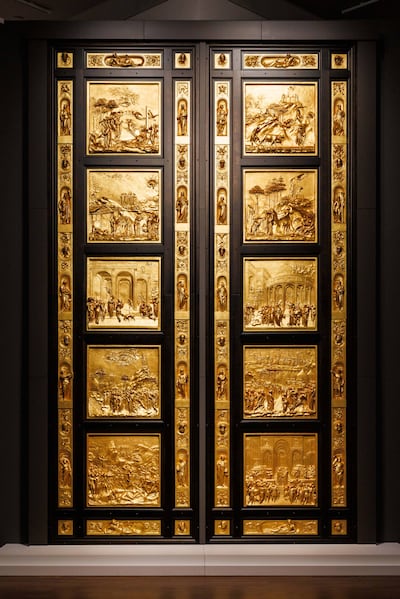
They stand 18 feet tall and 10 feet wide, giant slabs of gilded bronze that glitter in the sunlight.
Each wing weighs two tons and features five panels with scenes from the Old Testament bordered by busts of biblical figures. Adam and Eve are swayed by the serpent in one panel, its scaled body coiled tightly around a tree in the Garden of Eden. An elephant, a deer, lions and a cow wander into frame for another panel that depicts the story of Noah’s ark.
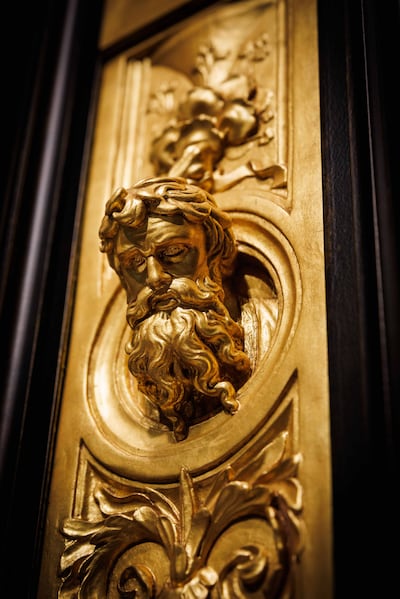
Every leaf, archway and facial feature is carved into an unbelievable three-dimensional being. The craftsmanship is awe-inspiring, a work to echo across generations — so long as it’s around.
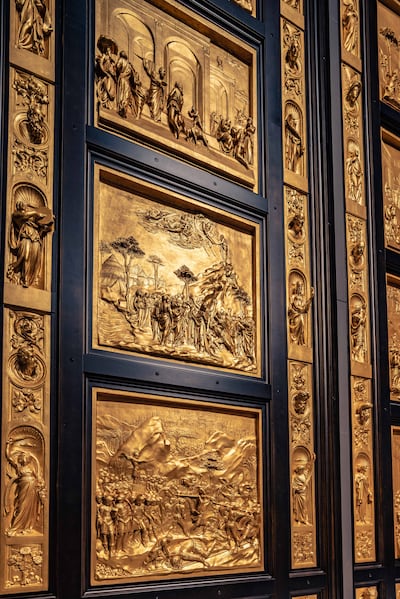
Italian Renaissance sculptor Lorenzo Ghiberti took 27 years to complete his magnum opus in 1452, a heavenly entrance to the Baptistery of San Giovanni in Florence, Italy. Michelangelo saw its lifelike detail and depth and deemed it magnificent enough to be the “Gates of Paradise,” which ultimately became the name of the artwork.
It is one of the greatest masterpieces of the Italian Renaissance, an early example of linear perspective and complete narrative applied to sculpture. The gates stood facing the Gothic-style duomo in Florence for nearly half a millennium. They withstood wars, plagues, geopolitical divisions, vandalism, air pollution and torrential downpours.
It was only in 1943, when the doors were temporarily removed and hidden to protect them from bombing during World War II, that their vulnerability first became apparent. Then in 1966, when the Arno River burst its banks and flooded the city, 10 feet of water ate away at the gilding and tore half of the panels off the frame.
By the time sculptor, painter and Brigham Young University–Hawaii art professor Jan Gordon Fisher visited Florence in 1984, the gates were undergoing a massive restoration project. Experts created plaster casts of the original doors.

While walking down an alleyway near the baptistery, Fisher chatted with workmen who were handling some of these plasters at a foundry. They helped him arrange to ship the replicas to his school — a private university owned by The Church of Jesus Christ of Latter-day Saints — near the north shore of O’ahu.
There, he hoped to cast them in bronze to display on campus as educational material about the Renaissance. When that proved impossible, they sat in storage, awaiting purpose.
Three decades passed.
Humans have sought to preserve art for as long as art has existed. From Spain to China, specialized workshops craft identical replicas and artistic reproductions of famous artworks, from ancient sculptures to Renaissance paintings like the “Mona Lisa.”
Even in Salt Lake City, a replica of Michelangelo’s “Pietà,” a marble sculpture from Ghiberti’s era depicting the Virgin Mary holding her son’s lifeless body, sits in the lobby of the Christ United Methodist Church, where visitors arrive by the busload.
And at the BYU Museum of Art, on the university’s main campus in Provo, Utah, an exhibition open through Oct. 24 tells the story of the Gates of Paradise, from Italy to Hawaii to the Wasatch Front.
The crate
Sharon Gray didn’t know what to expect when she opened up the crate. As a service missionary volunteering for the Church of Jesus Christ at BYU–Hawaii in January 2015, she was assigned to the art department. Her task appeared simple: clean out and organize the storage room.
There was a tremendous mess of materials, 11 crates filled with who-knows-what stacked up against a wall, surrounded by table saws, ceramics and carpentry tools. Outside, palm trees bristled in the Oʻahu island breeze at the base of the ancient Koʻolau Range. She cleared a path to the crates, cracked open the wooden box and peeled off a layer of bubble wrap. A plaster cast of Moses looked up at her.
At first she thought it looked like the actor Charlton Heston playing Moses in the 1956 film “The Ten Commandments.” But when she realized why it seemed familiar, she had to make sure her eyes weren’t deceiving her.
Time had worn away much of the detail, but she could make out the figure of Moses in the middle of the frame, holding stone tablets and leading a band of followers through a parted Red Sea.
When she wasn’t serving a church mission, Gray was an associate professor of art education at BYU in Provo, so she recognized this face immediately. She too had been studying Renaissance art in Italy in 1984, so she knew this depiction of Moses came from the Gates of Paradise.
“When I saw it, I went, ‘Are you kidding me? What is this doing here?’”
“I just felt more and more astonished,” she says. “I couldn’t compute — what are these doing in Hawaii?”
The plasters that sat gathering dust in Hawaii had been cast directly from the original doors. Fewer than a dozen such replicas exist worldwide. Rather than let them fall further into disrepair, Gray advocated for their preservation.
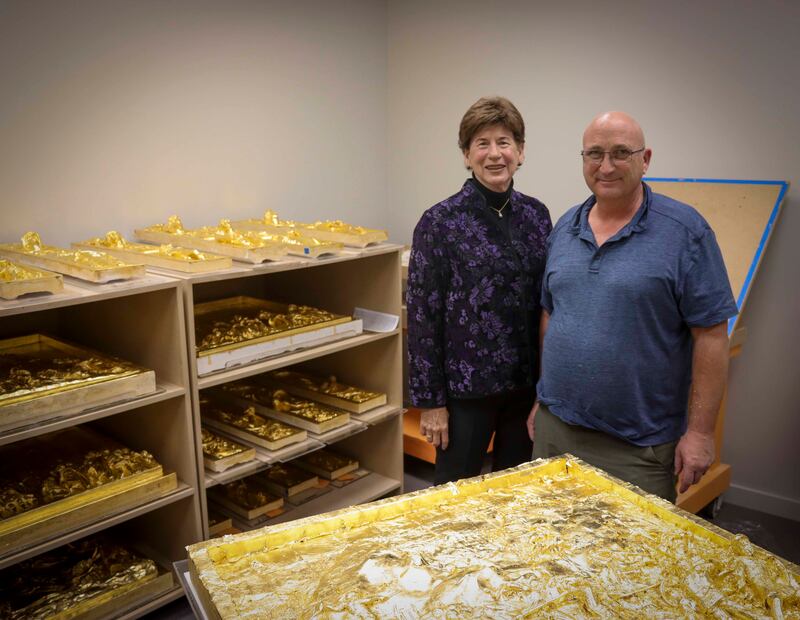
She worked with the chairman and dean of her department to communicate with their counterparts at Brigham Young University in Provo and arranged for a representative from the BYU Museum of Art to fly out to Oʻahu to determine if the casts were in good enough condition to be transferred and restored. The soonest that could happen was April 2016, more than a year after Gray had first made her discovery.
That’s roughly when the plasters were shipped to Provo. Bill and Barbara Benac — alumni who serve on the National Advisory Council for the university’s Marriott School of Business — helped fund a collaborative effort between BYU–Hawaii and BYU’s Museum of Art to ultimately display the replica in its full glory. After a decade-long restoration project, the plasters were shaped, gilded and mounted in Provo.
“Art preservation, depending on the object and the interest, is most often well worth the challenges and obstacles,” Gray says. “Climate, air pollution, aging and natural disasters create a need to preserve that which is valued.”
It would take tremendous effort and resources to breathe life back into the replicas. Ultimately, three decades in storage on a hot, humid island sometimes without climate control does take a toll.
What Gray and other advocates insisted on, though, is that they try.
As Italian critic and historian Cesare Brandi wrote in “Theory of Restoration,” his seminal 1963 text that formalized the discipline of art conservation: “Restoration consists of the methodological moment in which the work of art is recognized, in its physical being, and in its dual aesthetic and historical nature, in view of its transmission to the future.”
Which is to say that restoring a piece of art means honoring the physical form, the history it comes from as well as its beauty.
The restoration
John Adams is the primary architect behind the 18-foot-tall, 10-foot-wide installation. As the manager of exhibit production and installation at the BYU Museum of Art, practically every piece that has found its way onto the gallery’s walls has at some point entered his hands.
He’s built, painted, restored and installed frames for more works of art than he would care to count. Yet when he learned of the Gates of Paradise restoration project, he felt daunted. Because it didn’t just entail displaying the piece. It involved crafting it.
After decades of cleaning and conservation, the original gates are on display at the Opera di Santa Maria del Fiore in Florence, but the doors standing in their original place are plaster casts of their predecessors. Just like the plaster cast replica in Provo.
In fact, BYU’s casts are a sister set to the very ones now lining the baptistery in Florence. They are both molded from the original doors.
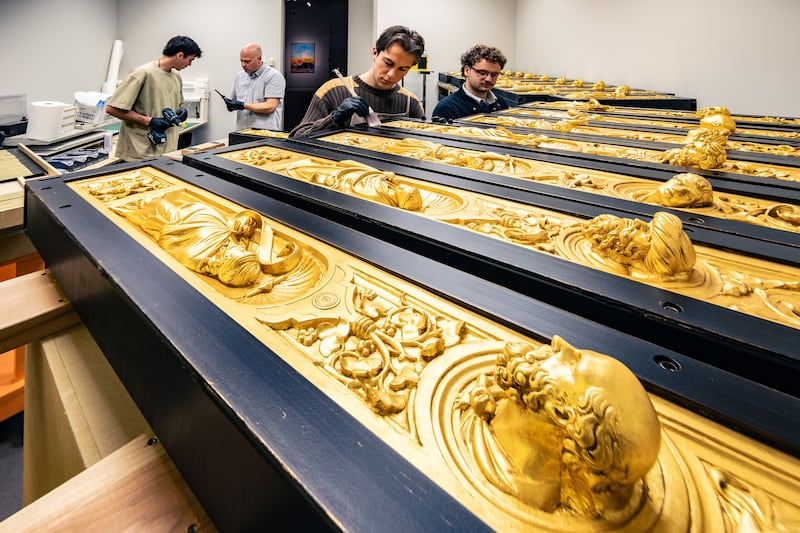
Adams had limited experience working with plasters, so he hired an assistant to draft a condition report detailing what work the replicas needed before planning a finish and method of display. That report came in at about 500 pages, documenting cracks along the width of panels, broken limbs of figures, dulled edges, missing facial features and other signs of decay.
He eventually devised a plan to stabilize the panels by backing them with metal rods, and filling the cracks with a mix of hemp fiber and plaster. Then, before the warped figures could be corrected, the plasters needed to be cleaned. He relied on unconventional materials like curettes, dental tools meant for scraping gunk out of teeth, to carefully pick off dirt and debris.
Once stabilized and cleaned, the plasters needed surface restoration to bring lifelike detail back into the damaged figures. He enlisted a team of two to three students at a time to work on the detailing. Each one was trained for four to six months on cast figurines and a 3-D-printed Ghiberti head before they were approved to work on the actual plasters.
“It wasn’t just me managing it — they were really doing a lot, collaborating with one another and trying to make things the best they could,” Adams says. “All those who worked with me did their very best to try and make it as close to Ghiberti’s hand as possible.”
Adams and his team of students reintroduced details like folds in drapery, facial features, perspective lines and architectural edges. They recreated patterns and textures that Ghiberti had included in his original design which had vanished from the plaster replicas, like a diamond pattern on the elephant in the panel that visualized the story of Noah’s ark.
This all took the better part of a decade.
In the final 18 months, the pressure compounded. Ghiberti took 27 years to create this sculpture, but Adams and his team only had 10. Beyond the time constraint, there was the added tension of working on a project so far beyond his comfort zone — the fear of not doing the artwork or the artist justice.
While detailing continued, Adams prepared for gilding and installation. He ran tests and consulted a nonprofit organization dedicated to the preservation of gilding techniques before deciding on an oil gilding method.
His team sealed the plasters in a shellac tinted orange and garnet to give a bronze undertone, then meticulously applied more than 16,000 sheets of Italian gold leaf onto the final plasters — a material so thin he says it can cover a football field with a single ounce.

During that last dash, the team of students and contractors swelled to more than a dozen people at a time. Adams even called in the campus machine and welding shops to design a six‑piece steel armature as the skeleton to bolt onto a structurally reinforced wall for the display.
The Gates of Paradise that Adams and his team restored is now the only known gold-leafed plaster replica of Ghiberti’s masterpiece. After the exhibit ends in October, the university plans to permanently preserve it onsite in the museum’s atrium.
What is widely agreed upon, though, is that the artwork has value beyond its superlatives or aesthetics. By the time the doors reached the exhibit, countless students had dedicated an estimated 13,000 hours on the project. People came together from different schools to pull off the feat.
“I would hope if (Ghiberti) could see it he’d be proud of it, and I can honestly say now, looking at it, I think he would be,” Adams says. “Really, the ability to create beautiful things is a divine gift to us. … It’s not hanging on to the past, it’s just showing us where we came from.”
The final product
I visited the museum on a warm afternoon and saw the Gates of Paradise gleaming gold under a spotlight. I got so close to the doors that the figures swallowed the entirety of my vision.
They appeared in full force, as defined as they would have been, I imagine, on the originals. It’s difficult to conceptualize the sheer scale of the artwork until you’re up against it, craning your neck skyward and straining your eyes to catch the intricacies of the top panels. It’s almost overwhelming to experience.
And I wouldn’t have been able to, if a flurry of mysterious circumstances hadn’t bounced the replica casts around the globe.
The art I grew up with is defined more by painted abstractions and computer pixels than the full-bodied realism of the Renaissance, yet I couldn’t help but feel that the challenge of preservation was timely and worth it. The story of how the original heavenly gates first came to be feels out of reach, almost otherworldly. But the genesis of this replica is a modern tale of human perseverance.
Of preserving the past as a means of serving the present.
As families filed in to sit and marvel at the work, parents with gawking children in tow, that felt all the more true.
In addition to the replica, the exhibit features a timeline breaking down key events of the Renaissance and the plaster casts’ trajectory from Florence to Hawaii to Provo. There are 3-D-printed scans of the Cain and Abel and Abraham and Isaac panels for kids to feel their grooves and dimensions. There are videos and puzzles to encourage engagement with the piece.
And unlike in Florence, guests can get face-to-face with the gates, rather than look from behind a wrought iron fence. That proximity and level of interaction makes ethical replicas of original artworks a worthwhile form of art preservation.
My personal favorite feature in the exhibit, though, is the wall where visitors can leave notes sharing their thoughts and insight.
“The attention to detail is incredible,” one reads. “
Amazing to see how humans can create great works taking inspiration from divinity.”
In an oversized and wobbly script, no doubt belonging to a child, another one simply reads “good.”
One visitor wrote that the exhibit took them right back to Florence, and another said they especially appreciated seeing information about the restoration process. “I like it,” a different kid wrote beneath a smiley face, “this is what I look like.”
As I watched teenagers and tweens circle the exhibit alongside primary school-aged children, fumbling the interactive 3-D-printed outlines with their grubby fingers, it dawned on me that even though this exhibit never once claimed to contain the original Gates of Paradise, it has managed to move people just as the originals would have.
When art is preserved, restored, replicated and shared, it does not cheapen or even change the experience of witnessing an original.
It just spreads it with more of the world.
This story appears in the September 2026 issue of Deseret Magazine under the headline “Origin story.” Learn more about how to subscribe.