

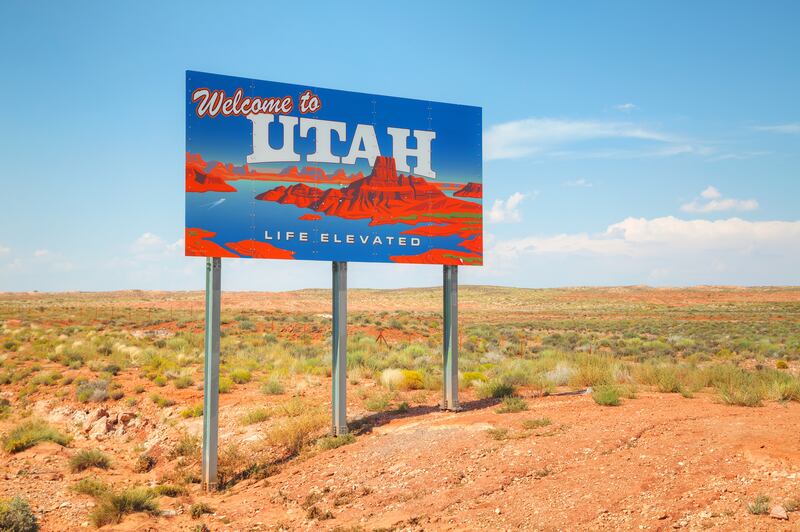
Utah is the Galápagos of American politics.
What does this mean? And why does it matter? Let me explain.
When Charles Darwin first stepped foot on the Galápagos Islands in 1835, he encountered flora and fauna unlike any the world had ever seen: Trees seemed to grow from the rock itself, penguins made their homes in tropical heat, and giant sea tortoises — some more than a century old — crawled across long stretches of sandy coastline. Due to the Islands’ remoteness, their plant and animal life had evolved independent of the natural selection taking place on the mainland. The result? A catalogue of curious specimens all living in a self-contained ecosystem with its own unique evolutionary history. Or as Darwin put it, “a little world within itself.”
Those same words could describe Utah politics. Thanks to a combination of factors, including an uncommon history, economy and culture, the state’s political evolution has not tracked with the rest of the country. And that’s a good thing. As the nation grows ever more divided, our leaders could learn from Utah — an island of sanity in a sea of chaos, “a little world within itself.”
Utah’s status as a political anomaly is nothing new; it’s been the Galápagos from the get-go. In fact, driving the state’s very founding was a desire to establish a society outside of and apart from the mainstream of American political life.
Disillusioned by the corruption and ineptitude of our nation’s leaders, Latter-day Saint pioneers answered Brigham Young’s call to “flee from Babylon” and go West. If Utah’s first settlers couldn’t put an actual ocean between them and the federal government, then an ocean of prairie would have to do. And so, the saints set out to build a new Zion far away from a political regime they viewed as oppressive. Geographically, economically and culturally detached from the rest of the country, America’s Galápagos was born.
Utah’s isolation gave rise to a political culture built on seeming paradoxes — and many of those paradoxes persist to this day. Among them are a fiscally conservative state government and an exceptionally compassionate civil society; a demographically homogeneous population and a thriving refugee resettlement program; and a local economy fueled at once by individualism and a strong commitment to community.
From this strange sociological landscape has evolved a wholly unique strain of conservatism and the politicians that have become its avatars: elected officials like Spencer Cox, Mitt Romney and John Curtis. In sharp contrast to today’s partisan firebrands, Utah’s leaders are remarkably optimistic, pragmatic, measured, and most of all, civil. It’s almost like they come from a different political planet — because, in fact, they do. They represent the Galápagos of American politics.
Utah’s outlier status comes into even sharper relief when you consider everything the state has going for it: a highly functional and efficient legislature with sky-high approval ratings, a robust civil society, sturdy families and strong marriage rates, a well-respected tech sector, low taxes, a balanced budget and a welcoming and sensible immigration policy. In other words, everything the country as a whole is lacking.
As America’s Galápagos, Utah has been insulated from many of the pathologies of today’s politics. Populism and identity politics, for example, don’t play well in a state that was founded by refugees fleeing mob violence and religious persecution. And critiques of capitalism fall flat in a state that prides itself on scrappy self-reliance, whose official motto is one word and one word only: “Industry.”
All the evidence points to a simple fact — Utah is not just different; it’s exceptional. And it’s Utah’s exceptionalism that legislators, policymakers, and political scientists should pay attention to. While everything seems to be going wrong in the rest of the country, everything seems to be going right in Utah. So if our leaders are serious about fixing this nation’s most pressing problems, they should look to America’s Galápagos for answers.
Just as the Galápagos held the secrets to the origins of life and human existence, Utah holds the keys to a new kind of politics — and a better path forward for America.
Sam Lyman is an executive communications consultant and the former chief speechwriter to Senator Orrin G. Hatch.