

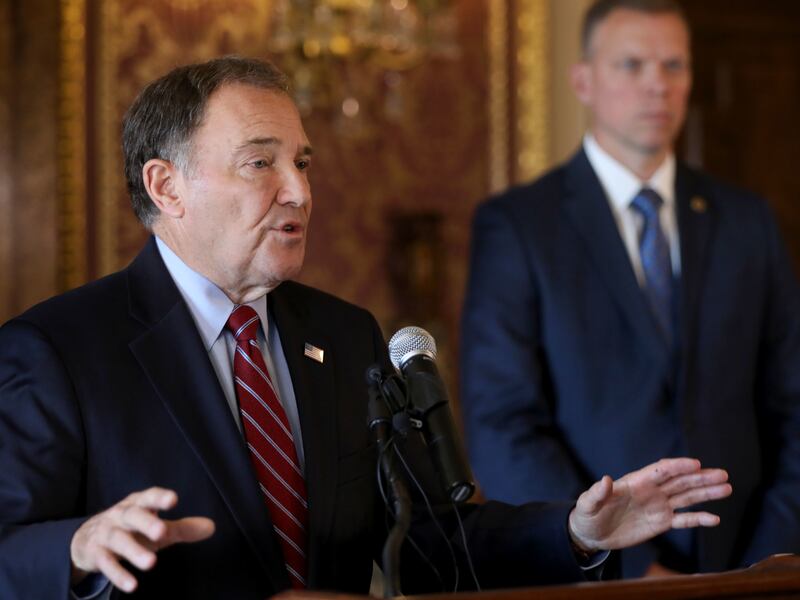

Tuesday, Gov. Gary Herbert proposed a new state licensing rule prohibiting conversion therapy on patients under the age of 18. The move would effectively make Utah the first red state to ban therapeutic practices that seek to change the sexual orientation of minors.
The effort has drawn public support from both local LGBTQ lobbyists and the state’s prevailing faith, The Church of Jesus Christ of Latter-day Saints. In an era rife with political dividing lines, the fact that progressives and social conservatives found common ground on this one issue alone is worthy of plaudits. But this isn’t the only example of political compromise to emerge from the Beehive State.
In recent years, Utah has offered a series of striking counterpoints to the nation’s political polarization. Some naturally attribute the state’s inter-aisle collaborations to the influence of the church, whose voice is still respected in the GOP-controlled Legislature. But, Utah’s bipartisan accomplishments are more properly understood as part of a deeper effort — once central to the American project — of balancing political paradoxes.
Last year, for instance, Herbert signed both a historic hate crimes law and the Utah Medical Cannabis Act — a bill that provides medical marijuana to patients with genuine health needs while also safeguarding against illegal distribution to minors or others. And then there’s the Utah Compromise and the Utah Compact. The former became law in 2015, balancing LGBTQ nondiscrimination protections and First Amendment rights. The Utah Compact, meanwhile, rallied local law enforcement officials, business leaders and lawmakers around a set of humane immigration principles.
“A clearer expression of good sense and sanity than Utah’s would be hard to find,” The New York Times editorialized at the time regarding Utah’s approach to legislation, and, with reference to Utah’s nondiscrimination efforts, the Boston Globe wrote that it was “remarkable for today’s political climate” and “a model for other red states.”
Known for rugged individualism and robust communitarianism, for radical free will and strict religious obedience, Utah embodies seemingly incongruous ideals. Teasing out the tension between such ideals leads to many of these fruitful frictions and compromises. Such healthy frictions, however, were once also quintessential elements of American democracy.
Although they may be currently lost on Congress or the White House, an appreciation for political paradox still remains part of the country’s mythos and iconography. Overlooking the steps to the U.S. Supreme Court, Lady Justice blindly balances her scales, reminding onlookers to weigh both sides. The talons of the eagle hold arrows and the olive branch. On every dollar and dime, U.S. currency cries to us “out of many, one.”
To be fair, paradoxes are not always easy to hold. The anxiety that accompanies incongruities is exhausting. And, in the face of political purity tests, holding fast to both sides can make reelection challenging. Far easier to retreat exclusively to one pole or the other — to seek either free markets or big government; isolationism or interventionism. This is not to say, of course, that personal ideals should be up for constant negotiation or that moral virtue must be compromised — stories as old as Faustus warn against cutting deals with the devil. But, in order to properly manage a pluralistic society, there must be sufficient space for all sorts of vines and fig trees under which individuals can live out worthy norms.
In order to properly manage a pluralistic society, there must be sufficient space for all sorts of vines and fig trees under which individuals can live out worthy norms.
A notable book by Latter-day Saint scholar, Terryl Givens, christened the early Mormon pioneers who helped established Utah a “people of paradox.” The phrase is a knowing nod to Michael Kammen, whose Pulitzer Prize-winning book with the same name, uses the phrase in reference to the cultural origins of the United States.
In other words, if political paradoxes illuminate Utah’s contemporary identity, it’s partly because they were embedded within America’s first. While cultures of comprise can be fleeting, Utah provides at least some evidence of their resiliency. It shows that cooperation doesn’t mean that Republicans must embrace elective abortions or that Democrats have to start expanding Second Amendment rights. It does mean, however, that partisans must mutually appreciate the ideals and verities within the other party.
In his 2010 farewell speech on the Senate floor, the late Utah Sen. Bob Bennett answered “those who say: Oh, there is not a dime’s worth of difference between the Republicans and the Democrats.”
There is in fact, he observed, “a significant difference” between the political parties: “The Democrats are the party of government. Going back to their roots with Franklin Roosevelt, they come to the conclusion that if there is a problem, government should solve that problem. The Republicans are the party of free markets, and they come to the conclusion that if there is a problem, it should be left to the markets to solve it.”
He concluded: “They are both right. That is the thing I have come to understand here”.
It may be that an inhospitable environment forced bipartisanship into an exile far away in the Mountain West, not unlike the early Mormon pioneers. But, as the success of political comprise reasserts itself in issues ranging from conversion therapy to immigration, perhaps the nation will begin to see how Utah and its paradoxes may very well save our national politics.
Hal Boyd is an assistant professor of family law and policy in Brigham Young University’s School of Family Life and a fellow of the Wheatley Institution. He is currently writing a book on Utah politics.