

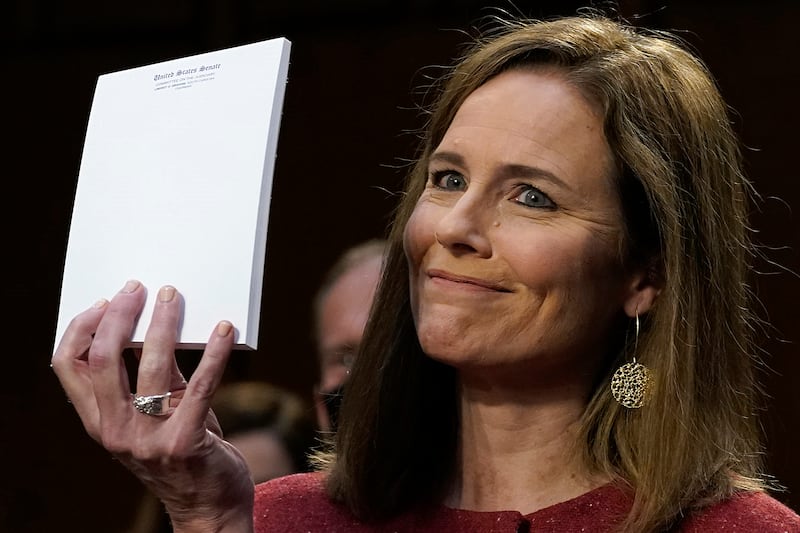
The moment became an instant meme on social media.
Sen. John Cornyn, R-Texas, asked Supreme Court nominee Amy Coney Barrett to show the notes she was working from while answering hour after hour of questions at her confirmation hearing.
“You know most of us have multiple notebooks and books and other things like that in front of us. Can you hold up what you’ve been referring to in answering our questions?” he said.
She held up a blank block of notebook paper. It contained, “Just a letterhead that says United States Senate,” she said.
No scribbles to keep track of the questions asked, or the order in which they came. No electronic tablet with which to do quick Google searches. No binders to bring to mind her past decisions or published work.
If nothing else, this demonstrated a thorough mastery of legal reasoning and a stunning degree of self-confidence by Barrett. But it also highlighted a stark contrast.
Most members of the Senate Judiciary Committee entered this week’s hearings with stacks of notes, having been prepped by their staffs on which questions to ask. For many of them on both sides of the aisle, these questions had less to do with determining whether Barrett has the background, training and expertise to receive a lifetime appointment than with carefully laid opportunities to grandstand for voters at home.
Apparently, it’s hard to do that without notes.
Many of the senators used their notes to seek subtle ways to entice Barrett into tipping her hand as to how she would rule in a number of high-profile, culture-war related matters sure to come before the court from time to time.
The irony of this is rich. Most of these contentious items — immigration reform, the Affordable Care Act, voting rights — are important matters before the court because senators and representatives have refused to do the hard work of legislating compromises that would best serve the American people.
Congress is the only branch of government empowered to write laws. But its inability to tackle difficult issues has pushed much of this duty onto the other two branches of government. Hence, presidents draft executive orders that act as quasi solutions to problems, and the court determines whether these are constitutional. President Obama’s executive order on the deferred action for childhood arrivals, or DACA, is a prime example of this.
In the case of the Affordable Care Act, a Democratically controlled Congress mustered the votes to pass sweeping legislation without a single Republican vote, guaranteeing future challenges as the balance of power changed hands.
Barrett has been trying to convince senators she is capable of judging each case fairly, on its merits and against the Constitution, despite whatever she may have said or written on the subject previously. Like many thoughtful adults, she has her own deeply held beliefs, but she subordinates those to the law, and to principles of sound jurisprudence. That’s what a good judge does. History, by the way, is replete with examples of justices whose eventual rulings came as a surprise to those who had tried to pigeonhole them during the confirmation process.
Senators who constantly rely on thick notebooks and well-informed staff members to remind them of their beliefs and to keep them on track may have trouble understanding all of this.
But the lesson for all is this: Don’t underestimate someone who has managed a full career while raising seven children, and who can navigate the intense glare and public scrutiny of a confirmation hearing without a single written note.