

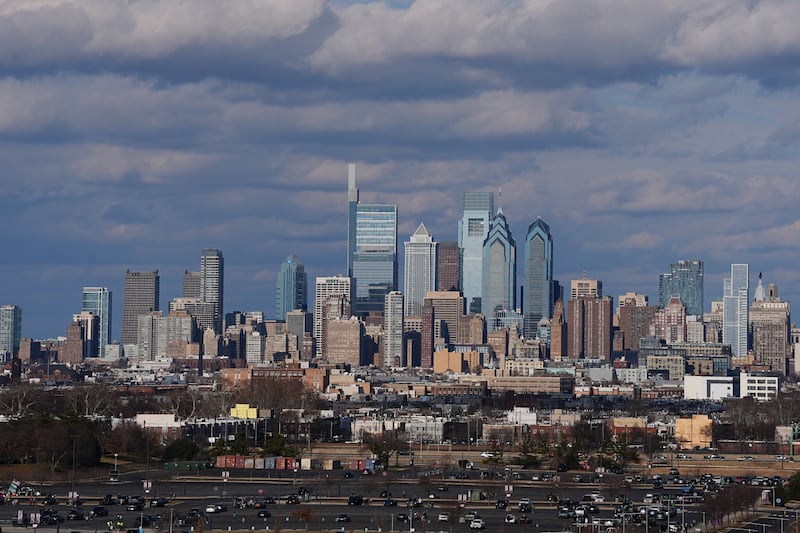

Cities leave marks on us long after we move away.
I grew up in Philadelphia, but I have now lived away from it far longer than I ever lived there. Still, when I return, something familiar settles back into place — the rhythm of the streets, the old buildings, the quiet sense that the past is never entirely past.
Recently, I took my son there for a quick trip from New York. Our plan was simple: a Flyers hockey game against his beloved Utah Mammoth and a walk through the historic district. What stayed with us most were the things we never intended to see.
We spent the morning walking along Independence Mall. School groups moved between the historic buildings. Tourists gathered near Independence Hall. The Liberty Bell drew its steady line of visitors. For my son, these were new sights. For me, they were part of the background of my childhood: places I had visited on school trips and family outings, absorbing their meaning long before I fully understood it.
Walking toward the Weitzman National Museum of American Jewish History, I noticed a sign I remembered from years ago: “Congregation Mikveh Israel,” often called the Synagogue of the American Revolution.
I had visited the synagogue decades earlier with my own family. The door happened to be open. We stepped inside.
The sanctuary was quiet.
My son sat in a pew beneath a chandelier, his feet barely reaching the floor. He is still at the age when much of the world arrives as a series of questions, and he studied the room with the focused attention of someone trying to understand what kind of place he had entered. The last time I stood in that sanctuary, I was roughly his age.
Mikveh Israel reflects the Sephardic roots of Philadelphia’s early Jewish community. The Torah reading platform stands at the center of the sanctuary rather than at the front, with pews arranged around it. The architecture communicates something subtle but important: The service is not directed toward an audience. It unfolds within a community gathered around the Torah itself.
Philadelphia, perhaps more than any other American city, makes visible the connection between religious life and the American experiment in liberty. Places like Mikveh Israel — where figures such as Haym Salomon were members — are quiet evidence that the promise of that connection held. The founders spoke often about liberty in abstract terms. Philadelphia reveals what it meant in practice: communities building synagogues, churches and meetinghouses side by side — confident that faith could be lived openly within the republic.
Near the central platform sat a chair decorated with carved hands forming the distinctive gesture of the priestly blessing.
My son noticed it immediately.
For most Jews, the symbol represents a ritual they observe. For our family, it carries something more personal. We are Kohanim, members of the Jewish priestly line.
A few months earlier, during Rosh Hashanah services, my son had asked me to give the priestly blessing for the first time in more than 20 years. When the moment came, he stood beneath my prayer shawl beside me, stretching his small hands forward as we recited the ancient words recorded in the Book of Numbers:
“May the Lord bless you and keep you; May the Lord make His face shine upon you.”
It had been his idea. Over the years, I had quietly allowed the practice to slip out of my life. He called it back.
In the months since Oct. 7, I have also noticed a change in him. I tried to shield him from much of what followed, but children absorb more than we imagine. He has come to understand that Jewish identity is not only a matter of heritage but also of responsibility. Perhaps that is part of why he stood so confidently beneath the prayer shawl that day and why he studies places like this synagogue with such seriousness.
Standing there looking at the carved hands, I realized something unexpected: The transmission had not moved from parent to child; it had moved the other way.
Before leaving, another surprise waited outside the sanctuary. On an easel stood a portrait of Rabbi Joshua Toledano — my Talmud teacher in high school, whose portrait had just been put on display earlier that week.
Rabbi Toledano did not teach Talmud as a set of conclusions to memorize. He taught it as a discipline of questioning: how to read arguments carefully, how to hold complexity without rushing toward easy answers. That education still shapes how I think about the world.
Standing there with my son beside me, I suddenly saw the chain clearly. A teacher who shaped how I think, a student standing in one of the country’s oldest congregations and beside him a child asking questions about everything.
After leaving the synagogue, we continued to the Weitzman National Museum of American Jewish History. One exhibit traces the spread of Jewish communities across the country — a large map showing early centers of Jewish life in Charleston, Cincinnati and San Francisco, communities that grew alongside the expanding republic. My son studied it for a long time.
What struck me most was how confidently the museum tells that story: Jewish life in America presented not as a footnote but as part of the national narrative itself. Watching my son move through the exhibits, I was reminded that the transmission of tradition rarely happens through strategy sessions or demographic reports. Continuity usually emerges in quieter ways: through institutions that endure, through teachers who shape how we think, and through parents and children encountering places that carry memory.
When we stepped back outside, my son walked ahead across the brick plaza, still asking questions about the carved hands, the portrait and what it means to be a Kohen. I did my best to answer him.
Cities like Philadelphia remind us that traditions survive only when someone decides they are worth carrying forward. Sometimes that work moves from parent to child. And sometimes, unexpectedly, the child is the one who calls the parent back to it.