

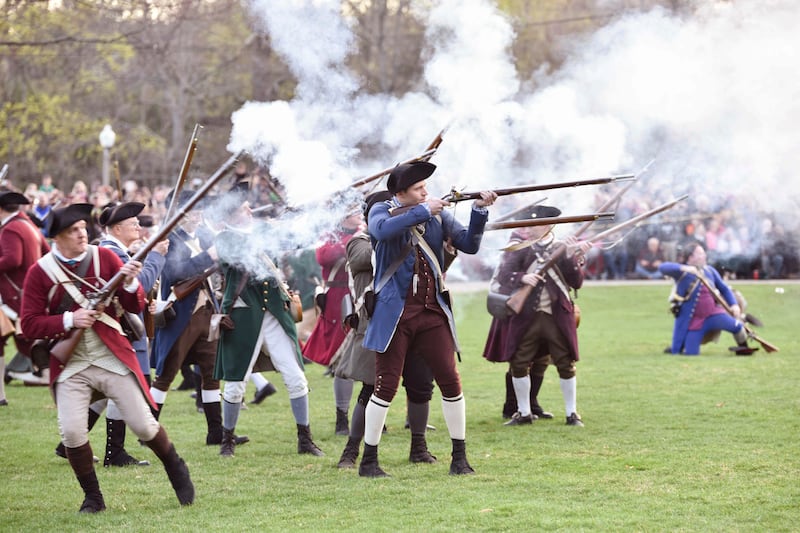

On historic Lexington Green in Massachusetts stands a granite obelisk erected in 1799 “by the inhabitants of Lexington … to the memory of their Fellow Citizens … who fell on this field, the first Victims to the sword of British Tyranny & Oppression.”
The inscription continues: “They nobly dar’d to be free!! The contest was long, bloody & affecting. Righteous Heaven approved the solemn appeal; Victory crowned their arms; and the Peace, Liberty & Independence of the United States of America, was their glorious Reward.”
It’s doubtful whether such a monument, bearing such an inscription, could be erected today.
Expressing such civilizational self-confidence now would likely prompt self-righteous ruminations on our forebears’ oppressions of others and trigger indignant objections to their claiming the approval of “Righteous Heaven.”
But we ought to be as robust in our patriotism now as were the citizens of Lexington then. The American Revolution and its aftermath, at home and abroad, merit our continued appreciation — indeed celebration.
Yet most Americans are hardly aware of what took place. A 2009 survey found that 83% of American adults are without even a basic understanding of the American Revolution. A year later, 26% of Americans in a Marist poll could not identify whom the United States declared its independence from.
Ask yourself: Do you really know what happened in Lexington and Concord?
Tensions between the colonists and the British government had been building for years. British troops had occupied Boston. And Parliament had passed the Tea Act, which prompted the Sons of Liberty’s Boston Tea Party.
Parliament responded with the Intolerable Acts, revoking the colonial charter — including its provisions for self-government — and transferring unprecedented authority to the appointed governor, General Thomas Gage.
When Gage dissolved the elected assembly, it met regardless as the “Massachusetts Provincial Congress” — becoming the de facto government of the entire colony outside occupied Boston. The British government declared Massachusetts in rebellion and ordered Gage to destroy the colonists’ military supplies.
On April 18, 1775, Gage ordered a force to Concord to destroy all military stores there. Thanks to intelligence sources in London and Boston, the patriots were alerted. Joseph Warren told Paul Revere and William Dawes that British troops would leave Boston that night by boat, land in Cambridge, march to Lexington and Concord, and arrest John Adams and John Hancock, president of the Massachusetts Provincial Congress.
Dawes went south by horseback across Boston Neck; Revere went north, rowing across the Charles River. They succeeded in warning Hancock and Adams and alerting townspeople along the way. Revere was captured before reaching Concord, but Samuel Prescott completed the ride.
At 2 a.m. on April 19, 700 British soldiers, having crossed the water, began their 17-mile march. At sunrise, they reached Lexington, where 80 militia, expecting them, had assembled on the village green. Militia Captain John Parker wasn’t picking a fight; his outnumbered men stood in parade formation, not on the road blocking the march and not in hiding, where they could take potshots.
Who fired the first shot remains unknown; neither commander ordered it. A brief but savage melee left eight militiamen killed and one British soldier wounded.
The column continued to Concord, where it divided into several groups to conduct the search. At Concord’s North Bridge, 400 militia blocked 100 redcoats — who requested and received reinforcements. As in Lexington, who fired the first shot remains unknown. In contrast to Lexington, shortly after the shooting began, so did a British retreat.
Rushing to Concord to defend their homes, their freedoms and their own elected government, militiamen from the surrounding countryside (ultimately numbering an estimated 4,000) routed the 1,700 British regulars (including reinforcements), pursuing them all the way back to Boston.
Loosely organized farmers, shopkeepers and tradesmen, who fought as volunteers, supplying their own weapons and electing their own officers, defeated the professional soldiers of the king’s well-funded, well-equipped army. For the British, it was a chaotic, harried and ignominious retreat. This was the first day of the American Revolution, and it was a resounding American success.
By the next morning, 15,000 militia surrounded the British, and the siege of Boston had begun. Less than a year later, the British abandoned Boston, never to occupy it again.
The battles of Lexington and Concord marked the start of the Revolutionary War. Or did they? John Adams wrote, “The Revolution was effected before the war commenced. The Revolution was in the minds and hearts of the people.”
Whether the Revolution remains in the minds and hearts of the people today is an open question. It certainly remained in the hearts of the people of Concord when they dedicated a monument commemorating the events of April 19, 1775, with these words of Ralph Waldo Emerson, who described the Old North Bridge in Concord and stated:
“Their flag to April’s breeze unfurled,
Here once the embattled farmers stood,
And fired the shot heard round the world.
On this green bank, by this soft stream,
We set today a votive stone;
That memory may their deed redeem,
When, like our sires, our sons are gone."
Do we, as the poem hopes, remember their deeds? Do we still possess the spirit that prompted those deeds? And of special importance: Are we cultivating that spirit in the rising generation?
All this matters more than we realize. Because if we lose our connection to the roots of what made America great in the past, our ability to reach for that again becomes nearly impossible.
The Declaration of Independence, with its ringing assertions of universal rights; the Constitution, with its enduring genius for securing those rights; the expansion in scope and influence of the American nation, extending those rights beyond our borders; our leadership of the Free World as a uniquely benign superpower — all this was made possible by the American Revolution, sparked by the heroes of Lexington and Concord.