


Conspiracy theories seem to rise and gain traction with amazing speed these days.
But before you assign the crazy narratives associated with the recent attempted attack on President Donald Trump to just another chapter in this modern phenomenon, consider this:
The first assassination attempt against a president happened on Jan. 30, 1835. An out-of-work housepainter named Richard Lawrence approached President Andrew Jackson after the funeral of a member of Congress and tried to shoot him. Lawrence carried two guns. Both of them misfired, giving Jackson enough time to launch an assault of his own on Lawrence, using a cane. Others, including members of Congress who also were exiting the funeral, joined in.
It was one of the most extraordinary moments in U.S. history. And as theweek.com describes it, conspiracy theories soon followed.
Jackson’s supporters spread the rumor that the assailant had been seen recently at the home of Jackson-hater Sen. George Poindexter. They must have been plotting the attack, the story went.
Not long after, the other side countered by saying the president staged the whole assassination attempt to make himself look good. That’s why the guns conveniently didn’t fire.
Stop me if any of this sounds familiar.
A familiar conspiracy theory
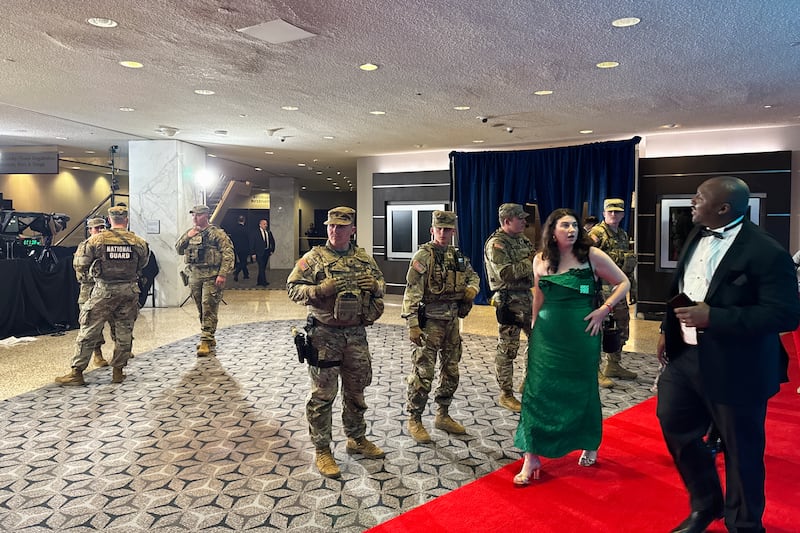
Fast-forward 191 years. Within hours of a gunman’s failed attempt to shoot his way into the hotel ballroom where Trump was waiting to speak to the White House Correspondents’ Association, the internet was full of posts suggesting it was all staged in order to increase support for construction of a ballroom at the White House.
Another version says Trump wanted to reverse his sagging poll numbers.
My first takeaway is that this nation’s conspiracists are pathetically lacking in originality. One hundred ninety-one years later and they’re still pushing the same narrative?
My second is that staging such a hoax would require a vast buy-in from interested parties, including the president’s security detail. That would require them setting aside personal pride and dedication to duty, to name a couple of unlikely factors. Getting a pretend gunman to risk his life, or at least a lengthy prison sentence, would be problematic, as well.
And then there were all the other people in the ballroom, especially the journalists. Any one of them could win a major award and instant notoriety uncovering such a plot. A conspirator’s first concern is to consider the venue. The only worse setting would have been a police convention.
The Washington Post said this “rush to (conspiratorial) judgment” was “marked and potent.” Perhaps it indicates Trump’s disfavor in some MAGA circles as well as from those on the left. As usual, people began to parse irrelevant actions by some in attendance, assigning sinister undertones to ordinary behavior during an extraordinary and stressful moment.
Fox’s correspondent Aishah Hasnie had to explain that she was cut off during a live report from the scene because her cell service dropped, not because network bosses didn’t want her to expose a phony assassination plot.
And yes, White House press secretary Karoline Leavitt said before the event that there would be “some shots fired tonight.” Taken in context, however, she clearly was referencing the content of the speech the president never got to deliver.
Fear, uncertainty, no control
One scholarly study of conspiracy theories, published a few years ago by the National Library of Medicine, said, “Evidence suggests that the aversive feelings that people experience when in crisis — fear, uncertainty and the feeling of being out of control — stimulate a motivation to make sense of the situation.”
Fear, uncertainty and the feeling of being out of control — if those things were water, the West could solve its drought. The problem is, the truth is often much simpler than we imagine, and politics often disappoints.
Not long after the botched attempt in 1835, Jackson’s assailant claimed to be King Richard III of England and accused the president of killing his father. He was sentenced to an asylum.
In other words, he was a disturbed lone wolf — an all-too-familiar thing that rarely brings comfort in a scary world.