

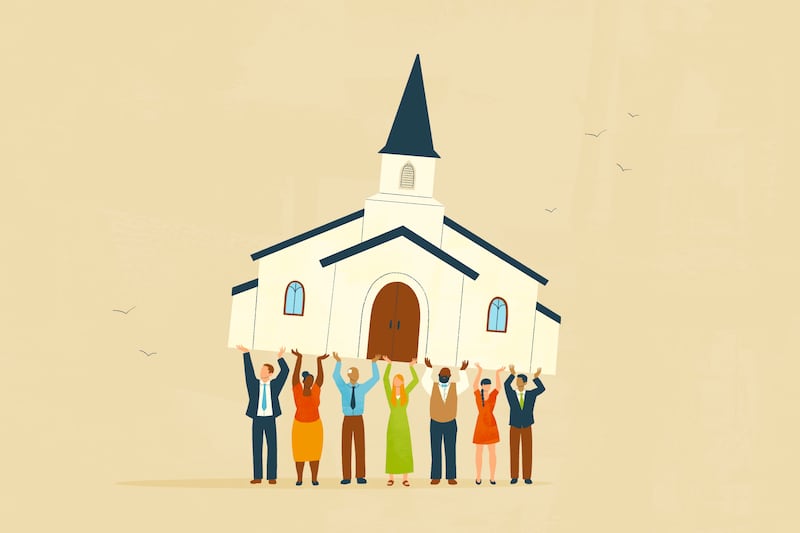


In recent weeks, numbers making the rounds are suggesting that a significant portion of Latter-day Saints are active but don’t actually believe the church’s truth claims. This is a common take in some circles and is sometimes used to pressure the church to change what it expects of its members or how firmly it holds to its fundamental truths.
This idea has reemerged with publicity around the upcoming book, “Torn: Why People We Love Are Leaving the Church and What We Can Learn from Them,” by Jeff Strong. Based on a 20,000-person survey drawn from Latter-day Saint and “exmormon” online forums, organizations and social media groups, this book suggests that about 1 in 3 active members “no longer believes the Church is what it claims.”
That’s a significant claim. Is it really true that a third of Latter-day Saint friends and family in the pews on Sunday don’t actually believe in the basic doctrines of the church?
This may not match the experiences of most members, but sometimes our intuitions don’t match reality. So it’s important to check whether our perceptions are corroborated by data.
Three representative data sources
If we look at three sources that have examined 21st-century belief and practice among Latter-day Saints — namely, the Pew Research Center, the Danforth Center on Religion and Politics, and our own B.H. Roberts Foundation — we find data that is at odds with this claim.
All three strongly indicate that the vast majority of Latter-day Saints believe core tenets of the church.
These documented levels of belief are so unusually high, in fact, that when Pew Research Center conducted their 2012 survey on Latter-day Saints, the title of their report read: “Mormons in America — Certain in Their Beliefs, Uncertain of Their Place in Society.”
In that report, 91% of Latter-day Saints indicated that the Book of Mormon was “written by ancient prophets and translated by Joseph Smith,” and 94% believed that the president of the church was a prophet of God.
The 2023 Current and Former Latter-day Saint Survey, conducted by the B.H. Roberts Foundation (which we participate in), drew from a representative sample of Latter-day Saints in the Latter-day Saint Corridor region. The survey weighted different counties according to the percentage of Latter-day Saints as indicated by the U.S. Religious Census, randomly selected mail routes within those counties and tens of thousands of mailers sent to solicit survey responses.
Similar to the Pew data a decade earlier, we found: Over 85% of Latter-day Saint participants indicated that they believed Joseph Smith “saw God the Father and Jesus Christ,” and 90% said they believed the Book of Mormon was a “true record of ancient people who actually existed.”
A recent survey by prominent religion researcher Ryan Burge of the Danforth Center on Religion and Politics likewise drew a nationally representative sample of 907 Latter-day Saints and asked a series of questions about fundamental Christian beliefs. Of self-identified members who attend church weekly, 96% agree that Jesus was resurrected from the dead.
When asked, “Which statement comes closest to your personal beliefs about Jesus?” 85% of all Latter-day Saints said, “Jesus is the Son of God.” Only 6% said, “Jesus was one of many messengers or prophets of God,” and only 3% said that “Jesus was an extraordinary person but wasn’t a messenger of God.”
This number was higher among weekly attending Latter-day Saints, with 92% identifying Jesus as the Son of God.
These three representative surveys all point in the same direction: By and large, Latter-day Saints, especially those actively participating, believe fundamental truth claims of the church. The notion that a mass of hidden nonbelievers sits in our congregations is simply not supported by representative data.
Of course, there are many people who do grapple with sincere questions and doubts about Latter-day Saint teachings. President Dallin H. Oaks, the current leader of The Church of Jesus Christ of Latter-day Saints, said in his first public remarks as prophet, “Even active members may sometimes have concerns about some historical, doctrinal or social issues connected with the Church.”
He then continued, “I want to help all our members overcome present or future doubts. Whatever those doubts, the way to overcome them is to get closer to our Savior Jesus Christ.”
Skewed samples misrepresent Latter-day Saint beliefs
But the question remains: How could a survey of 20,000 respondents be so out of step with the other surveys on this important question of belief? The likely answer is selection bias — the people who end up in your sample are not representative of the population you’re trying to study because of how participants are selected or who chooses to respond.
For example, if you wanted to know what the typical American thinks about fitness and posted your question to the thousands of members of the CrossFit Reddit forum, you would get very different answers than if you asked the same question to attendees of the Nebraska State Fair.
Both data sets would technically be “about what people think about fitness,” but neither would represent what a typical American thinks, and the results might create a skewed story that doesn’t reflect reality in an accurate way.
Strong’s survey appears to have precisely this problem. Rather than sampling from a random distribution of Latter-day Saints, it was posted to different social media sites, including Reddit, home of the largest and most active ex-Mormon community in the world. The survey was posted to mailing lists of both apologetic and ex-Mormon podcasts as well.
This methodology creates selection bias because it taps into a highly activated online population, as opposed to what is typically found in the pews on Sunday. This explains the mismatch between Strong’s results and the three representative data sets from Pew, Danforth and BHR, all of which used a more representative methodology.
None of this diminishes the very real and often painful faith journeys of those who do wrestle with doubt. Nor is any of this to say “all is well in Zion.” Doubt and disbelief are real challenges in Latter-day Saint communities, but dramatic narratives supported by unrepresentative data and a flawed methodology, no matter how well intentioned, don’t help those who are struggling.
The question of who Latter-day Saints actually are, and what they actually believe, is too important to be answered by convenience samples drawn from self-selected online communities. As the church navigates an increasingly complex religious landscape, the conversations we have about faith, doubt and retention need to be anchored in rigorous, representative research.