

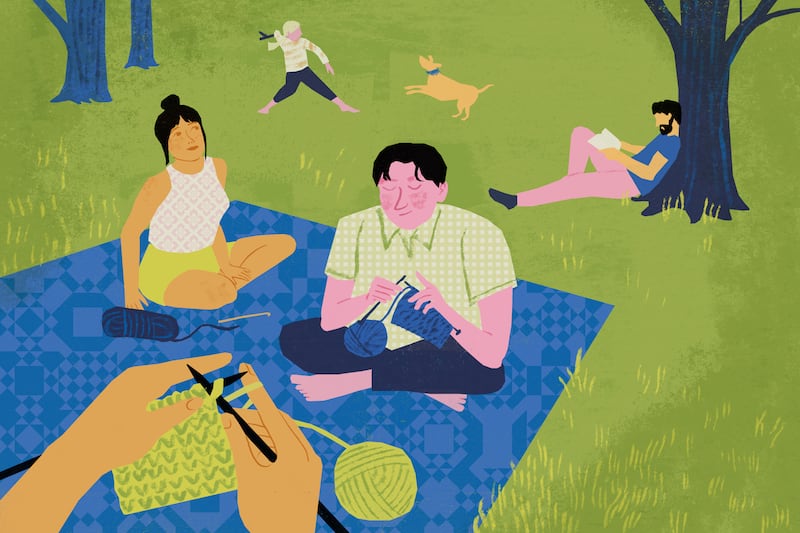

I was at a Kentucky Derby party recently, sweet tea sweating in my hand, watching my wife laugh with someone across the room and my children dart around the adults with that unselfconscious glee kids have at parties they aren’t really part of. And I caught myself thinking: These are the good old days and I am grateful.
That recognition is the exception. I keep the phone away during meals with my kids, though most days my attention is divided. I open the laptop after the kids are in bed and call it work, when half of it is just the reflex of reaching.
The Derby party moment was different. For an afternoon, I had simply stopped reaching.
The problem isn’t the phone. The phone enables intimacy and connects a deployed parent to a child at bedtime, a grandparent to grandchildren across a continent, a mother to her college freshman. Those are gifts. The problem is the substitute — when the phone stops connecting us to the people we love and starts standing in for the work of being with them.
A famous line from the final episode of “The Office” — “I wish there was a way to know you’re in the good old days before you’ve actually left them” — lands because it names the failure most of us are living and realize is a problem but then fail to act on. We trade presence for documentation and embrace nostalgia where we wanted memory.
Our culture has made this a default setting. Watch a school pickup line, a Little League game, a wedding reception. Most are looking down, filming their experiences rather than living them. The U.S. Surgeon General has called loneliness an epidemic, and time spent in face-to-face socializing has fallen by about 30% for adults since 2003 — and by more than 45% for teens. We are both surrounded and unaccompanied at the same time.
Tocqueville saw a version of this two centuries ago: a people materially comfortable beyond anything the Old World had known, yet always reaching, never able to sit still inside their own lives. He thought it the temperament of democratic societies. What was once a tendency is now an architecture. The platforms that organize our days are designed, at the level of code and incentive, to keep us reaching. Comparison is the product; hunger is the engine.
Arthur Brooks has been making this sort of argument for years: take fewer pictures. The counsel sounds trivial until you look at the research. Linda Henkel, a Fairfield University psychologist, walked museumgoers through an exhibit and asked them to photograph some objects and observe others. Those who took photos remembered less. She called it the “photo-taking impairment effect.” The photo is not the memory. It is the substitute, and a poor one at that.
Religious traditions have long understood that this discipline cannot be sustained on willpower alone. It has to be structured into life. My own Jewish community calls it Shabbat. Latter-day Saints and many Christians call it the Lord’s Day. The form varies but the logic is the same: a weekly, protected pause from acquisition and acceleration. For 24 hours, the ladder is put away. The phone goes into a drawer. You sit at a table with the people you love and let the meal take as long as it wants. The Sabbath is not nostalgia. It is a deliberate answer to a permanent problem.
The Jewish tradition I was raised in has a related practice for smaller moments. There is a blessing for almost everything: first fruits, new clothes, the sight of the ocean. The shehecheyanu, said at thresholds, thanks God for sustaining us and bringing us to this season. The point is the discipline of stopping, naming what is in front of you, and refusing to take it for granted. Gratitude is not a feeling. It is a practice. And it requires the very thing the feed is built to destroy: attention to what is here.
Gratitude is not a feeling. It is a practice. And it requires the very thing the feed is built to destroy: attention to what is here.
There is a civic dimension too. Democracy is a habit before it is a system. It is built in small rooms and particular spaces — the dinner table, the block party, the bowling alley, the Derby gathering with children underfoot — where people learn to belong to something they did not choose and cannot scroll past. These are what Tocqueville called the schools of democracy. They only work if we show up, and showing up means more than physical presence. It means attention, and being seen giving it, by the people learning what attention looks like by watching us. Children don’t absorb presence from a lecture. They absorb it from the regard their parents give to the world and to them. We are not just losing our capacity for presence. We are failing to transmit it.
The good old days are not in the rear-view mirror. They are not coming later, when the work is done or the kids are older or the country is fixed. They are now, and the only question is whether we will be present enough to notice. The disciplines are not complicated. Put the phone away during dinner. Take fewer pictures. Honor a Sabbath, or build your own pause if you do not have one. Sit with the people in front of you and recognize that what is here is enough.
Presence is a moral inheritance and a civic one. The habits we keep at the table become the society we live in. If we want a better one, we have to show up to the lives we already have.