

Editors note: This is the first in a series of six pieces exploring the ideas behind America’s founding. Each piece will accompany one of five master classes on the Declaration of Independence from Utah Valley University’s Center for Constitutional Studies. The classes are free and open to the public. Read more about and access the classes here.
When the United States of America declared their independence from Great Britain in 1776, their representatives in the Second Continental Congress chose their words carefully. Their audience was not King George III. It was the American people.
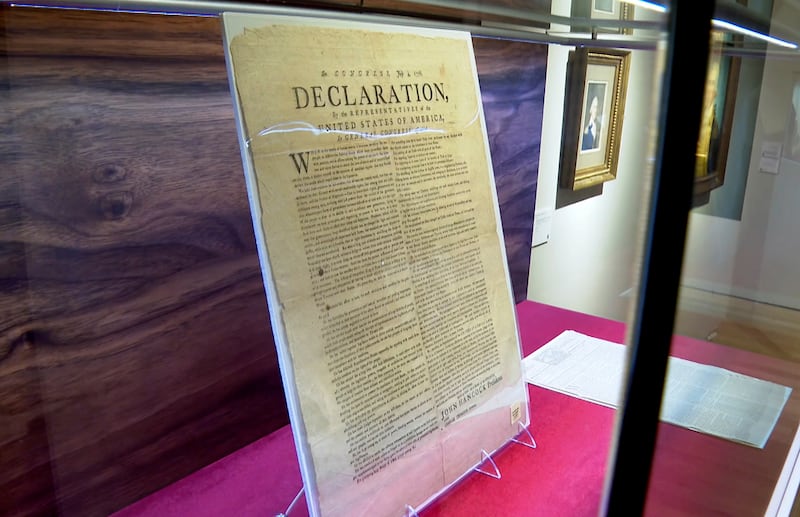
You can see this in how the Declaration of Independence was published.
The so-called Olive Branch Petition, published a year earlier as a last-ditch effort to make the colonists’ case to the crown, had been copied out in manuscript on parchment and signed by the delegates. That hand-delivered document, a personal appeal to the king — who refused to read it — can still be seen today at the British National Archives.
By contrast, Congress hired a Philadelphia printer, John Dunlap, to print 200 copies of the Declaration of Independence as broadsides meant for wide public distribution. Copies were sent to each colony’s legislature and to George Washington’s Continental Army, then camped out in Manhattan awaiting a British invasion. Three copies still reside in the British National Archives, but not because Congress bothered to send them. They were collected by British officers in North America and sent to the ministry in London.
The “engrossed” — or signed — copy of the Declaration of Independence on display at the U.S. National Archives actually came later, almost as an afterthought, and remained rolled up among documents possessed by federal officials for decades. No one outside that small circle of bureaucrats would have seen the engrossed copy until five decades later, when William Stone produced a copperplate engraving at the behest of the State Department, allowing the handwritten text to be readily copied and distributed.
Charles Thomson, the secretary of the Congress in 1776, even pasted a copy of the Dunlap broadside into the official journal, as if emphasizing that the declaration is a public document for dissemination, not a missive from North American subjects to the crown.
The declaration rapidly proliferated through the ordinary operation of a free press, as colonial printers churned out innumerable copies in newspapers and broadsides. Their counterparts in England and Europe followed, and by the fall of 1776, the entire reading public of Europe had encountered the declaration’s immortal words.
In America then — and in modern times — the Declaration of Independence sits at the center of civic life. It sets a high bar for good government. Our national squabbles and scrums are routinely about whether we as a people and our governments live up to that standard.
In the midst of our national crisis over slavery, and while he himself was cut off from the blessings of American citizenship by the color line, the great orator Frederick Douglass urged his audience to hold fast to the Declaration of Independence as the “ring-bolt to the chain of your nation’s destiny …. The principles contained in that instrument are saving principles. Stand by those principles, be true to them on all occasions, in all places, against all foes, and at whatever cost.”
While Americans spend a great deal of time arguing over the principles of equality, representative government, and the God-given rights to life, liberty and the pursuit of happiness, we spend precious little time in our educational system learning about them.
These saving principles of our national freedom — the “ringbolt,” as Douglass termed them — did not appear out of thin air. They were and are the hard-won result of long experimentation and serious thinking. They are the fruit of Western civilization in all its complexity, building on biblical religious traditions, classical civic republicanism, natural rights political philosophy and the English legal tradition that gave us the blessings of the common law. Few Americans receive a civic and humane education sufficient to appreciate and savor this constitutional and intellectual inheritance. Indeed, few universities possess a faculty eager to teach it.
As we celebrate the semiquincentennial of American independence, the time is ripe to recover our love of the intellectual and political tradition that bequeathed us the American Founding. And not just for those fortunate enough to find their way into a classroom where that tradition is being faithfully taught. Like the Declaration, which was sent out into the world for everyone to read, Utah Valley University’s Center for Constitutional Studies is offering free master classes to anyone who wants to learn more about the Declaration and the ideas that gave birth to the American experiment in self-government.
Each class, taught by professors from UVU, BYU and the University of Oxford, will introduce viewers to the key ideas and history that animate the fundamental document of American independence. We hope you will join us.
Please visit the Declaration Master Class page for more information.