


The genius of federalism, as coined by Supreme Court Justice Louis Brandeis in 1932, is that states can act as “laboratories of democracy.” Empowered with the autonomy to explore and test new policies, leaders can set examples for others to follow or prove to be cautionary tales.
But, the dynamic only works if states are protected from intrusion by other states.
Unfortunately, California is forcing its experiment on the rest of the country — and Utahns are bearing the costs. Sens. Mike Lee and John Curtis have an opportunity to act.
At issue is California Proposition 12, which imposes costly restrictions on how farmers can raise pigs or egg-laying hens. Under the law, only eggs and pork that are produced under a “Whole Foods”-style system can be sold in Golden State supermarkets. That also means consumers are paying expensive “Whole Foods”-level prices.
The policy runs afoul of the federalist system. Unlike local sales taxes or minimum wage laws, Proposition 12 applies to farmers in Utah — or any state — who sell food in California. Given that California accounts for a big chunk of the consumer market and imports most of its eggs and pork, the law is a de facto national standard. Simply ignoring the state is impossible for any farmer who values staying in business.
If the regulation isn’t fixed, cattle ranchers could be targeted by California next.
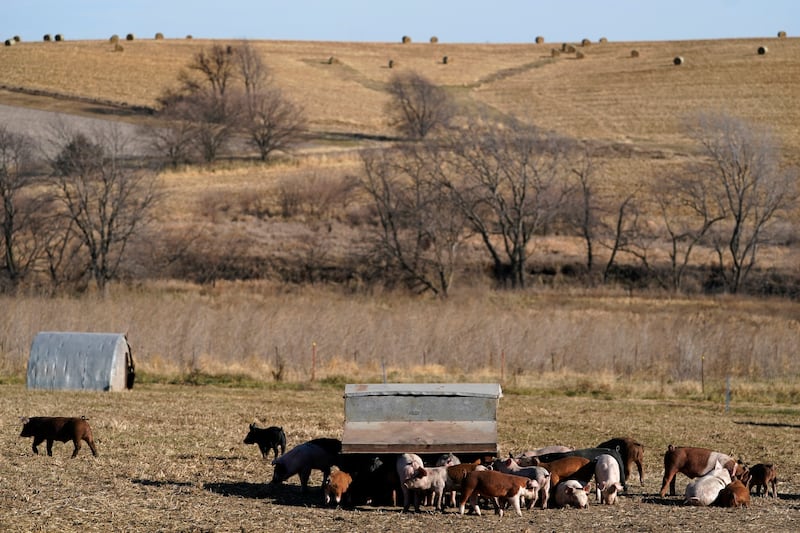
Proposition 12 weakens the free market. Family farms are hard-pressed to absorb the extra costs required to satisfy California’s new arbitrary regulation, which is estimated to be roughly $4,000 extra per animal. That means small family farms will increasingly disappear — leading to more consolidation.
Utahns value a resilient economy made up of many small- to medium-sized businesses that can deliver a wide variety of food options. Not only would Proposition 12 leave Utah families paying more for food, but fewer choices will exist as more and more affordable products are driven out of grocery aisles.
Some in Washington claim the attack on states’ rights and consumer choice is justified because California’s law supposedly helps animals. The American Veterinary Medical Association argues otherwise, saying Proposition 12 does “not objectively improve animal welfare and may unintentionally cause harm.” Meanwhile, the American Association of Swine Veterinarians emphasizes that “there is no single housing system that is optimal in all situations.”
The 2026 Farm Bill — which passed the House in April — stops California from imposing its will on Utah and the rest of the country. All but three Republicans and more than a dozen Democrats in the lower chamber came together to approve the bipartisan package. Even President Donald Trump has come out swinging, saying “I will use all authority under the Constitution and U.S. law to stop efforts by California — or other states — that hurt American farmers in other states.”
The legislation now heads to the Senate where Utah’s delegation can help ensure that California’s foolish regulatory ambitions stop at the state line. Sen. Mike Lee is a famously staunch defender of federalism. This is an opportunity for him to vote his principles.