


Across the country, children are finishing their last days of school, turning in textbooks and beginning three months of freedom. For many parents, relief arrives with a familiar question close behind: What are they going to do all summer?
This year that question carries new weight. After years of debate, schools across the country are finally limiting smartphones during the school day, and the early results are promising: calmer classrooms, steadier attention, and teachers reporting fewer distractions and more conversation. This is welcome news.
But, it points to a gap most of the coverage has skipped. If children spend the academic year free from their phones only to spend the summer staring at screens, we will not have solved the problem. We will have merely changed its location. Summer is the hinge: the next three months can deepen what the school year began, or undo it in a matter of weeks.
Childhood is a time of formation
The deeper challenge facing parents is not how to subtract screen time; it is how to think about childhood itself.
The question is never whether our children are being formed. It is what is doing the forming.
Every generation has to decide what kind of adults it hopes to raise, and then build the experiences that turn children into them. Families, congregations, coaches, neighbors and civic institutions have always carried the bulk of that work; school was never meant to do it alone. That work has a name: formation.
Whether we plan for it or not, childhood is a season of formation. Every hour a child spends somewhere, with someone, doing something shapes the adult he or she is becoming. The question is never whether our children are being formed. It is what is doing the forming.
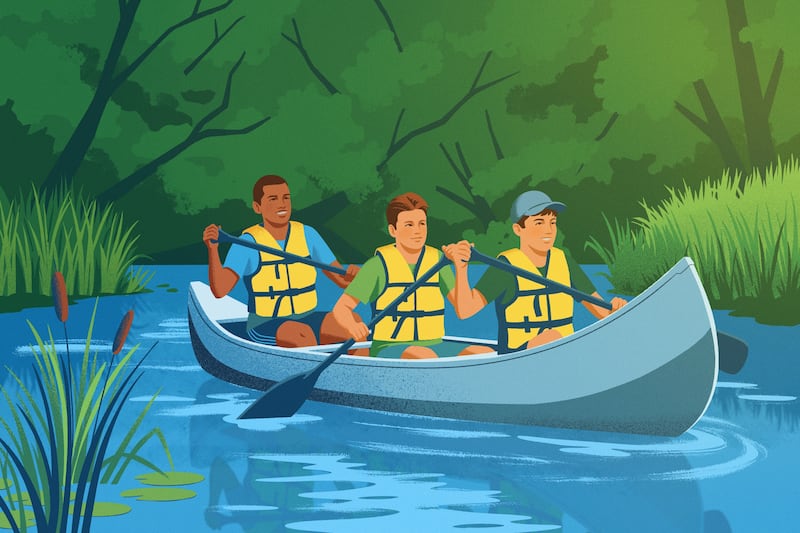
For generations, summer was one of America’s great institutions of formation. Children went to camp and played ball. They worked their first jobs, volunteered, and joined scout troops, youth groups and faith communities. They rode bikes, roamed their neighborhoods and spent long days outdoors with friends. They learned to settle disagreements without a parent refereeing, discovered what they were good at and built friendships that lasted for years. My time as a scout camping on Treasure Island along the Delaware River in Pennsylvania remains one of my most cherished moments and represents a place where I took risks and grew tremendously.
These experiences did more than fill the days. They prepared me and countless children for adulthood.
A summer job taught responsibility. A coach became a mentor. A camp counselor modeled leadership. A religious leader helped you make sense of the world and open your eyes to new ways of seeing. Even an unstructured afternoon with neighborhood friends taught cooperation and compromise. And in the hours without an adult hovering nearby, children learned to navigate the world on their own, gaining the confidence that comes from solving problems themselves.
How smartphones impact childhood formation
Many of those opportunities still exist. But they now compete with the most effective attention-capturing device ever built. A smartphone which by design offers an endless stream of stimulation that can fill every spare hour. Unlike a campfire, a pickup basketball game or a long talk with a friend, it asks almost nothing in return.
These lessons cannot be downloaded. They have to be lived.
That ease comes at a cost. The traits parents most hope to cultivate — resilience, patience, empathy, self-control, independence and responsibility — are nearly impossible to develop alone. They are forged in the company of other people, through obligations met, disappointments survived and challenges overcome in the real world. A child learns empathy by caring for a friend, responsibility by showing up for work on time and confidence by trying something hard and finding she can do it.
These lessons cannot be downloaded. They have to be lived.
Long before anyone worried about social media, religious communities grasped this. They understood that values are not transmitted through lectures alone but cultivated through shared experience, relationships, responsibility and ritual.
Consider the role summer camp has played in Jewish life. Jewish overnight camps have become one of the most powerful engines of identity in American Judaism. The research bears it out: adults who attended Jewish overnight camp as children are markedly more likely to feel attached to Israel, observe Shabbat and stay connected to a synagogue community.
The same pattern runs across traditions. For many Latter-day Saint teens, summer means For the Strength of Youth (FSY) conferences — five-day gatherings that now draw roughly 120,000 young people across the United States and Canada each year — along with Young Women camps, service projects and outdoor treks. Christian congregations of every kind host camps, retreats and mission trips. The theologies differ, but the insight is shared: the young are shaped not only by what they are taught, but by what they live through together.
Social scientists have understood this now for generations. The sociologist Émile Durkheim argued more than a century ago that people are formed by the communities and institutions to which they belong, and Robert Putnam has since documented how social connection and civic participation sustain both individuals and the societies they make up. Parents need no degree to recognize the truth in it: children flourish when they belong to something larger than themselves, when trusted adults invest in them, and when they learn that other people are counting on them.
The freedom of summer is important
This is why summer still matters. The school year is tightly scheduled; summer opens space for something else: for camps and leagues, jobs and service, congregations and the outdoors, and the unhurried hours in which young people discover who they are becoming.
None of this requires a flawlessly planned summer. Overscheduling defeats the very purpose; children do not need every minute accounted for, only room to meet the real world. A simple aim helps more than a packed calendar: one job, one team, one camp, one service commitment, one regular routine outdoors. Not a perfect summer; a formative one.
The movement to get phones out of schools rightly recognizes that children need to focus, learn and connect — but it is only a first step. The goal was never merely less screen time. It is to raise young people who are capable, resilient, responsible and bound to the people around them.
Summer remains one of our best opportunities to form the next generation. Some of the most important lessons of childhood are still learned far from a classroom and far from a screen — through friendship, responsibility, service, adventure, faith and play. Those lessons have always mattered. In an age of screens, they matter more than ever.