


For a decade, one of the courses I taught as a professor was business ethics. My students and I wrestled with questions about personal values, moral versus nonmoral standards, ethical relativism, individual integrity, social responsibility and much more.
Because of our readings and students’ experiences, our conversations often wandered into gray areas. Yet, at the end of every semester, I reminded them of something I believe deeply: There is still a great deal of black and white in this world. Some things are clearly right, and some things are clearly wrong. And it becomes dangerous — personally and societally — when we convince ourselves that there are exceptions to everything.
Justification is rarely neutral; it’s often the first warning light that an ethical boundary is being bent.
In recent years, I’ve become increasingly troubled by how quickly many of us — myself included — reach for justification when our choices don’t align with our values. I used to tell my students that the instant you feel the need to justify something, you should pay attention. Justification is rarely neutral; it’s often the first warning light that an ethical boundary is being bent.
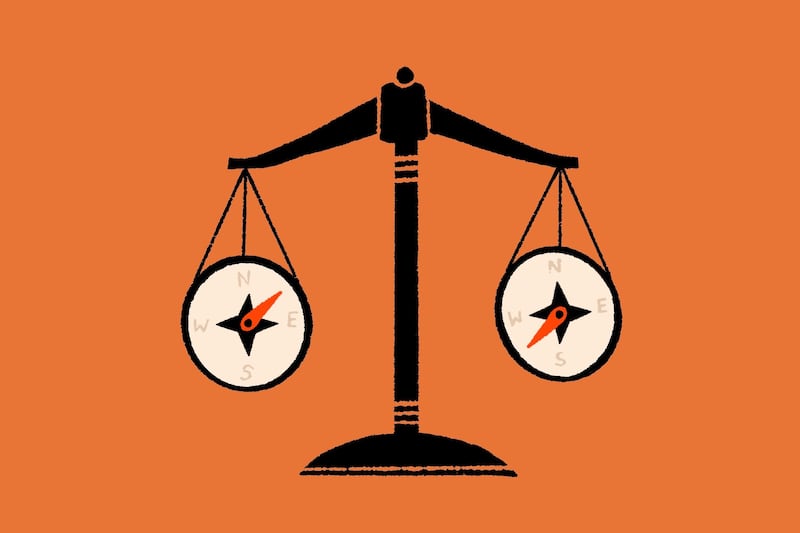
Part of the confusion comes from the way we blur three ideas that should stay distinct: morality, ethics and character. Morality is what you believe — your internal compass of right and wrong. Ethics is how you reason — how you examine, justify and apply those beliefs when choices get complicated. And character is how you behave — the consistency and courage to live out your values, especially when it’s difficult.
When we collapse these into one vague notion of “being a good person,” it becomes far easier to rationalize our way around principles that should anchor us.
Today we often confuse preference with principle. In ethics, we distinguish between moral standards — those that affect human well‑being — and nonmoral standards, which are simply matters of taste. Yet our culture increasingly treats moral questions as if they were no more significant than choosing a paint color. When everything becomes a matter of personal preference, justification becomes easy, and accountability becomes optional.
One of the most persistent challenges I saw in the classroom was ethical relativism — the belief that right and wrong depend entirely on personal or cultural preference. The problem is that relativism leaves us with no independent standard for judging harmful behavior. It makes ethical progress impossible. And it silences our ability to call out wrongdoing in our own communities. When everything is relative, nothing can be wrong.
But relativism isn’t the only challenge. Increasingly, we treat conscience as if it were infallible — as if “follow your truth” were a reliable moral compass. Yet conscience can sometimes be conflicted or even erroneous — a point emphasized in the ethics textbook I taught from, which notes that “conscience is not always a reliable guide because it can be conflicted and erroneous.”
A conscience that is unexamined or unformed can easily confuse desire with duty. And justification often disguises itself as conscience, giving us permission to do what we already wanted to do.
I’ve encountered moments in my own work that illustrate this all too clearly. These experiences reminded me how easily justification can override commitments when moral clarity slips.
For example, I had a leader who redirected funds specifically earmarked for the Utah Women & Leadership Project because he believed his own priorities outweighed the commitments already made.
Another moment stands out from last year. I asked a few colleagues about a decision that had harmed several employees and publicly humiliated one of them — a woman who had contributed in meaningful ways for decades. The way the decision was communicated failed to acknowledge her service or her humanity.
Their response was essentially that it was “just business,” and that it wasn’t their responsibility to ensure people felt valued or respected. It was a stark example of how moral clarity erodes when we treat people as problems to manage rather than individuals deserving dignity.
And the consequences become even more serious when these patterns show up in situations involving safety and justice.
I’ve also heard from dozens of women over the past few years who were urged not to pursue action through the justice system after experiencing domestic violence or sexual assault because doing so would “cause conflict” in the family. They were told, implicitly or explicitly, that it was better for everyone if they stayed silent and “sacrificed” their own well‑being — because that is what “good women” supposedly do.
If we want stronger families, healthier workplaces and more just communities, we must choose clarity over convenience and character over comfort.
It’s a painful example of how cultural expectations can masquerade as moral principles, and how quickly preference for comfort or harmony can be elevated above justice, safety and truth.
At the end of every semester, I reminded my students that despite all the gray we can analyze, there is still a great deal of black and white in this world. I believe that even more today.
Every one of us will face moments when justification feels easier than honesty, when comfort feels safer than courage, and when silence seems simpler than standing for what is right. But moral clarity is forged in those moments — in the quiet decisions no one sees, in the commitments we keep even when they cost us something.
If we want stronger families, healthier workplaces and more just communities, we must choose clarity over convenience and character over comfort. Moral clarity still matters, not because life is simple, but because people are worth protecting.