


Two hundred and fifty years ago, Thomas Jefferson enshrined “the pursuit of Happiness” in the Declaration of Independence. But today, the news is grim on the happiness front.
By almost every measure, Americans are losing that pursuit. The U.S. depression rate is near record highs. The World Happiness Rankings put America much lower than countries of comparable wealth. Optimism is at historic lows.
We are in the midst of a “happiness crash,” in the words of University of Chicago economist Sam Peltzman.
At the heart of America’s happiness crash is the decline of marriage and family formation. Peltzman found in a 2023 study that marriage is the single greatest differentiator between happy and unhappy Americans — and its retreat “can explain (statistically) most of the recent decline in overall happiness.”
This happiness crash suggests the solution lies in revitalizing the fortunes of the family in America. At the center of any marriage revival will be creating what the late sociologist Peter Berger called “plausibility structures” — institutions and communities that articulate and reinforce the ideas, virtues and values required for any worldview to succeed. In his words, “Ideas do not succeed in history by virtue of their truth but by virtue of their relationship to specific social processes.” Without a strong social base, even deeply held beliefs begin to feel uncertain or implausible.
This is Berger’s most important practical insight: you cannot revive a belief system and way of life through intellectual persuasion alone. You have to rebuild the institutions and communities that make it feel livable and real. Ideas follow social structures as much as they lead them.
Building a “family-first marriage culture” for the 21st century requires more than the right ideas. It requires plausibility structures — the communities, rituals and social environments that make getting married and raising a family feel not just virtuous, but attractive and attainable. Churches are built for exactly this. Most aren’t using that capacity. Few congregations have a dedicated marriage and family ministry, or any clear message designed to strengthen the families already in their pews. Here are four steps to change that.
Step 1: religious institutions need to emphasize family-centered life
The first step for churches and other religious institutions to take is to be bolder in emphasizing the ways that the “true, good, and beautiful” can be found by living a family-centered life — that family is an essential vehicle for human flourishing. There are plenty of voices out there spreading anti-marriage and anti-family messages in the name of individual empowerment or careerism — from New York Times articles claiming that “Married heterosexual motherhood in America ... is a game no one wins” to influencers like Andrew Tate telling us that “there is zero statistical advantage” for men from marrying.
Religious communities can push back against these messages in two ways. First, they can make the factual case for family — plainly, from the pulpit, to adults and children alike. The data is unambiguous: married people with children are among the happiest men and women and most financially stable Americans alive.
But facts alone don’t move people toward lifelong commitment. What religious communities can uniquely provide is a sense of sacredness — the conviction that family life is not just statistically advantageous but genuinely transcendent, not just true but good and beautiful. A father-son pilgrimage to Santiago de Compostela. A Sunday night visit to serve the homeless. Welcoming Shabbat around the table on Friday evening. Saturday Vespers at St. Vladimir’s with your young family. Monday nights in Family Home Evening. These kinds of shared religious practices make family feel like a calling rather than a burden, a form of abundance rather than a loss.
Step 2: Give people hope of a strong and stable marriage
Once the benefits of marriage are established, the second vital step churches should take is to give young adults hope that they can actually forge a strong and stable marriage. One reason that young adults are hesitant to put a ring on it is that they think unhappy marriages and divorce are endemic. Faith is a great help in ensuring existing marriages can thrive and serve as a model for marriage-minded young people.
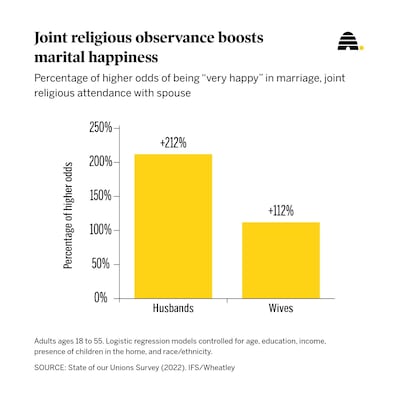
The numbers are striking. Wives who attend church regularly with their husbands are 112% more likely to report being very happy in their marriage than their less religious peers, according to a 2025 report from the Institute for Family Studies and the Wheatley Institute. The effect is even larger for men: husbands who worship regularly alongside their wives are 212% more likely to be very happy in marriage.
Churchgoing doesn’t just increase your odds of marital bliss, it reduces your risk of landing in divorce court. Couples who attend church together are also 30 to 50% less likely to divorce, as I (Wilcox) noted in my book, “Get Married.” Yet most churches lack any substantive marriage ministry. Budget constraints play a role, but so does a broader failure to treat marriage as a pastoral priority. Helping couples in distress and those looking to forge strong marriages must become an urgent priority for churches, faith leaders and faith-oriented organizations in order to resuscitate a marriage-oriented, family-first culture.
A perfect example of how to do this on a grassroots level comes from Communio, a new nonprofit partnering with hundreds of churches nationwide to launch and sustain marriage and family ministries. For instance, Communio provides church partners with consumer insights and survey tools to analyze the relationship quality in their church and help with marriage and family ministry outreach. From there, Communio works with churches to launch ministries designed to strengthen existing marriages and forge new ones.
Last year, Communio churches saw 22,149 people complete marriage and relationship ministry skills activities and classes. In exit surveys, 74% of those who self-reported being at high risk for divorce said they were very satisfied or better with their marriage after participating. Likewise, 57% of singles who participated said they now had the knowledge and skills to build a healthy relationship.
Step 3: Get young adults to the altar
Demonstrating the benefits of marriage and nurturing a faith-based underpinning for marriage are prerequisites for step three: Getting young adults to the altar. Right now, almost two-thirds of single young adults are not dating seriously, either because they lack the confidence to date, haven’t met anyone who seems promising or have had negative experiences with previous relationships. Religious groups can help remedy what’s been called the “dating market recession” by boosting young adult ministries, talking up marriage, giving practical advice about dating and providing a range of opportunities for young adults to get involved with faith communities.
Two hundred and fifty years after Thomas Jefferson wrote the pursuit of happiness into the nation’s founding charter, the path back to it doesn’t run through Washington. It runs through churches and homes across America.
Once again, here is where organizations like Communio come into play. Several churches working with Communio have witnessed significant declines in divorces and noticeable increases in church membership. Mountain View Baptist Church, a church of under 300 attendees in Tucson, Arizona, has attracted more than 1,600 to participate in their marriage and family ministry. The ministry has saved numerous marriages and cultivated more than 50% growth in Mountain View’s Sunday attendance. Out in Vero Beach, Florida, St. Helen’s Church has attracted 4,015 people from both their parish and outside community to participate in their marriage and family ministry. Thousands of hours of relationship skills practice have occurred, saving dozens of marriages and fueling a two-thirds increase in new weddings annually. St. Helen’s now has a reputation for being the “family church” and it has seen Sunday attendance grow by 54% since 2023.
These outcomes indicate that when churches intentionally invest in relationships and families, they create the kind of plausibility structures that make faith, marriage and family life more attractive and attainable in modern America. Religious organizations like Communio can help churches do this effectively.
Step 4: Parents need to integrate faith into their homes
The fourth and final step to forming family-focused plausibility structures is to encourage parents to integrate faith into the fabric of their own homes. A new report from Communio and the Institute for Family Studies found that parental religious attendance and prayers, a warm parent-child relationship and a stable marriage are the three of the most powerful engines of faith transmission — more powerful than any youth group, Sunday school program or church camp combined.
Data from the report shows kids who had a “very good” relationship with both parents in childhood were 76% more likely to attend church weekly, 66% more likely to pray daily and 97% more likely to believe in God as adults. Churches should tell parents plainly: if you want your children to believe, let them watch you believe — pray at the table, talk about God in the car, make faith a living presence in your home and love your spouse well, because children raised in warm and religious homes are dramatically more likely to carry faith into adulthood.
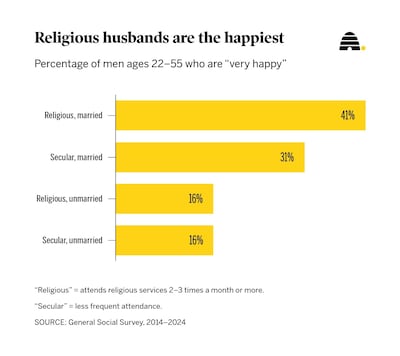
All of this increases the odds that children embrace a faith-oriented, family-focused life when they become adults. Doing so naturally lends itself to a meaningful and happy life, especially for those who are married. Even among religious Americans, there is a notable happiness gap between the married and unmarried.
According to the General Social Survey, religious, married women and men aged 25 to 55 are more than twice as likely to report being “very happy” in life compared to unmarried religious counterparts.
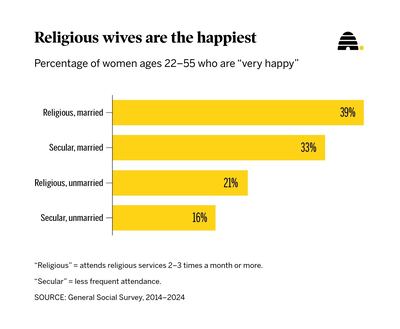
Getting religious men and women to the altar, many of whom desire marriage and family life, is an essential component of tackling the happiness crisis head-on and regenerating a family-oriented culture.
Communio is already proving that revitalizing marriage and the family can be done, one congregation at a time. Two hundred and fifty years after Thomas Jefferson wrote the pursuit of happiness into the nation’s founding charter, the path back to it doesn’t run through Washington. It runs through churches and homes across America.