

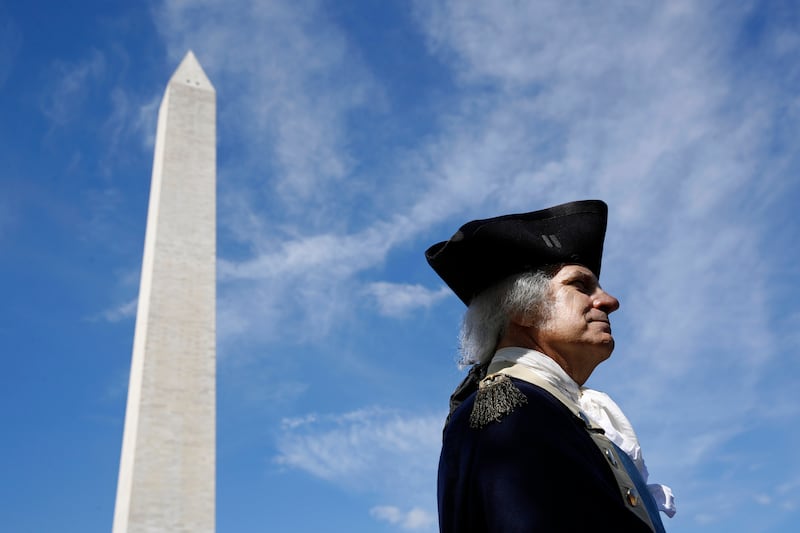

When news of the American experiment reached the courts of Europe, the reaction was not admiration. It was skepticism, and in many places, outright mockery. And we could forgive them their doubt. A nation governed by and for the people had no precedent in the modern world.
The dominant intellectual tradition the founders inherited said this was all impossible. Thomas Hobbes, whose “Leviathan” had shaped political thought for a century, argued that men left to govern themselves would descend into chaos, a war of “every one against every one,” where life would be “solitary, poor, nasty, brutish, and short.”
The only remedy, Hobbes believed, was a sovereign with absolute authority to impose order. The idea that ordinary men could sustain order themselves, through reason and virtue rather than force, was untested and contradicted what the most serious political minds of the age believed about human nature.
Anne-Robert-Jacques Turgot, the French economist and statesman, wrote to Richard Price in 1778 that Americans were “the hope of the human race” but doubted whether they could sustain what they had started. Aristotle had warned that democracy decayed into mob rule. Montesquieu believed republics could only survive in small city-states, and the notion that one could function across a continent, among millions, struck him as politically impossible. Even Alexander Hamilton, in Federalist No. 1, questioned “whether societies of men are really capable or not of establishing good government from reflection and choice, or whether they are forever destined to depend for their political constitutions on accident and force.”
How the founders built the American republic
The founders were not naive about the odds. They knew the history. Every republic before theirs had failed. And yet they made the bet anyway, not out of blind optimism, but out of a conviction that something different was possible if the people themselves were equal to the task. That conviction came with a condition.
James Madison wrote in Federalist No. 55 that republican government “presupposes the existence of these qualities in a higher degree than any other form.” What are “these qualities” that Madison references? They include virtue, judgment and the capacity of ordinary citizens to look beyond immediate self-interest and reason together toward something larger. Benjamin Franklin, emerging from the Constitutional Convention in 1787, was asked what kind of government the delegates had produced. “A republic,” he reportedly said, “if you can keep it.”
That “if” has always been the weight-bearing wall of the American experiment.
The habits of liberty still have to be learned, and relearned, by every generation.
George Washington understood this better than anyone. In his Farewell Address, a document every American should read and reread, instead of celebrating what had been built, he warned against what could destroy it. He cautioned against the “spirit of party” that would pit citizens against one another until faction mattered more than country. He decried “the impostures of pretended patriotism.” He pleaded for an educated, engaged citizenry, because he knew that a republic running on apathy was a republic running on borrowed time.
“Promote, then, as an object of primary importance, institutions for the general diffusion of knowledge,” he wrote. “In proportion as the structure of a government gives force to public opinion, it is essential that public opinion should be enlightened.”
The French learned this lesson the hard way. In the same era, inspired by the same Enlightenment ideas, France attempted its own revolution. It ended with the Reign of Terror, thousands guillotined, and liberty consumed by the very passions it had unleashed. The difference between Philadelphia and Paris was not philosophy, but preparation. The American founders had spent 150 years practicing self-governance in town halls, colonial legislatures and local courts before they ever declared independence. The habits of liberty had to be learned before they could be kept.
We have to work to keep the American experiment alive
That is still true. The habits of liberty still have to be learned, and relearned, by every generation.
This is the responsibility that falls to us as we mark 250 years of American self-governance. Not simply to celebrate what the founders built, but to honestly ask whether we are doing what they understood was required to sustain it. Are we informed? Are we engaged? Are we willing to reason together across disagreement, or have we settled for the comfort of an echo chamber?
The audacity of the original bet was not that free men could overthrow a king. It was that they could then govern themselves wisely, generation after generation, without a king to tell them what to do.
Two hundred and fifty years in, that bet is still being settled. For my part, I’m willing to wager my time, my effort and my future on the idea that Americans are still up to the task of self-government.