


After John Quincy Adams left the White House, he did something no former president had ever done. Nearly two centuries later, he remains the only former president ever to do so.
After serving as president of the United States, 63-year-old Adams stunned the nation by running for the House of Representatives — and winning.
For the next 16 years, our former president returned to the U.S. Capitol — not as the nation’s chief executive, but simply as an ordinary congressman from Massachusetts.
From his sometimes solitary position, Adams fought passionately against slavery, argued the famous Amistad case before the Supreme Court and ultimately collapsed at his desk on the House floor. Carried into the Speaker’s Room just outside the House chamber, he died there two days later.
The document that John Quincy Adams believed in
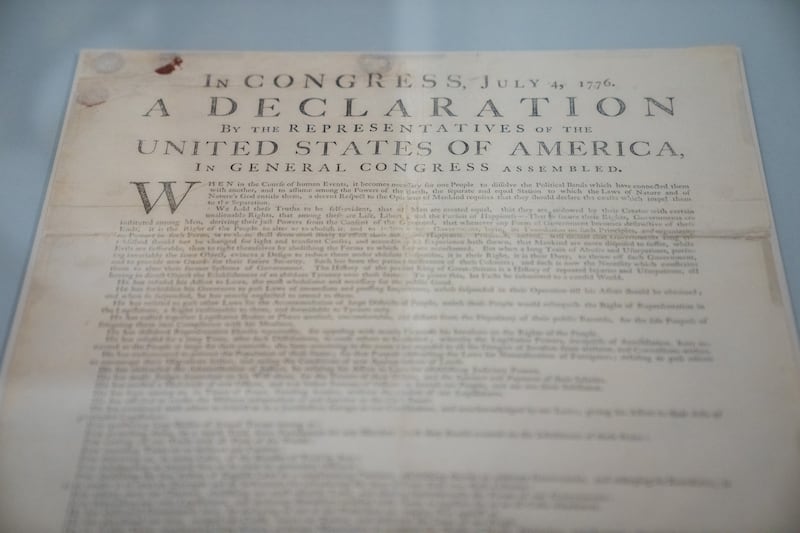
Why would a former president voluntarily return to public life at that level, after already holding the highest office in our country? The answer wasn’t ambition. It was a document. A document whose 250th anniversary we celebrate this Fourth of July.
Adams believed the Declaration of Independence was far more than America’s explanation for separating from Great Britain. It was America’s statement of first principles.
Before America, nations typically justified their existence through conquest, bloodlines, ethnicity, geography or even the divine right of kings. America justified itself with an idea.
For centuries, governments claimed authority over people. America turned that idea upside down, declaring that people possess unalienable rights before governments even exist — rights that come not from kings or legislatures, but from our creator. The declaration did not attempt to prove those rights. It simply called them “self-evident.”
America’s greatness lies in the fact that our founders declared principles so lofty — and yet so self-evident — that every generation since has been continually challenged to live up to them.
There is something remarkable about what we call that document. We don’t call it the Explanation of Independence or the Justification of Independence. We call it the Declaration of Independence — or simply, the declaration.
Our founders were not trying to make an argument to King George III that might persuade him. They were proclaiming truths they believed already existed, whether any king acknowledged them or not.
The declaration became more than America’s birth certificate. It became America’s measuring stick.
Birth certificates record the past. The declaration does something far more remarkable: it tells every subsequent generation what America is striving to become.
The Declaration of Independence has helped each generation improve
America’s greatness has never rested on the claim that we were perfect in 1776. We weren’t. Our founders certainly knew that. Yet, America’s greatness lies in the fact that our founders declared principles so lofty — and yet so self-evident — that every generation since has been continually challenged to live up to them.
John Quincy Adams understood that. This is why he returned to Congress and led the fight to eliminate the “Gag Rule,” which automatically silenced debate over slavery. Later, before the Supreme Court, Adams successfully argued that the Africans aboard the Amistad were free human beings — not property — and should be allowed to return home.
Yet even though Adams spent his years in Congress fighting slavery, he never lived to see Lincoln sign the Emancipation Proclamation. That came nearly 15 years after his death.
But Adams understood something essential: the declaration was never meant to be admired from a distance. It was meant to be applied. And Adams was not alone.
In America, every generation inherits both the blessings of what came before and the responsibility to improve what it has received.
Elizabeth Cady Stanton spent more than 50 years insisting that those principles proclaimed in 1776 applied equally to women. She organized the first women’s rights convention, spent decades writing and speaking for the cause, and helped build a movement larger than herself.
While Stanton lived to see Utah schoolteacher Seraph Young become the first woman in the United States to cast a ballot under an equal suffrage law, she nonetheless died 18 years before the 19th Amendment became law.
Thurgood Marshall carried those same principles into the courtroom, persuading the Supreme Court in Brown v. Board of Education that separate could never truly be equal.
The following year, Rosa Parks carried them onto a Montgomery bus, helping launch the modern Civil Rights Movement that hastened the dismantling of legalized segregation.
Each of these heroes believed the principles in the declaration were true. And each challenged America to live up to those promises.
The crown jewels of America
Abraham Lincoln once compared the declaration and the Constitution to a priceless work of art. Borrowing from Proverbs, he called the declaration the “apple of gold” and the Constitution the silver frame built around it. The frame mattered — but only because it protected the priceless treasure within.
George Washington often referred to America as the great experiment in liberty. An experiment, by definition, is unfinished until its results are known. In America, every generation inherits both the blessings of what came before and the responsibility to improve what it has received.
When John Quincy Adams died, Sen. Thomas Hart Benton famously eulogized him by asking, “Where could death have found him but at the post of duty?”
That question now belongs to us.
Our own “post of duty” will probably not be on the floor of Congress or before the Supreme Court. It will be found in our homes, our schools, our churches, our neighborhoods and our Utah communities. It will be found wherever we choose principle over convenience, service over comfort and courage over complacency.
Britain’s Crown Jewels are gemstones.
America’s Crown Jewels are words.
Words that have outlived kings. Words that have challenged presidents, inspired abolitionists and suffragists, strengthened immigrants and soldiers, guided civil rights leaders and called ordinary citizens to extraordinary acts of courage.
Two hundred fifty years after they were first declared, those words are still calling us.