




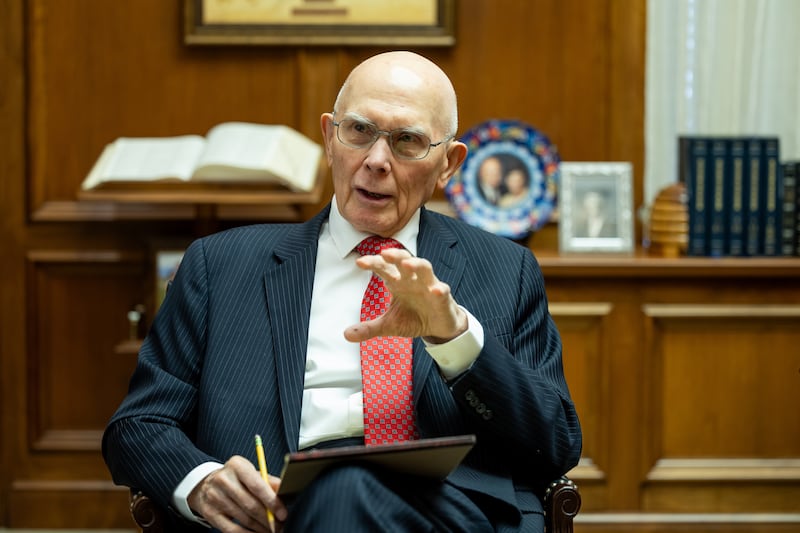
At a time when much of the political energy in America has been directed at polarizing our citizenry, President Dallin H. Oaks of The Church of Jesus Christ of Latter-day Saints has pushed back against forces of division and called us to work together across our differences.
He has done so both as an apostle of Jesus Christ and as one of the wisest living students of the U.S. Constitution.
In a series of lectures, sermons and interviews over the last tumultuous decade, President Oaks has set forth what one sympathetic observer calls “a remarkable civic theology” — one which underscores the Constitution’s potential as a unifying force.
According to President Oaks, two principles in particular account for the Constitution’s remarkable success (thus far). The fate of our Republic depends on sustaining these two principles.
The first is that the Constitution protects moral agency — the liberty to act in accord with one’s conscience. The second is that the Constitution’s structure, in conjunction with the social bonds on which it depends, helps form community amid diversity — “E pluribus unum,” as our currency puts it.
Moral agency emphasizes the individual. Social bonds emphasize the communal. At first blush these principles seem in tension if not in conflict. But in President Oaks’s view, they can — and they must — work in tandem to create “a more perfect union.”
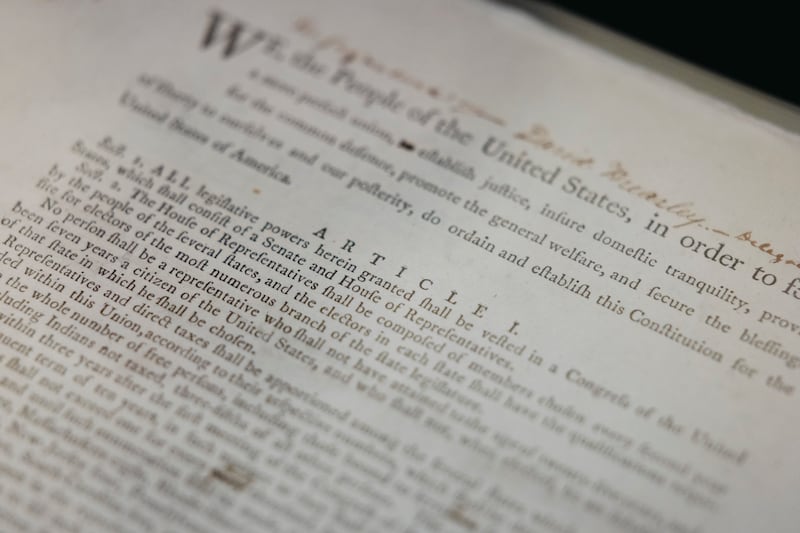
At the very heart of constitutionalism is the challenge of combining individual agency with communal agency. How do you give a government sufficient powers to govern but not to oppress? How do you empower a community to act together while preserving space for individuals and groups to act on their own?
The genius and inspiration of the U.S. Constitution is that it answers this challenge in ways that optimize both individual and communal agency. The Constitution unites us as a people in a shared project and toward shared ends, including establishing justice, ensuring tranquility, and forming a more perfect union. The Constitution also provides protection for each individual to follow his or her personal conscience. And the more effectively we work together, the more committed we become to preserving individual choice.
This is the great balancing act of our Constitution — to preserve and sustain a vibrant political community while allowing for differences — even large ones — among individuals and groups within that community. Nothing like this had ever been tried on this scale before the summer of 1787.
We hold that both sides of this constitutional fulcrum — the one centered on individual moral agency and the other on cooperation and community — are inspired and indispensable components of our Constitution.
That the Constitution values moral agency is widely understood, as the common refrain “I know my rights,” suggests.
According to President Oaks, an important part of God’s purpose in establishing the Constitution is to protect “the doctrine of moral agency.” But moral agency, President Oaks has taught, is not a zero-sum game in which protecting my rights means diminishing yours.
In fact, my very commitment to my own rights demands that I honor yours.
Abraham Lincoln expressed this idea as a kind of democratic Golden Rule: “As I would not be a slave,” he said, “so I would not be a master. This expresses my idea of democracy. Whatever differs from this, to the extent of the difference, is no democracy.”
That is where the Constitution’s demand for compromise begins. Each of us should be looking for ways to allow others to exercise their moral agency as well — to follow the dictates of their conscience, even when they conflict with our own. This may be the element of the Constitution that requires most of us. In his words and deeds, President Oaks has taught us how we can meet that demand.
In a number of recent addresses — most recently his April 2026 General Conference address — President Oaks has explained how we can better cooperate with our fellow citizens who see the world differently than we do. And, as it turns out, at the heart of compromise is the desire to protect the ability of others to make their own choices. “As followers of Christ,” he declared, “we should seek to live peaceably and lovingly with other children of God who do not share our values and do not have the covenantal obligations we do.”
One way to ensure that peace abounds in society is, as President Oaks reminds us, to “seek fairness for all.” Doing so is hard work. When we encounter real and deep differences, it requires that we work to “[resolve] differences through mutual respect, shared understanding, and good faith negotiations.”
President Oaks calls this “principled accommodation.” It is the process by which “contending parties identify and preserve the deepest interests of the greatest number of parties through mutual respect, principled toleration of differences, and shared commitment to the common good.” Importantly, President Oaks has taught us that we can’t approach this task by seeking “dominance for our own position.”
Instead, we must “use the language and methods of peacemakers,” and pursue solutions that we can all live with. We seek to optimize the interests of all, rather than strive to maximize our own.
One example of this is the 2015 Utah Compromise, in which representatives from The Church of Jesus Christ of Latter-day Saints worked with Equality Utah, an LGBTQ advocacy group, to pass legislation extending nondiscrimination protections in housing and employment while preserving religious liberty exemptions in areas of great importance to the Church. At the center of the effort was Elder Alexander Dushku, now a General Authority Seventy, but then a lawyer in private practice, who began by meeting quietly with local LGBT leaders — not to press for his position, but to listen. They “talked story,” Elder Dushku recalled, about family, faith, love, and loss. “Over months and years of these interactions, friendships grew, and so did understanding and trust.”

Once this trust took hold, each side could advocate for its positions in an environment of good faith and genuine compromises could be reached. What emerged was an extraordinary law that surprised the nation — one that protected both religious liberty and LGBT persons.
This triumph represented, in Elder Dushku’s words, “some combination of respect, equality, freedom, acknowledgment, inclusion, community and compromise.” Seven years later, the same spirit of principled accommodation helped produce the federal Respect for Marriage Act, which codified judicial decisions recognizing same-sex marriage while including meaningful religious liberty protections.
These legislative achievements represent President Oaks’s civic theology in action: proof that Americans can govern themselves across deep differences when they are willing to see their opponents as neighbors first.
As Elder Robert M. Daines, a General Authority Seventy in the Church of Jesus Christ, has written, what we need is not more lawyers but “better disciples and bridge builders” — people willing to “love, sacrifice for, and compromise with those who don’t share their faith or values.” In the long run, as he puts it, “law will not protect religious traditions that do not earn their neighbor’s friendship.”
The willingness to treat our political adversaries not as enemies to be defeated but as fellow citizens with whom we are engaged in a common project is among the most vital purposes of our constitutional framework. As the political theorist Yuval Levin notes, “Creating common ground is a key purpose of the Constitution.... It does so by compelling Americans with different views and priorities to deal with one another — to compete, negotiate, and build coalitions in ways that drag us into common action.”
The Constitution’s protection of freedom is not an invitation toward withdrawal and retreat to ever more insular communities. To claim the protections of moral agency while refusing engagement with our neighbors is to misunderstand what agency is for. We must resist a radically individualistic conception of rights that does not take seriously communal obligations. Agency isn’t about getting whatever we want — it’s about becoming who God wants us to be. The rich theology of The Church of Jesus Christ of Latter-day Saints proclaims that we are social creatures, that our major work in time and eternity is to forge relationships. Joseph Smith taught that our great project is to link all humankind together in eternal relationships.

In his April 2026 General Conference address, President Oaks told the story of a nurse who despised a patient for his contemptuous language and repulsive conduct. Her feelings changed when, finding him dying, she felt “an almost electric current of love” from God toward him. She saw him as a child of God. “That lesson,” President Oaks concluded, “can transform all of us to see each other as children of God who belong to each other.” That belonging is the very foundation of our civic obligations.
We seek to cooperate with our fellow citizens not just because the Constitution requires it but because our faith demands that we see those with whom we disagree as more than political adversaries.
They belong to us and we to them. Abraham Lincoln called these ties “bonds of affection.” That is the character the Constitution presupposes in its citizens, and President Oaks has shown us how we can measure up.
Those obligations, presupposed by the Constitution, are rooted and grounded in biblical values of neighborliness found in the command to be peacemakers, to love our enemies, and to be a neighbor to those who see the world differently than we do.
The German word for “charity” is Nächstenliebe — love of neighbor. In our constitutional democracy, we are all neighbors. And charity is the greatest of all.